01Facts
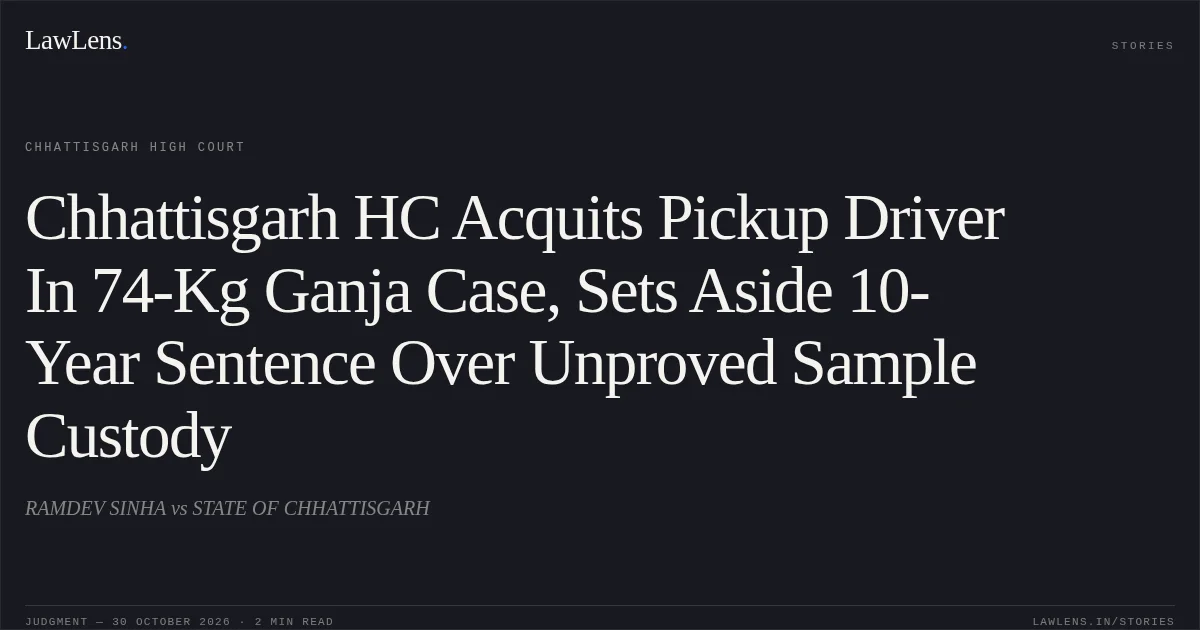
On 23 May 2022, police intercepted a pickup vehicle driven by the appellant and allegedly recovered five packets of ganja weighing 74.019 kg.
¶ 2The prosecution case was that the contents were mixed, two 100-gram samples were drawn, and the remaining contraband was deposited in the police-station malkhana.
¶ 2–6One sample was sent to the Regional Forensic Science Laboratory, which identified it as ganja.
¶ 2–6The Special Judge convicted the appellant under Section 20(b)(ii)(C) of the NDPS Act and sentenced him to ten years’ rigorous imprisonment and a fine of ₹1,00,000.
¶ 10On appeal, the appellant challenged, among other things, the identification and safe custody of the sample; the State attributed some documentary discrepancies to clerical errors.
¶ 7–802Issues
i.Whether the prosecution proved that the sample examined by the laboratory was drawn from the contraband allegedly seized from the appellant and remained safely stored and untampered with until its receipt at the laboratory.
¶ 22ii.Whether the conviction could be sustained in light of the discrepancies in the description, marking, storage, and movement of the seized contraband and samples.
¶ 25–3003Law Applied
Under the NDPS Act, the prosecution must prove not only the recovery of contraband but also the identity and integrity of the sample examined, through credible evidence establishing an unbroken chain of custody; an FSL report alone cannot establish the identity of the seized substance if that evidentiary link is not proved.
¶ 23–24The Court relied on Abdul Rajik v. State of Madhya Pradesh and Govind v. State of Madhya Pradesh, Criminal Appeals Nos. 1561 and 1562 of 2014, 2026 INSC 1001, for the requirement that the prosecution establish safe storage and movement of samples and account for any gap in custody.
¶ 24The charge was under Section 20(b)(ii)(C) of the NDPS Act.
¶ 1, 4Provisions in the judgment · 9 · Linked ones open on LawLens
Bharatiya Nagarik Suraksha Sanhita, 2023 Section 415Section 481
Narcotic Drugs and Psychotropic Substances Act, 1985 Section 20Section 42Section 50Section 57Section 67
Code of Criminal Procedure, 1973 Section 160Section 313
04Reasoning
The prosecution evidence did not reliably establish what was deposited in the malkhana: the investigating officer described the remaining contraband as sacks marked B-1 to B-5, while the malkhana evidence and register differed as to packaging and marking.
¶ 25Neither the deposit receipt nor the malkhana register recorded samples X-1 and X-2, leaving their custody unexplained between seizure and dispatch of X-1 to the laboratory.
¶ 26The Court also noted discrepancies in dates and crime-number entries, a substantial difference between the original and inventory weights, and the absence of fresh sampling during the delayed inventory proceedings.
¶ 27–28Taken cumulatively, these deficiencies meant the prosecution had not proved that the laboratory sample was the sample drawn from the seized substance; the FSL result therefore did not cure the broken chain of custody.
¶ 29–3005Holding
The Court held that the prosecution had failed to prove the case beyond reasonable doubt and extended the benefit of doubt to the appellant.
¶ 30–31It allowed the appeal, set aside the conviction and sentence, and acquitted the appellant; it directed his release if not required in another case and ordered any deposited fine to be refunded in accordance with law.
¶ 32–33The appellant was also directed to execute a personal bond of ₹25,000 under Section 481 of the BNSS, 2023, to remain in force for six months.
¶ 34Original Court PDF
RAMDEV SINHAvsSTATE OF CHHATTISGARH
Click to open original judgment
Original judgment, available to read, download and summarize on LawLens.in