01Facts
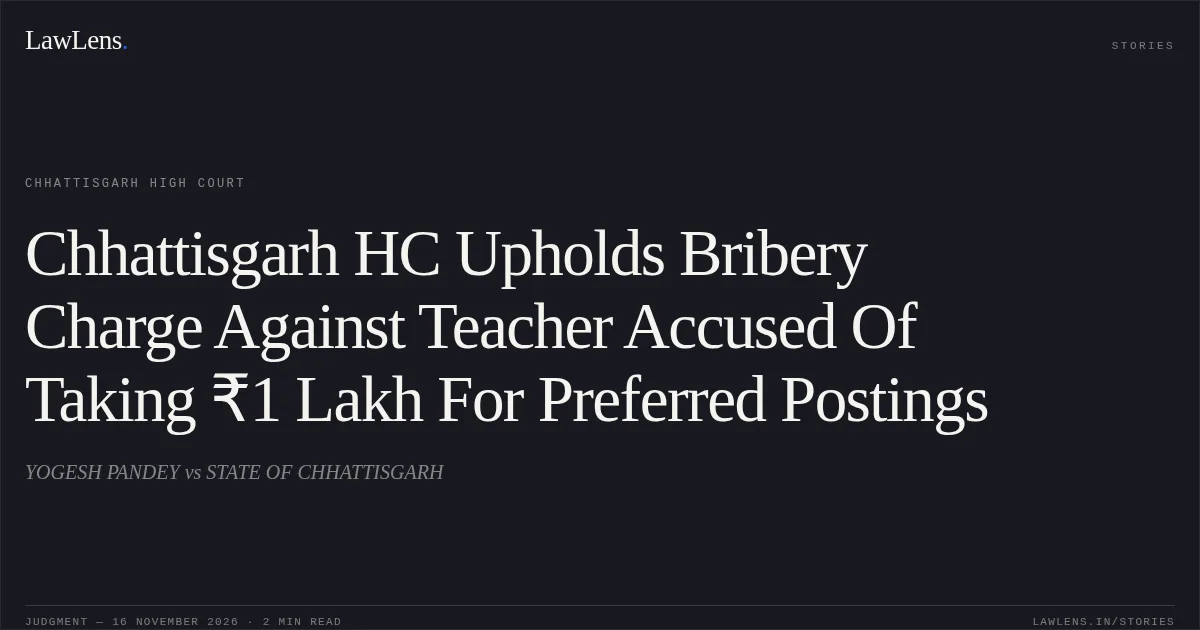
The complainant alleged that a co-accused, Nandkumar Sahu, demanded and received money in connection with the complainant’s wife’s posting as a teacher.
¶ 1–6During investigation, Sahu stated that the applicant had supplied a list of candidates and that he passed on ₹1,00,000 to the applicant from money collected from candidates.
¶ 1–6The applicant’s memorandum statement also referred to receiving ₹1,00,000 from Sahu, of which ₹18,000 remained with him.
¶ 1–6The applicant was charged under Section 7 of the Prevention of Corruption Act, 1988 (PC Act), as amended in 2018. He challenged the order framing charge in revision under Section 397 CrPC, arguing, among other things, that the allegations against him arose only from inadmissible co-accused statements and that no demand or acceptance by him was established.
¶ 1–602Issues
i.1. Whether the material on record justified framing a charge against the applicant under Section 7 of the PC Act
¶ 9ii.2. Whether the absence of the applicant’s name from the FIR and the reliance on memorandum statements warranted interference with the charge at the revision stage
¶ 13–1603Law Applied
Section 7 of the PC Act, as amended in 2018, criminalises a public servant’s obtaining, accepting, or attempting to obtain an undue advantage, including for another person and directly or through a third party.
¶ 10–12At the charge stage, the court assesses whether the prosecution material, taken at face value, raises a strong suspicion that an offence has been committed; it does not determine guilt or undertake a detailed assessment of the evidence.
¶ 16, citing Manendra Prasad Tiwari v. Amit Kumar Tiwari, (2022) 20 SCC 757 · ¶ 17, citing State of Orissa v. Pratima Behera, AIR 2025 SC 218In PC Act cases, courts should generally avoid premature interference, except where special features justify it.
¶ 15, citing State of Chhattisgarh v. Aman Kumar Singh, (2023) 6 SCC 559Revisional jurisdiction under Section 397 CrPC is directed to correcting patent defects, errors of law or jurisdiction, and perversity.
¶ 16Provisions in the judgment · 7 · Linked ones open on LawLens
Code of Criminal Procedure, 1973 Section 239Section 240Section 397Section 401Section 482
04Reasoning
The Court considered the statements attributed to both the applicant and Sahu, which together indicated that money collected from candidates for preferred postings had been passed to the applicant.
¶ 13–14, 18Although the applicant disputed the evidentiary value and reliability of the memorandum statements, the Court held that their credibility and correctness were matters for trial, not for determination on revision against the charge.
¶ 13–14, 18It also rejected the objection that the applicant was not named in the FIR, observing that the FIR is not an exhaustive account and that the prosecution material as a whole must be considered.
¶ 13–14, 18Applying the charge-stage test, the Court found the material sufficient to raise a prima facie case and not so deficient or inherently improbable as to warrant interference.
¶ 13–14, 1805Holding
The High Court dismissed the criminal revision and affirmed the order framing a charge under Section 7 of the PC Act.
¶ 19It vacated the interim order and clarified that its observations were confined to the revision; the applicant could raise his defences at trial, where the case must be decided on the evidence adduced and independently of those observations.
¶ 20–22Original Court PDF
YOGESH PANDEYvsSTATE OF CHHATTISGARH
Click to open original judgment
Original judgment, available to read, download and summarize on LawLens.in