01Facts
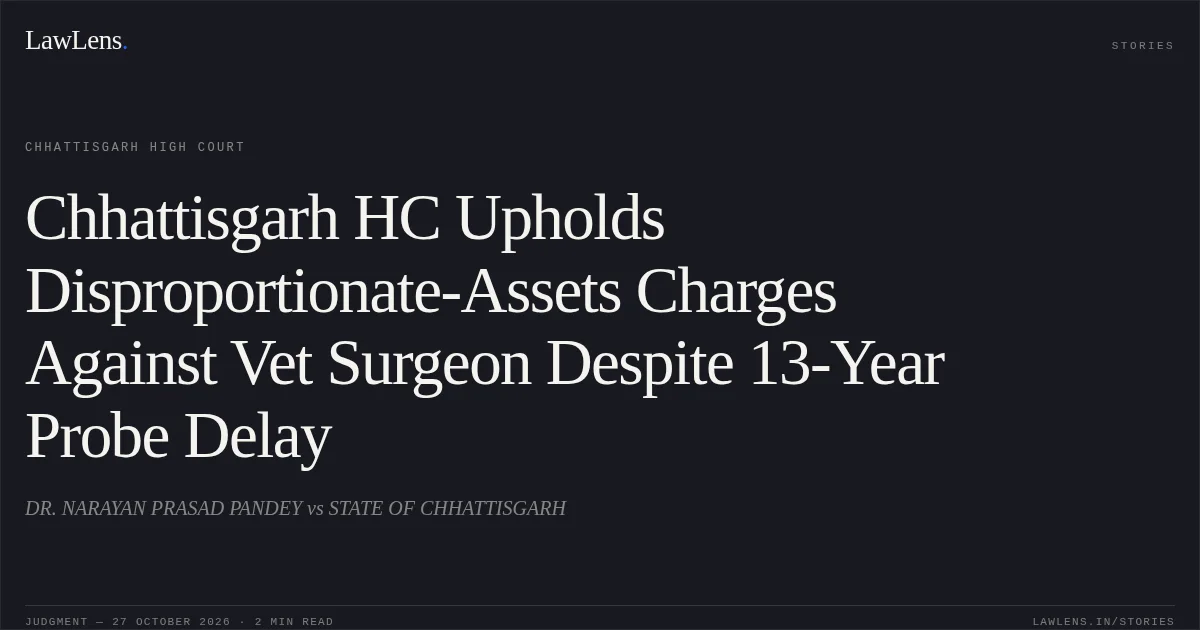
The Anti-Corruption Bureau investigated allegations that Dr. Pandey, an Assistant Veterinary Surgeon, had acquired assets disproportionate to his known sources of income. Searches conducted at his residences in Jagdalpur and Raipur in May 2005 resulted in assets being valued at approximately ₹57.85 lakh; the FIR was registered on 8 May 2005 and the charge-sheet was filed on 29 November 2018
¶ 3–7The Special Judge framed charges under Sections 13(1)(e) read with 13(2) of the Prevention of Corruption Act, 1988, and Dr. Pandey challenged that order in revision under Sections 397 and 401 CrPC, arguing, among other things, that the assets and income of relatives had been wrongly included, the valuation was inflated, and the investigation delay warranted quashing
¶ 2, 8–1002Issues
i.Whether the material before the Special Judge disclosed sufficient grounds to frame charges under the Prevention of Corruption Act, or whether the revisional court should interfere with the framing order
¶ 13, 17ii.Whether the delay in completing the investigation and filing the charge-sheet warranted quashing the charges
¶ 1403Law Applied
Sections 397 and 401 CrPC permit revisional interference to correct jurisdictional or legal error, patent defect, or perversity; at the charge stage, the court asks whether the prosecution material, taken at face value, raises a strong suspicion or otherwise provides sufficient ground to proceed, not whether guilt is proved
¶ 15 · ¶ 17In State of Chhattisgarh v. Aman Kumar Singh, the Supreme Court cautioned that courts should ordinarily avoid interfering with investigations in Prevention of Corruption Act cases, except where exceptional features—such as an absolute absence of material supporting reasonable suspicion—justify intervention.
¶ 13The court also relied on State of Orissa v. Pratima Behera for the principle that a strong suspicion founded on the available material may justify framing a charge, while the presumption of innocence remains relevant.
¶ 16The alleged offence was under Sections 13(1)(e) and 13(2) of the Prevention of Corruption Act, 1988
¶ 2, 18Provisions in the judgment · 6 · Linked ones open on LawLens
Prevention of Corruption Act, 1988 Section 13
Code of Criminal Procedure, 1973 Section 397Section 401Section 482Section 239Section 240
04Reasoning
The court held that whether the assets were acquired from legitimate sources, whether relatives’ assets had been wrongly attributed to the applicant, and whether the valuations were accurate involved factual matters for trial; it would not conduct a merits-based inquiry into those defences at the charge stage.
¶ 13The prosecution material was not so deficient or inherently improbable as to warrant revisional interference, and no exceptional feature justified departing from the restrained approach applicable to corruption cases.
¶ 13, 17The delay argument also failed: the record showed prior proceedings and interim protection, while the court found the delay insufficient, in the circumstances, to invalidate the charges.
¶ 1405Holding
The High Court dismissed the criminal revision and affirmed the order framing charges under Sections 13(1)(e) read with 13(2) of the Prevention of Corruption Act, 1988; the interim order was vacated.
¶ 18It directed that its observations be confined to the revision and not prejudice either side at trial.
¶ 19Original Court PDF
DR. NARAYAN PRASAD PANDEYvsSTATE OF CHHATTISGARH
Click to open original judgment
Original judgment, available to read, download and summarize on LawLens.in