Facts
The applicant’s father, T. Chelladurai, a Fitter Helper in Southern Railway, died in harness on 12.09.2011
Source reference: p.2, 4The deceased had two wives; the applicant is the son of the second wife, Saroja
Source reference: p.2While the first wife and her children received terminal benefits, they did not initially apply for compassionate appointment due to illiteracy
Source reference: p.2A Succession Certificate issued on 14.10.2019 by the Subordinate Civil Court, Trichy, declared the applicant a legal heir but noted the second marriage was void under the Hindu Marriage Act
Source reference: p.5Upon attaining majority, the applicant applied for compassionate appointment on 08.07.2022
Source reference: p.3The respondent rejected the application via an impugned order dated 11.01.2023, relying on Railway Board Circular RBE No. 1/1992, which excludes children of a second wife from such appointments unless the administration had permitted the second marriage
Source reference: p.3-4Subsequently, the first wife and her son filed a belated competing claim in July 2023
Source reference: p.20Issues
1. Whether children born of a second/void marriage are eligible for compassionate ground appointment in the Railways
Source reference: p.11 / para. 122. Whether the restrictive conditions in Railway Board Circular RBE No. 1/1992 and its subsequent iterations are constitutionally valid under Article 14
Source reference: p.13-14 / para. 14-15Law Applied
Section 16 of the Hindu Marriage Act, 1955, which confers legitimacy upon children born of void or voidable marriages
Source reference: p.11-12The court relied on the Supreme Court precedent in Union of India v. V.R. Tripathi (AIR 2019 SC 666), which established that excluding legitimate children of a second marriage from compassionate appointment is discriminatory and ultra vires Article 14 of the Constitution
Source reference: p.11, 14It further cited Namita Goldar v. Union of India (2010), where the Calcutta High Court quashed RBE No. 1/1992 for being inconsistent with the statutory legitimacy granted to such children
Source reference: p.10Reasoning
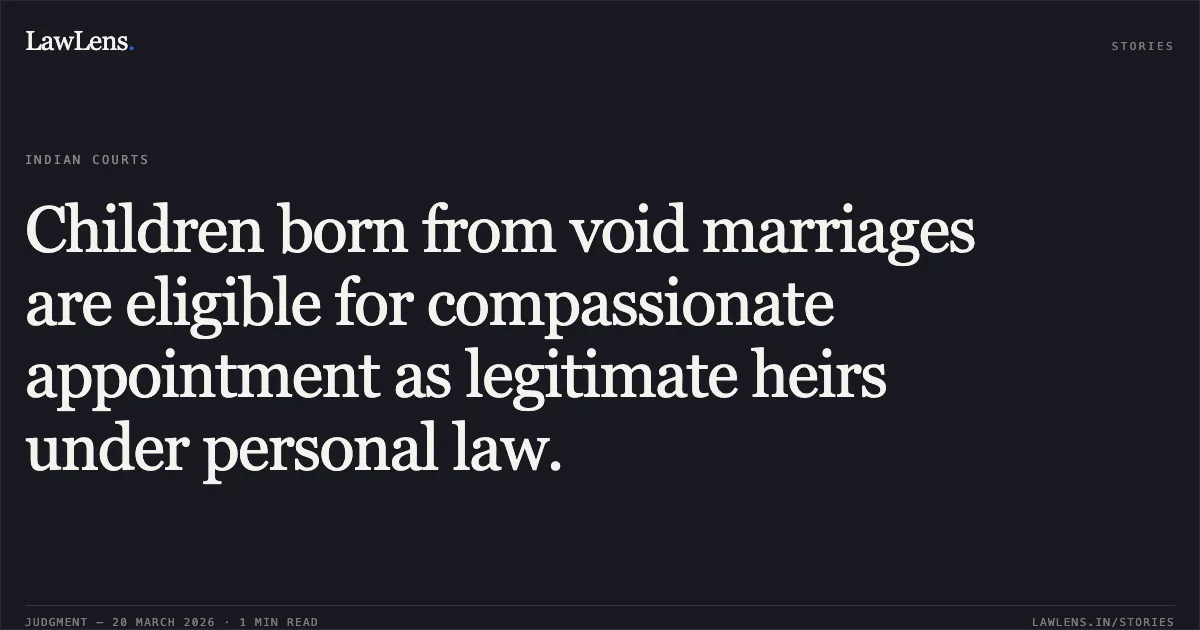
The Tribunal reasoned that the purpose of compassionate appointment is to prevent destitution and penury in the family of a deceased employee
Source reference: p.14By operation of Section 16(1) of the Hindu Marriage Act, the applicant is a legitimate child regardless of the validity of his parents' marriage
Source reference: p.12-13The court observed that the Railway Board's circulars created an impermissible classification between two sets of legitimate children (those from the first marriage vs. those from the second), which lacks a reasonable nexus to the objective of the scheme
Source reference: p.14-15The Tribunal noted that the Supreme Court in V.R. Tripathi had explicitly held that such exclusion is offensive to human dignity and constitutional guarantees against discrimination
Source reference: p.15The Tribunal found the competing claim by the first wife’s son to be mala fide and "highly belated," intended only to frustrate the applicant's legitimate claim after he had successfully litigated for consideration
Source reference: p.20Holding
The Tribunal quashed the impugned order dated 11.01.2023
It held that the applicant cannot be denied consideration for compassionate appointment solely on the ground of being born to a second wife
Source reference: p.18The Respondents were directed to consider the applicant’s claim afresh in light of the V.R. Tripathi judgment within a period of two months
Source reference: p.21The Original Application was disposed of in favor of the applicant with no order as to costs
Source reference: p.21Acts & Sections Cited
5 provisions across 2 statutes referred to in this judgment. Each provision opens on LawLens.
Hindu Marriage Act, 19554
Administrative Tribunals Act, 19851
Original Court PDF
C KATHIRVELvsM/o Railways
Click to open original judgment
Original judgment, available to read, download and summarize on LawLens.in


