Facts
The Petitioner’s father, a permanent driver with the Respondent-Zilla Parishad, died in service on March 23, 2003.
Source reference: p.1-2At the time, the Petitioner was a minor (four years old).
Source reference: p.2Upon attaining majority on January 15, 2017, the Petitioner applied for a compassionate appointment on February 2, 2017.
Source reference: p.2The Respondent rejected the claim via a communication dated May 16, 2023, asserting that the Petitioner was the son of the deceased's second wife, and since the second marriage was invalid under Hindu Law, he was ineligible for the appointment.
Source reference: p.2The Petitioner approached the High Court to quash this communication.
Source reference: p.1Issues
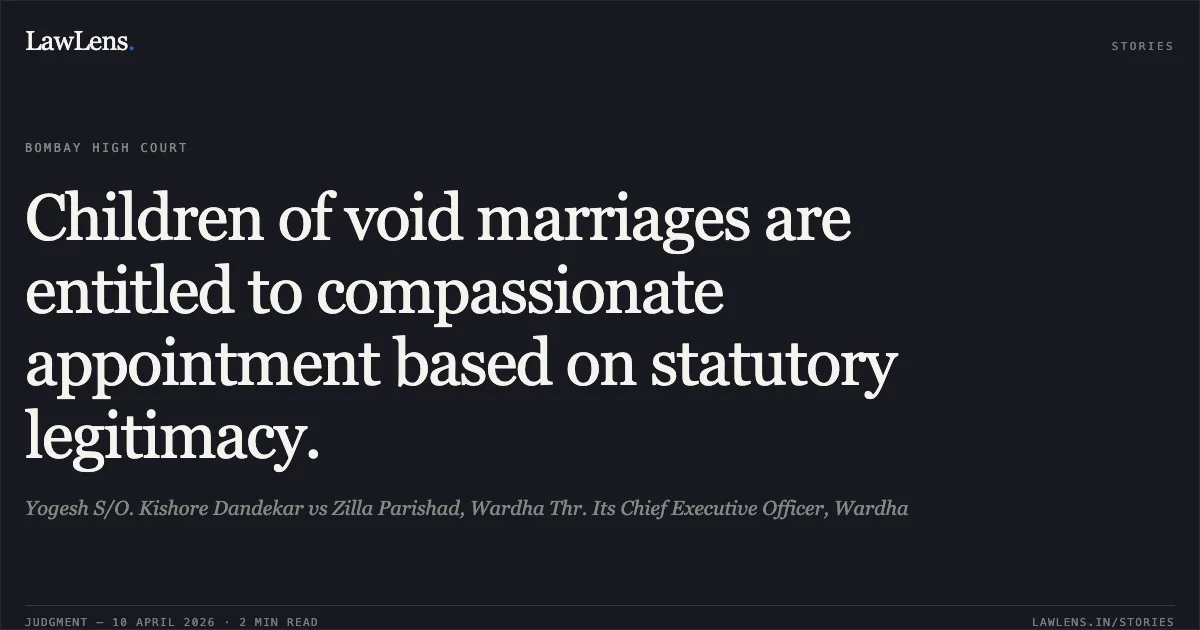
1. Whether the child of a second marriage, which is null and void under the Hindu Marriage Act, can be denied compassionate appointment on the grounds of illegitimacy.
Source reference: p.2 / para. 5Law Applied
The Court primarily applied Section 16 of the Hindu Marriage Act, 1955, which provides that children of void and voidable marriages are deemed legitimate.
Source reference: p.3It further relied on the Supreme Court precedent in Union of India v. V.R. Tripathi (2018), which held that excluding children born from a second marriage from compassionate appointment benefits is inconsistent with Article 14 of the Constitution and basic notions of fairness.
Source reference: para. 6The Court noted that Section 16(1) acts as a matter of public policy to protect children from the social consequences of their parents' void marriages.
Source reference: para. 15Reasoning
The Court found the Respondent's rejection of the claim to be "apparently erroneous".
Source reference: para. 5It reasoned that under Section 16(1) of the Hindu Marriage Act, the legislature specifically protects the legitimacy of children born from marriages that are null and void under Section 11 (such as bigamous marriages).
Source reference: para. 6, 15The Court emphasized that although the marriage itself is void, the law treats the offspring as legitimate.
Source reference: para. 7Therefore, the Respondent could not discriminate against the Petitioner based on his status as the son of a second wife, as such a distinction lacks legal merit and violates the principle of equal treatment.
Source reference: para. 6, 7Holding
The Court allowed the Writ Petition and quashed the impugned communication dated May 16, 2023.
It held that the Petitioner is entitled to be considered for compassionate appointment regardless of his mother's status as a second wife.
Source reference: para. 7The Respondent was directed to include the Petitioner’s name in the list of candidates for compassionate appointment within two weeks, provided he meets all other eligibility criteria.
Source reference: para. 9No costs were awarded.
Source reference: para. 10Acts & Sections Cited
4 provisions across 1 statute referred to in this judgment. Each provision opens on LawLens.
Hindu Marriage Act, 19554
Original Court PDF
Yogesh S/O. Kishore DandekarvsZilla Parishad, Wardha Thr. Its Chief Executive Officer, Wardha
Click to open original judgment
Original judgment, available to read, download and summarize on LawLens.in