Facts
The appellant-father, a U.S. citizen, and Respondent No. 4 married and established their matrimonial home in California, where their daughter was born.
Source reference: para. 4–6, 28After Respondent No. 4 petitioned for divorce and custody, a California court ordered joint custody and equal parenting time, and prohibited either parent from taking the child outside California without consent or court order.
Source reference: para. 4–6, 28About two weeks later, Respondent No. 4 brought the child to India.
Source reference: para. 4–6, 28The California court subsequently recorded a breach of its order and directed the child’s return to the father’s physical custody.
Source reference: para. 4–6, 28The Karnataka High Court dismissed the father’s habeas corpus petition, finding that the child’s welfare favoured remaining with her mother in India.
Source reference: para. 4–6, 28The father appealed.
Source reference: para. 4–6, 28Issues
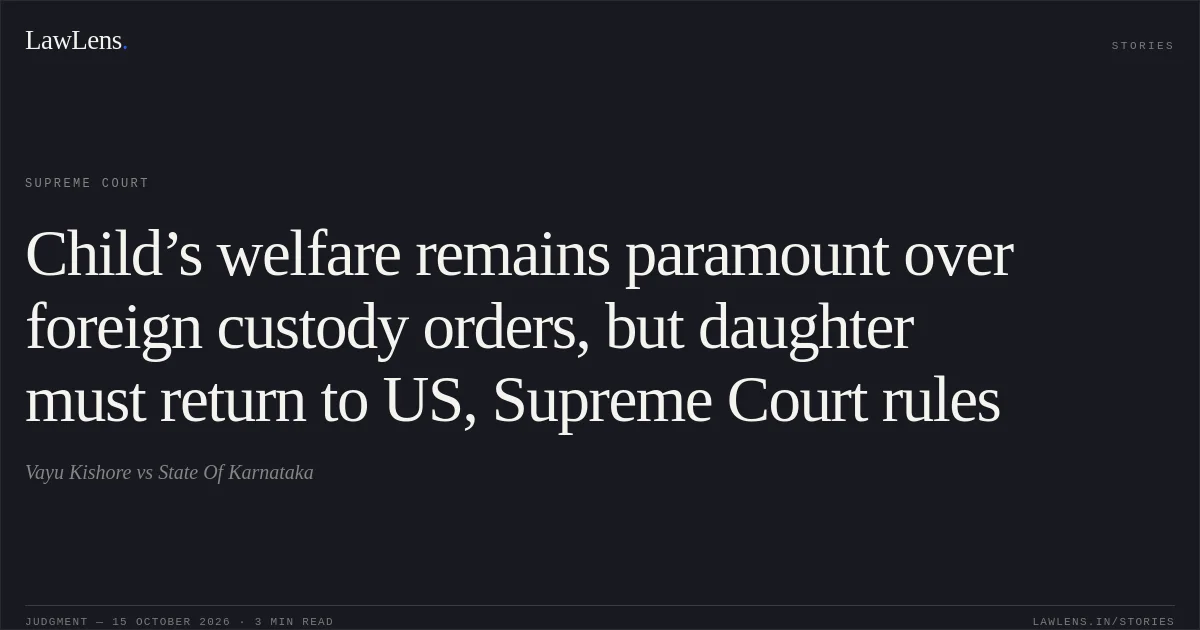
Whether the High Court erred in dismissing the habeas corpus petition and declining to direct the child’s return to the United States
Source reference: para. 10Whether, in determining the child’s welfare, the Court should direct her return despite her residence in India with her mother and the passage of time, having regard to the California custody order and the circumstances of her removal
Source reference: para. 14, 29–35Law Applied
The child’s welfare is the paramount consideration in custody proceedings, including habeas corpus petitions involving competing parental claims; the court exercises its own parens patriae jurisdiction and must not act merely as an executing court for a foreign order.
Source reference: para. 12–17A foreign custody order is not conclusive but must receive proper, and potentially grave, consideration in light of its nature, the process by which it was made, the time elapsed, and changed circumstances.
Source reference: para. 18–19The court must choose between a summary inquiry—ordinarily favouring return unless return would harm the child—and an elaborate inquiry, determined by the child’s welfare, including promptness and the child’s roots in the country of removal.
Source reference: para. 20–22; Dhanwanti Joshi v. Madhav Unde, (1998) 1 SCC 112Welfare encompasses emotional, psychological, educational and other relevant considerations, not merely material comfort; relevant parental factors include maturity, stability, ability to provide education and the parent-child relationship.
Source reference: para. 23–25; Lahari Sakhamuri v. Sobhan Kodali, (2019) 7 SCC 311; Rajeswari Chandrasekar Ganesh v. State of Tamil Nadu, (2023) 12 SCC 472A parent’s breach of a foreign order cannot displace the paramountcy of welfare, but may be considered where welfare factors do not clearly point in one direction.
Source reference: para. 26–27Reasoning
The Court held that the father’s wrongful deprivation of custody was sufficient to cross the threshold for habeas corpus, without requiring a determination that the mother’s custody was strictly illegal.
Source reference: para. 28It treated the matter as requiring an elaborate inquiry because, although the father approached the High Court within eight months, the child had by then spent nearly four years in India.
Source reference: para. 29The High Court’s reliance on the child’s demeanour, the absence of proof of harm by the mother, and the eight-month delay did not establish that her welfare could be served only by remaining with her mother.
Source reference: para. 30–32The Court considered the child’s U.S. citizenship and the absence of evidence that upbringing or education in the United States would harm her.
Source reference: para. 32–35It also gave weight to the fact that the parties had established their home in the United States, the mother herself had initiated the U.S. custody proceedings, and she removed the child shortly after the joint-custody order without evidence of circumstances compelling her departure.
Source reference: para. 32–35Taken together, the welfare considerations and the circumstances of removal supported return to the United States.
Source reference: para. 32–35Holding
The appeal was allowed.
The Court directed Respondent No. 4 to travel with the child to the United States by 31 December 2026, subject to the father’s cooperation and the directions concerning renewal or replacement of the child’s passport.
Source reference: para. 36, 39–40The father’s undertakings—including separate accommodation and financial support for Respondent No. 4, assistance with her Green Card, and refraining from legal action concerning the alleged breach—were to be provided by affidavit; he was also directed to furnish security of ₹1 crore.
Source reference: para. 41–43The Court clarified that its observations would not affect the pending U.S. custody or divorce proceedings, which are to be decided on their merits.
Source reference: para. 44The connected SLP filed by Abhilasha Sharma was dismissed.
Source reference: para. 49–51Acts & Sections Cited
1 provisions across 1 statute referred to in this judgment. Each provision opens on LawLens.
Hindu Minority and Guardianship Act, 19561
Original Court PDF
Vayu KishorevsState Of Karnataka
Click to open original judgment
Original judgment, available to read, download and summarize on LawLens.in


