Facts
The petitioner was implicated in Sultanganj P.S. Case No. 278 of 2025, registered under Section 103(1) of the Bharatiya Nyaya Sanhita and Section 27 of the Arms Act, concerning the shooting death of the informant’s brother.
Source reference: paras. 3–4Although not named in the FIR, the petitioner’s name emerged during investigation.
Source reference: paras. 3–4He was taken into custody on 16 July 2025 and was determined by the Juvenile Justice Board to be 15 years, 9 months and 26 days old on the date of the alleged offence, thereby declaring him a child in conflict with law (CICL).
Source reference: paras. 3–4The Juvenile Justice Board rejected his bail application on 21 November 2025.
Source reference: para. 5His appeal was dismissed by the District and Additional Sessions Judge-cum-Special Judge, Juvenile Court, Patna, on 28 April 2026.
Source reference: paras. 5–7The petitioner thereafter filed the present criminal revision, contending that he had no criminal antecedents, no incriminating article or weapon had been recovered from him, and that the statutory grounds for denying bail under Section 12 of the Juvenile Justice (Care and Protection of Children) Act, 2015 were not established.
Source reference: para. 8The State and informant opposed bail, relying on the allegation that the petitioner was the principal assailant and on the Social Investigation Report (SIR).
Source reference: para. 9Issues
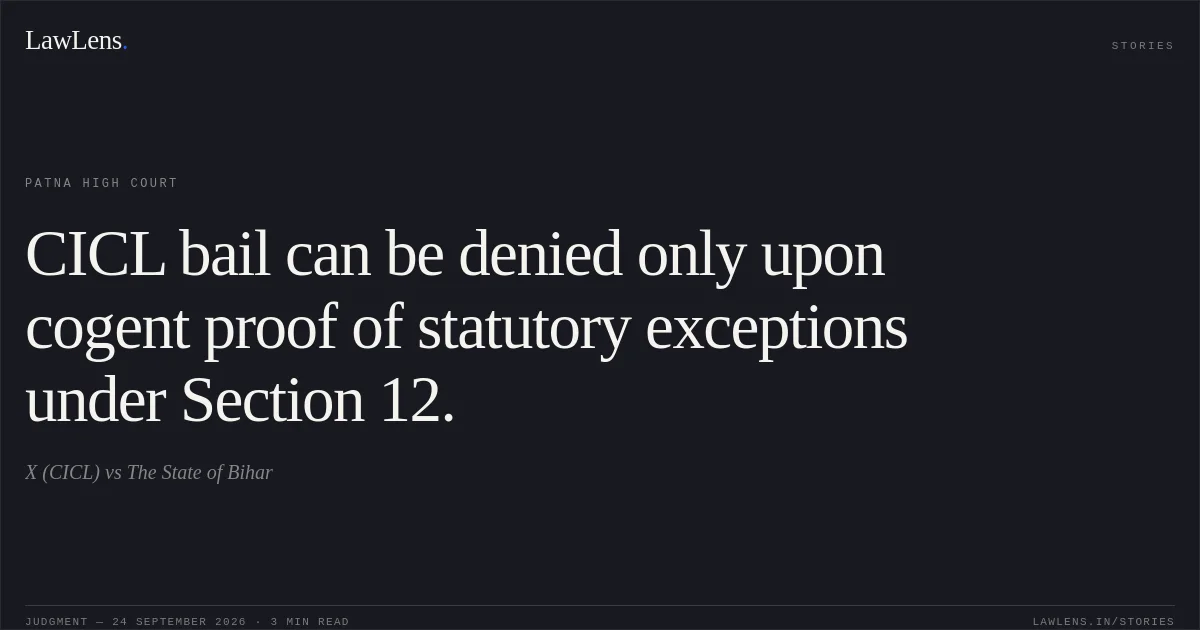
Whether the petitioner/CICL could be denied bail under Section 12 of the Juvenile Justice Act, 2015 in the absence of cogent material showing that his release would bring him into contact with known criminals, expose him to moral, physical or psychological danger, or defeat the ends of justice?
Source reference: paras. 12–15Whether the concurrent orders of the Juvenile Justice Board and the appellate court, refusing bail primarily on the basis of conjecture and the seriousness of the allegation, were legally sustainable?
Source reference: paras. 8, 12, 15–16Law Applied
The Court primarily applied Section 12 of the Juvenile Justice (Care and Protection of Children) Act, 2015, under which a CICL is ordinarily entitled to bail unless there are reasonable grounds to believe that release would bring the child into association with known criminals, expose the child to moral, physical or psychological danger, or defeat the ends of justice.
Source reference: para. 12The Court also applied the child-friendly principles under Section 3 of the Act, particularly the best-interest principle under Section 3(iv), the principle that institutional care must be a measure of last resort under Section 3(xii), and the principle of repatriation and restoration under Section 3(xiii).
Source reference: paras. 13–14The Court held that the seriousness or gravity of the alleged offence, by itself, is not a sufficient ground to refuse bail to a CICL, and that denial of bail must be supported by cogent material rather than surmise or conjecture.
Source reference: para. 15Reasoning
The Court found that, although the petitioner’s name had emerged during investigation, the record did not contain material demonstrating that his release would expose him to known criminals, moral, physical or psychological danger, or otherwise defeat the ends of justice.
Source reference: para. 15The SIR indicated that the alleged occurrence might have resulted from inadequate parental and family guidance, but it did not establish any statutory ground for refusing bail.
Source reference: para. 15The petitioner had no criminal antecedents, and the allegation that he was the principal assailant could not override the protective and reformative framework of the Juvenile Justice Act.
Source reference: paras. 8, 15The subordinate courts had relied on an unsupported apprehension that the petitioner might come into contact with anti-social elements, without identifying cogent supporting material.
Source reference: paras. 8, 15Considering the best interests of the child, the principle that institutionalisation is a last resort, and the petitioner’s need for rehabilitation in a family environment, the Court held that the impugned orders were unsustainable.
Source reference: paras. 13–15Holding
The High Court allowed the revision petition and set aside the appellate order dated 28 April 2026 as well as the Juvenile Justice Board’s order dated 21 November 2025 refusing bail.
The petitioner/CICL was directed to be released on bail on furnishing a bond of ₹10,000 with two sureties of the like amount, subject to the satisfaction of the Juvenile Justice Board, Patna, or the concerned court.
Source reference: para. 17One bailor was required to be a parent and the other a relative without criminal antecedents, both undertaking to ensure the petitioner’s care and upkeep.
Source reference: para. 17The petitioner was also directed to remain present before the Board on every date fixed in the case.
Source reference: para. 17Acts & Sections Cited
4 provisions across 3 statutes referred to in this judgment. Each provision opens on LawLens.
Bharatiya Nyaya Sanhita, 20231
Arms Act, 19591
Juvenile Justice (Care and Protection of Children) Act, 2015.2
Original Court PDF
X (CICL)vsThe State of Bihar
Click to open original judgment
Original judgment, available to read, download and summarize on LawLens.in