Facts
The deceased, Dhumman @ Surjeet Bhattacharya, was found murdered in his house on 15.01.2011 with multiple incised injuries
Source reference: para. 6, 8The prosecution alleged that the appellant (Accused No. 1) harbored animosity toward the deceased due to a prior legal dispute
Source reference: para. 4On the evening of 13.01.2011, the appellant allegedly threatened the deceased
Source reference: para. 4Raja Ram (PW-4) testified to seeing the appellant near the deceased's house carrying an axe on the night of the murder
Source reference: para. 5Following disclosure statements under Section 27 of the Evidence Act, the police recovered blood-stained axes and clothes from the appellant and a co-accused (Accused No. 2)
Source reference: para. 11, 21The Trial Court convicted the appellant under Section 302 of the IPC but acquitted Accused No. 2, citing insufficient evidence despite similar recoveries
Source reference: para. 2, 23The High Court of Chhattisgarh affirmed the appellant's conviction on 19.07.2017
Source reference: para. 2Issues
1. Whether the circumstantial evidence presented by the prosecution established a complete and unbroken chain of events pointing solely to the guilt of the appellant.
Source reference: para. 142. Whether the testimony of Raja Ram (PW-4) regarding the "last-seen" circumstance was reliable enough to sustain a conviction.
Source reference: para. 15-163. Whether the principle of parity applies to the appellant following the acquittal of the co-accused on similar evidence.
Source reference: para. 24Law Applied
The Court applied the "five golden principles" (Panchsheel) of circumstantial evidence established in Sharad Birdhi Chand Sarda v. State of Maharashtra, requiring that the hypothesis of guilt be fully established and exclude every other possible hypothesis
Source reference: para. 14It utilized Section 302 of the IPC regarding murder and Section 27 of the Indian Evidence Act concerning the admissibility of information leading to discovery
Source reference: para. 2, 11The Court distinguished between "related" and "interested" witnesses, referencing State of Rajasthan v. Smt. Kalki and Md. Rojali Ali v. State of Assam
Source reference: para. 18It applied the principle of parity in criminal trials as articulated in Javed Shaukat Ali Qureshi v. State of Gujarat, which mandates that the Court cannot distinguish between two accused individuals when the evidence against them is identical
Source reference: para. 24Reasoning
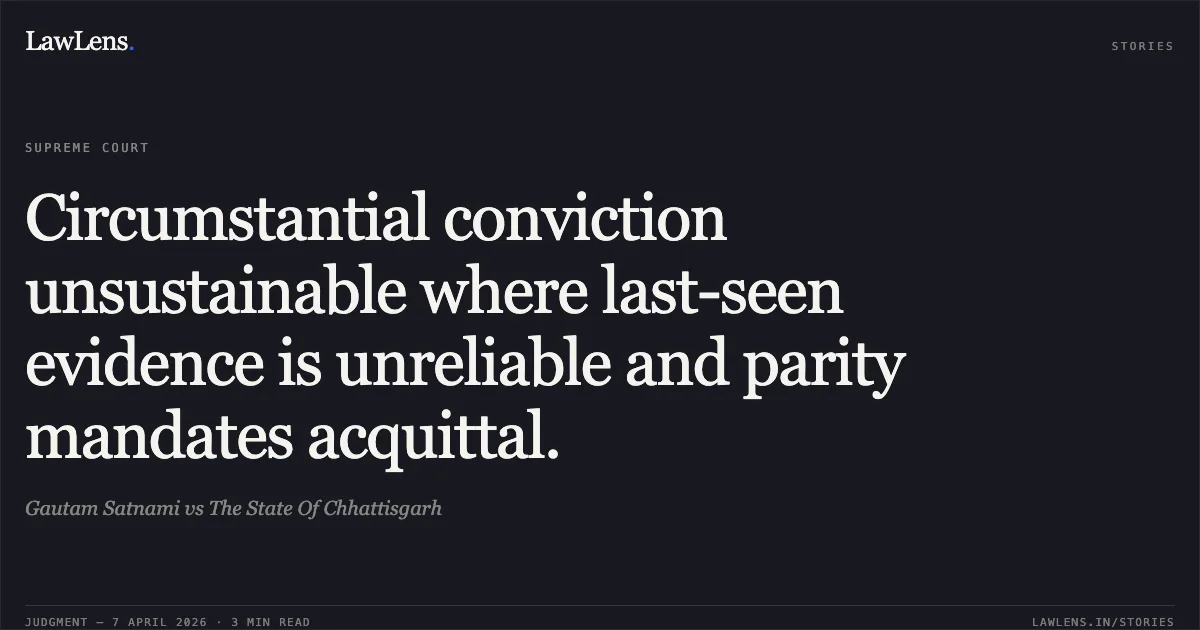
The Supreme Court held that the prosecution failed to meet the high threshold for circumstantial evidence.
Source reference: para. 14First, the Court discredited the "last-seen" evidence of PW-4, noting the lack of electricity at the site rendered visual identification at night doubtful
Source reference: para. 15PW-4 was deemed an "interested witness" due to admitted prior hostility with the appellant, and his Section 161 statement was recorded with a suspicious one-month delay
Source reference: para. 17, 19Second, the Court found the Section 27 recoveries legally tenuous; the FSL report failed to determine the blood group on the seized articles, and the weapons were never shown to the medical officer to confirm they caused the injuries
Source reference: para. 22Additionally, the seizure witnesses turned hostile or admitted they did not sign the memos at the spot
Source reference: para. 25Third, the Court emphasized that the Trial Court had already acquitted Accused No. 2 on the same evidence regarding the recovery of the axe and clothes
Source reference: para. 23-24Under the principle of parity, the Court ruled it discriminatory to convict the appellant when the only distinguishing factor—the unreliable testimony of PW-4—was excluded
Source reference: para. 24, 31Holding
The Supreme Court allowed the appeal and set aside the judgments of the Trial Court and High Court
The Court held that the prosecution failed to establish the circumstances firmly and fully, and the evidence against the appellant was insufficient to displace the presumption of innocence
Source reference: para. 31The appellant was acquitted of the charge under Section 302 of the IPC, his conviction and life sentence were quashed, and his bail bonds were discharged
Source reference: para. 32Acts & Sections Cited
4 provisions across 2 statutes referred to in this judgment. Each provision opens on LawLens.
Indian Penal Code, 18601
Code of Criminal Procedure, 19733
Original Court PDF
Gautam SatnamivsThe State Of Chhattisgarh
Click to open original judgment
Original judgment, available to read, download and summarize on LawLens.in