Facts
The deceased, Ratan Prajapati, went missing on 06.02.2001 while traveling to his in-laws' house
Source reference: p. 2On 13.02.2001, his body was found in a well with its throat slit
Source reference: p. 3The prosecution alleged that the appellant, who ran a tadi (liquor) shop nearby, murdered the deceased
Source reference: p. 14The Trial Court convicted the appellant under Sections 302 and 201 of the IPC, primarily based on circumstantial evidence: the recovery of a pasuli (cutting tool) from the appellant’s hut, the recovery of the deceased’s bicycle from a well allegedly based on the appellant's confession, and a gamcha (towel) found on the body
Source reference: p. 4-6The appellant challenged this conviction, citing a lack of motive and gaps in the circumstantial chain
Source reference: p. 3-4Issues
1. Whether the impugned judgment of conviction and sentence of the appellant suffers from any error of legal reasoning or evidentiary appraisal
Source reference: p. 6, para. 92. Whether the circumstantial evidence presented by the prosecution completes a chain so consistent as to exclude every hypothesis other than the guilt of the accused
Source reference: p. 20-25Law Applied
The court applied Section 302 (Murder) and Section 201 (Causing disappearance of evidence) of the Indian Penal Code
Source reference: p. 2It relied on Section 27 of the Indian Evidence Act, which governs the admissibility of facts "discovered" in consequence of information received from an accused
Source reference: p. 19The court also adhered to the established legal standard for circumstantial evidence, which requires that the chain of links must be complete and point solely to the guilt of the accused
Source reference: p. 25-26Reasoning
The High Court found several fatal infirmities in the prosecution's case. First, P.W.6 (Moien Mian), the star witness who claimed to have known about the body since 06.02.2001, failed to explain the seven-day delay in informing the police
Source reference: p. 21-22The Court noted contradictions regarding the "discovery" under Section 27; while the I.O. (P.W.11) claimed the pasuli and bicycle were found via a disclosure statement, seizure witnesses (P.W.8 and P.W.9) provided conflicting accounts of the location and manner of recovery, suggesting a routine search rather than a legal "discovery"
Source reference: p. 23-24The prosecution failed to conduct FSL testing on the pasuli or the dried blood found near the well to link them to the crime
Source reference: p. 4, 18, 25The Court observed that the appellant was implicated solely on suspicion because he owned a liquor shop, but evidence from P.W.3 showed the deceased had actually visited a different shop on the night of the incident
Source reference: p. 24-25Holding
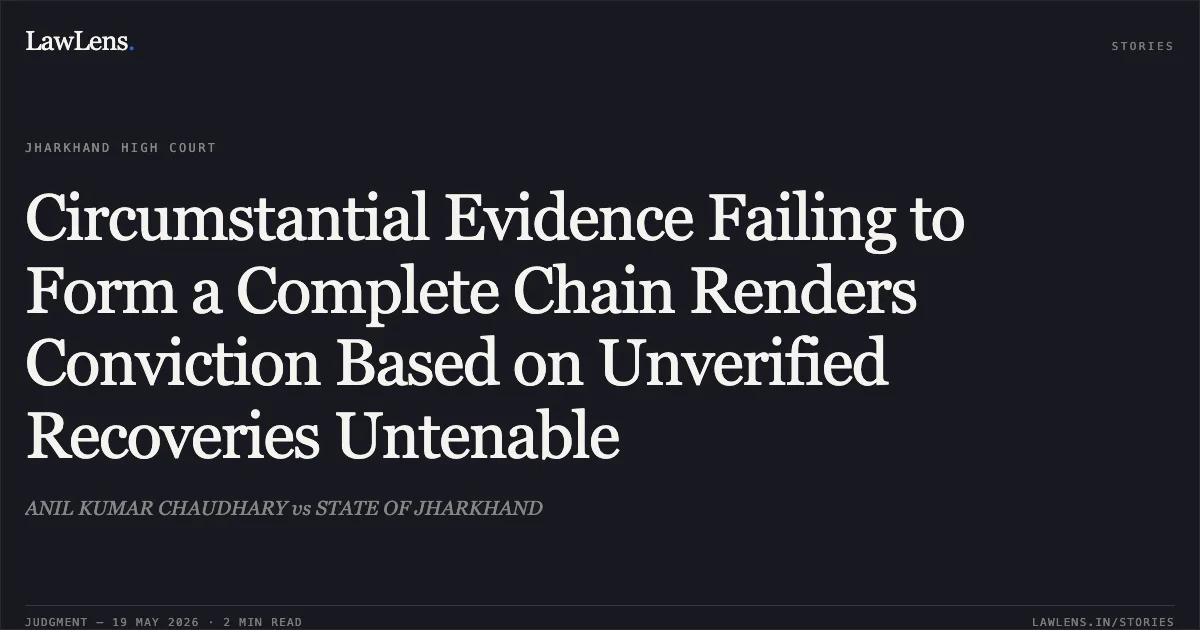
The Court held that the prosecution failed to establish a complete chain of incriminating circumstances and that the conviction was based on "guesswork" and "rumour" rather than legal proof
The court answered the primary issue in the affirmative, finding the Trial Court’s judgment to be in manifest error. The appeal was allowed, the conviction and sentence were set aside, and the appellant was acquitted of all charges
Source reference: p. 26Acts & Sections Cited
4 provisions across 2 statutes referred to in this judgment. Each provision opens on LawLens.
Indian Penal Code, 18603
Code of Criminal Procedure, 19731
Original Court PDF
ANIL KUMAR CHAUDHARYvsSTATE OF JHARKHAND
Click to open original judgment
Original judgment, available to read, download and summarize on LawLens.in