Facts
The appellant was convicted under Section 302 IPC for the alleged murder of Rameshwar Painkra on January 15, 2019
Source reference: p. 1-2The deceased's body was found near a roadside with head injuries; bloodstains and dragging marks allegedly led toward the appellant's house
Source reference: para 3, 24The prosecution's case rested on circumstantial evidence: a memorandum statement [Ex.P/9] leading to the recovery of an iron Parsul and a wooden stick, and an FSL report [Ex.P/20] showing blood group “A” on the weapon
Source reference: para 6The Trial Court sentenced the appellant to life imprisonment
Source reference: para 2The appellant challenged the conviction, asserting that the chain of circumstances was broken and independent witnesses had turned hostile
Source reference: para 12Issues
1. Whether the death of the deceased was homicidal in nature
Source reference: para 172. Whether the recovery of incriminating articles under Section 27 of the Evidence Act was proved and sufficient to sustain conviction in a case of circumstantial evidence
Source reference: para 213. Whether the prosecution established an unbroken chain of circumstances pointing exclusively to the guilt of the appellant
Source reference: para 39Law Applied
The court applied Section 302 of the IPC regarding murder
Source reference: para 2Section 27 of the Indian Evidence Act, 1872, which permits the admission of only that part of an accused's statement that leads distinctly to the discovery of a fact
Source reference: para 28Doctrine from Pulukuri Kotayya v. King Emperor and Asar Mohammad v. State of U.P., establishing that "fact discovered" includes the place of recovery and the accused's knowledge, but not confessional history
Source reference: para 30Principle from Aghnoo Nagesia v. State of Bihar regarding the bar on police confessions
Source reference: para 32Principle from Balwan Singh v. State of Chhattisgarh, which necessitates proving a clear nexus between the blood found on seized articles and the deceased's blood group
Source reference: para 35Reasoning
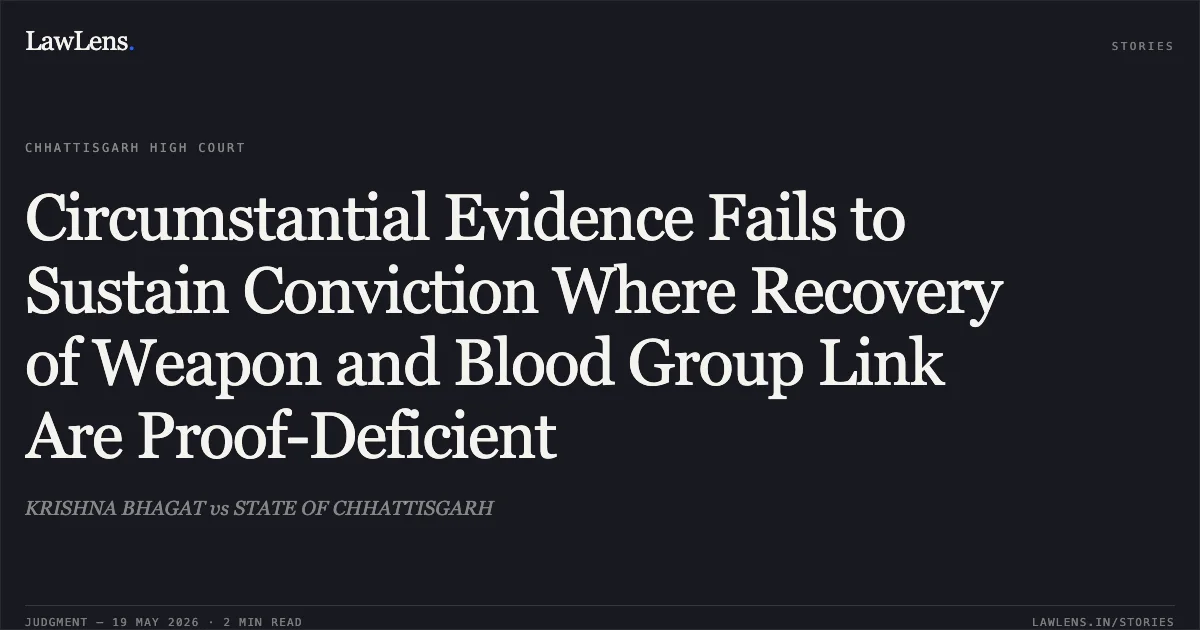
While the court affirmed the death was homicidal based on medical testimony, it found the circumstantial evidence insufficient for conviction.
Source reference: para 19-20Independent witnesses (PW-2 and PW-6) to the memorandum and seizure turned hostile, stating no interrogation or recovery happened in their presence, making the recovery under Section 27 doubtful
Source reference: para 23Although the FSL report detected blood group “A” on the weapon and shirt, the prosecution failed to prove the deceased’s blood group was “A,” thereby failing to establish a nexus
Source reference: para 27, 37The prosecution failed to prove any motive, which is critical in circumstantial cases
Source reference: para 40The court held that the "chain of circumstances" was broken as the forensic evidence was inconclusive and the recovery was not corroborated by reliable independent evidence
Source reference: para 41Holding
The Court holding that while the death was homicidal, the prosecution failed to prove the appellant's involvement beyond reasonable doubt; the recovery of the weapon alone, without matching blood groups or credible witness testimony, cannot sustain a conviction
The appeal was allowed, the Trial Court’s judgment dated 29.01.2025 was set aside, and the appellant was acquitted of the charge under Section 302 IPC, ordered to be released forthwith subject to furnishing a bond under Section 437-A Cr.P.C.
Source reference: para 43-45Acts & Sections Cited
7 provisions across 3 statutes referred to in this judgment. Each provision opens on LawLens.
Bharatiya Nagarik Suraksha Sanhita, 20232
Indian Penal Code, 18601
Code of Criminal Procedure, 19734
Original Court PDF
KRISHNA BHAGATvsSTATE OF CHHATTISGARH
Click to open original judgment
Original judgment, available to read, download and summarize on LawLens.in