Facts
M/s. Citibank N.A. provided EMI-based loan facilities to existing credit-card holders under schemes including “Loan on Phone,” “Balance Conversion,” “Dial-an-EMI” and merchant EMI arrangements. The amounts were sanctioned and recovered through credit-card statements, with separate principal, interest, tenure and repayment components.
Source reference: paras. 2, 13, 19–20The Department alleged that these transactions were integral to credit-card services and that the interest embedded in the EMIs constituted consideration for taxable banking, financial or credit-card services. It further alleged that additional interest charged for delayed payment of EMIs was consideration for tolerating an act under Section 66E(e) of the Finance Act, 1994.
Source reference: paras. 2, 5By Order-in-Original No. 59/2016–17 dated 30 November 2016, the Commissioner confirmed service tax of ₹2,49,34,71,485 for the period October 2010 to March 2015, together with interest and penalties, including an equal penalty under Section 78 of the Finance Act, 1994.
Source reference: para. 1Citibank appealed against the order, contending that the transactions were loans and advances and that the receipts were non-taxable interest.
Source reference: paras. 3–4.2Issues
1. Whether interest earned on EMI-based loans and advances extended through credit-card accounts constituted consideration for taxable credit-card or banking services, or was excluded from service tax as interest on loans and advances?
Source reference: para. 8(i); paras. 10–232. Whether additional or penal interest charged for delayed payment of EMIs was taxable as consideration for tolerating an act under Section 66E(e) of the Finance Act, 1994?
Source reference: paras. 2, 8(i), 233. Whether the extended period of limitation under the proviso to Section 73(1) and penalty under Section 78 were invocable?
Source reference: para. 8(ii); paras. 24–28Law Applied
The Tribunal applied the pre-negative-list service-tax framework under Sections 65(12), 65(105), 67 and Rule 6(2)(iv) of the Service Tax (Determination of Value) Rules, 2006, under which interest on loans was excluded from the taxable value, and the post-1 July 2012 framework under Section 66D(n)(i) of the Finance Act, 1994, which excluded services of extending loans or advances insofar as the consideration was represented by interest.
Source reference: paras. 11, 15.2It also relied on Sections 65B(30), 65B(33) and 65B(44), distinguishing interest payable for money borrowed from consideration for a taxable service and excluding transactions in money from the definition of “service”.
Source reference: paras. 11, 15.1Applying the substance-over-form principle stated in Wockhardt Ltd. v. CCE, 2012 (277) E.L.T. 299 (S.C.), the Tribunal held that a transaction involving disbursement of money, an obligation to repay, and compensation for its use is a loan.
Source reference: para. 12It relied on Association of Leasing & Financial Services Companies v. Union of India, 2010 (20) S.T.R. 417 (S.C.), Karur Vysya Bank Ltd. v. CCE, 2015-TIOL-631/635-CESTAT-MAD, Mahindra Holidays & Resorts India Ltd., the Larger Bench decision in Standard Chartered Bank v. CST, 2015 (40) S.T.R. 104 (Tri.-LB), and other cited precedents for the distinction between interest and consideration for services.
Source reference: paras. 16, 16.1, 21For limitation and penalty, it applied the principles in Uniworth Textiles Ltd. v. CCE, 2013 (288) E.L.T. 161 (S.C.), Continental Foundation v. CCE, 2007 (216) E.L.T. 177 (S.C.), and Citibank N.A. v. Commissioner of Service Tax, 2021 (12) TMI 483 (S.C.), that mere non-payment does not establish suppression and that the extended period requires wilful suppression or misstatement with intent to evade tax.
Source reference: paras. 26–28Reasoning
The Tribunal examined the substance of the EMI arrangements rather than the fact that they were administered through credit-card accounts. The facilities involved independently sanctioned amounts, specified repayment periods, principal and interest components, and a creditor-debtor relationship; the credit-card platform merely served as a mechanism for disbursement, accounting and recovery.
Source reference: paras. 13, 19–21Unlike a conventional credit-card transaction, the EMI loans did not involve merchants, acquiring banks or card associations, and were bilateral lending transactions between Citibank and its cardholders.
Source reference: para. 21Accordingly, the interest represented compensation for the use and time value of money, not consideration for an independent credit-card service, and fell within the statutory exclusion for interest on loans and transactions in money.
Source reference: paras. 15.1–16.1The Tribunal further held that additional or penal interest for delayed EMI payments retained the character of interest arising from the underlying loan. It was compensatory and could not be re-characterised as consideration for “tolerating an act” under Section 66E(e).
Source reference: para. 23On limitation, the Tribunal noted that Citibank’s transactions were recorded in its books, had been examined during earlier departmental proceedings and audits, and were supported by a contemporaneous professional opinion. The dispute was interpretational, and there was no evidence of concealment, wilful misstatement or intent to evade tax.
Source reference: paras. 25–28Therefore, the extended period and penalty were unsustainable.
Source reference: paras. 25–28Holding
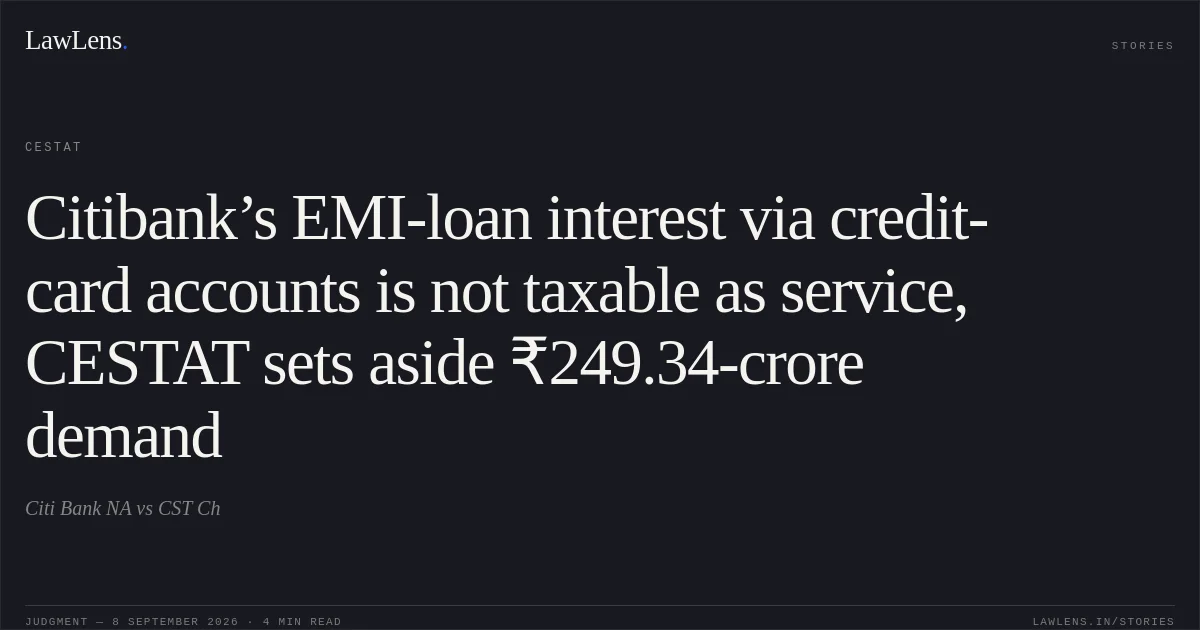
The Tribunal held that interest earned on EMI-based loans extended through credit-card accounts was interest on loans and advances, and not consideration for taxable credit-card or banking services.
Additional or penal interest charged for delayed EMI payments was likewise non-taxable interest and did not constitute consideration for tolerating an act under Section 66E(e).
Source reference: para. 29The extended period of limitation under Section 73(1) was unavailable because suppression, fraud or wilful misstatement with intent to evade tax had not been established; consequently, the penalty under Section 78 also failed.
Source reference: paras. 28–29The Order-in-Original dated 30 November 2016 was set aside in toto, and the appeal was allowed with consequential relief in accordance with law.
Source reference: para. 30Acts & Sections Cited
8 provisions across 1 statute referred to in this judgment. Linked provisions open on LawLens.
Finance Act, 19948
Original Court PDF
Citi Bank NAvsCST Ch
Click to open original judgment
Original judgment, available to read, download and summarize on LawLens.in