Facts
The Appellant (Paschim Gujarat Vij Company Ltd.) conducted a surprise inspection at the Respondent’s premises on June 13, 2010, and discovered electricity theft through illegal hooking.
Source reference: para. 2Consequently, a supplementary bill was issued for the unauthorized consumption.
Source reference: para. 2The Appellant filed Regular Civil Suit No. 23 of 2012 for the recovery of this bill amount.
Source reference: para. 1The Trial Court (Special Judge, Electricity) dismissed the suit on April 25, 2012, ruling that the plaintiff failed to prove the bill.
Source reference: para. 1The Appellant challenged this dismissal, arguing that the validity of the bill was never challenged by the consumer in the proper forum.
Source reference: para. 4Issues
1. Whether the Trial Court was justified in examining the validity and proof of a supplementary bill in a recovery suit when the consumer had not challenged the bill before the statutory Appellate Authority.
Source reference: para. 52. Whether the lack of a formal challenge to the supplementary bill by the defendant renders the bill final for the purposes of a recovery suit.
Source reference: para. 6Law Applied
The Court relied on Section 126 and 127 of the Electricity Act, 2003 (as interpreted via conditions of supply).
Source reference: para. 6The Court specifically followed the precedent set in Paschim Gujarat Vij Company Ltd. v. Bhikhabhia Arjanbhai Varu (Second Appeal No. 11 of 2012) and Vrajlal Devjibhai v. GEB (First Appeal No. 2506 of 2003) which established that if a consumer is aggrieved by a supplementary bill for malpractice/theft, the mandatory remedy is to prefer an appeal before the statutory Appellate Authority; failure to do so results in the bill attaining finality.
Source reference: para. 6, para. 5.1The Court also cited Punjab State Electricity Board v. Ashwani Kumar (1997) 5 SCC 120, which held that Civil Courts should not entertain challenges to such bills without the party first exhausting statutory remedies.
Source reference: para. 6, sub-para. 5Reasoning
The Court observed that the Trial Court committed a "serious and manifest error" by examining the validity of the supplementary bill when its issuance was not even challenged by the defendant through appropriate legal proceedings.
Source reference: para. 5The Court reasoned that since the respondent/defendant did not appeal the bill before the Appellate Committee as required under the conditions of supply, the bill had attained finality.
Source reference: para. 6Therefore, the Civil Court's role in a recovery suit is limited to the recovery of the amount due, rather than re-adjudicating the legality of the bill itself.
Source reference: para. 6The High Court noted that the Trial Court missed the core objective of the suit by focusing on the "branches" (validity) rather than the "wood" (recovery of a finalized debt).
Source reference: para. 6, sub-para. 7Holding
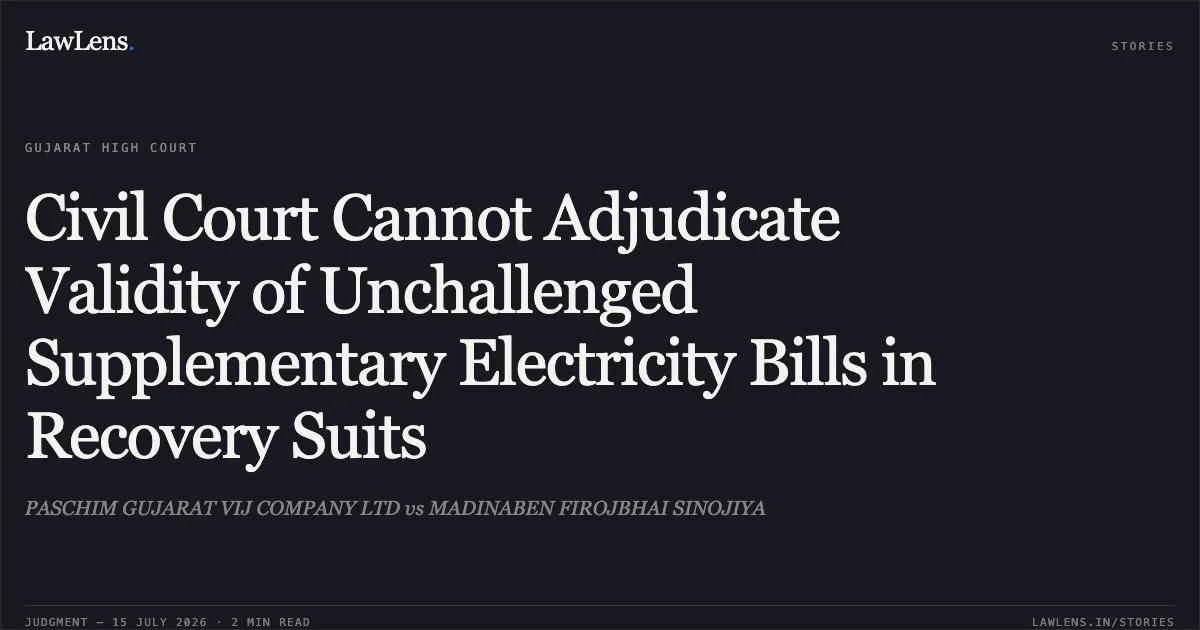
The Court held that a consumer cannot challenge a supplementary bill as a defense in a recovery suit if they failed to utilize the statutory appeal process.
The High Court allowed the appeal and quashed the judgment and decree dated April 25, 2012.
Source reference: para. 7The matter was remanded to the Trial Court with directions to restore the suit and decide it afresh within three months, considering the observations on the finality of the supplementary bill. The Record and Proceedings were ordered to be returned to the Trial Court immediately.
Source reference: para. 7, para. 8, para. 9Acts & Sections Cited
3 provisions across 1 statute referred to in this judgment. Each provision opens on LawLens.
Electricity Act, 20033
Original Court PDF
PASCHIM GUJARAT VIJ COMPANY LTDvsMADINABEN FIROJBHAI SINOJIYA
Click to open original judgment
Original judgment, available to read, download and summarize on LawLens.in