Facts
The suit property was originally let by the Respondents’ predecessor to the Appellants’ predecessor.
Source reference: para. 2-3During the tenancy, the tenant claimed an agreement of sale and filed a suit for specific performance in 1971, which was ultimately dismissed in 1995.
Source reference: para. 2-3On March 19, 1996, in a subsequent miscellaneous proceeding, the tenant filed a reply denying the landlord’s title and claiming independent ownership.
Source reference: para. 3Consequently, the landlord issued a notice of forfeiture under Section 111(g) of the Transfer of Property Act and filed a suit for possession in the Civil Court (Regular Civil Suit No. 3636 of 2001).
Source reference: para. 4The Trial Court and the First Appellate Court both decreed the suit in favor of the landlord.
Source reference: para. 4The Appellants challenged these decrees before the High Court, primarily arguing that the Civil Court lacked jurisdiction and that the Small Causes Court was the appropriate forum.
Source reference: para. 5Issues
1. Whether the Civil Court has jurisdiction to entertain and decide a suit for declaration and restoration of possession based on the forfeiture of tenancy under Section 111(g) of the Transfer of Property Act when a Special Court (Small Causes Court) is available.
Source reference: para. 12. Whether the suit was barred by the law of limitation.
Source reference: para. 12Law Applied
The court applied Section 111(g) of the Transfer of Property Act, 1882, regarding the forfeiture of lease by the tenant's renunciation of their character as such by setting up a title in a third person or claiming title in themselves.
Source reference: para. 4It relied on the principle from Kashinath Gosavi Patil v. Govala Vyankanna Tatayya (1995), which establishes that disclaimer of title terminates the landlord-tenant relationship and removes Rent Act protection.
Source reference: para. 8Furthermore, the court applied the Supreme Court ruling in Abdulla Bin Ali v. Galappa (1985), holding that a suit against a tenant who denies the landlord's title is effectively a suit against a trespasser and is triable by a Civil Court.
Source reference: para. 9Regarding limitation, the court applied Articles 65 and 67 of the Limitation Act, which provide a 12-year period for possession suits.
Source reference: para. 12Reasoning
The Court reasoned that the jurisdiction of a forum is determined by the allegations made in the plaint.
Source reference: para. 9Since the Appellants denied the landlord's title in their reply dated March 19, 1996, they forfeited their tenancy and their occupation assumed the character of a trespasser.
Source reference: para. 8, 10The Court observed that a tenant who renounces their character as a tenant cannot simultaneously seek protection under Rent Control legislation or the specialized jurisdiction of the Small Causes Court.
Source reference: para. 6, 8Relying on Abdulla Bin Ali, the Court held that once the landlord treats the occupant as a trespasser following a denial of title, the Civil Court alone possesses the jurisdiction to adjudicate the dispute.
Source reference: para. 9-10On the issue of limitation, the Court rejected the Appellants' argument that the 1971 specific performance suit triggered the limitation period, noting that seeking specific performance acknowledges the landlord's ownership.
Source reference: para. 12The cause of action for forfeiture arose only on March 19, 1996, making the suit filed in August 1996 well within the 12-year statutory limit.
Source reference: para. 12Holding
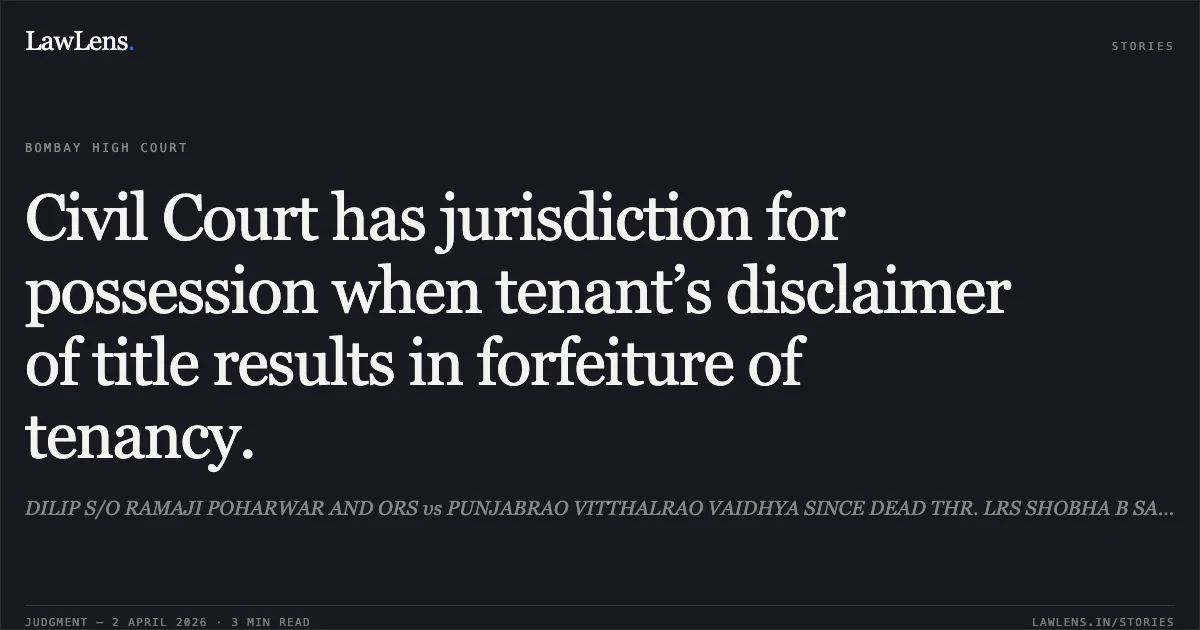
The High Court answered the substantial question of law against the Appellants, holding that the Civil Court had proper jurisdiction because the tenancy was forfeited by the tenant’s denial of title.
The Court further held that the suit was within the period of limitation as the cause of action accrued in 1996.
Source reference: para. 12Consequently, the Second Appeal was dismissed, and the concurrent decrees for possession passed by the lower courts were upheld.
Source reference: para. 13Acts & Sections Cited
3 provisions across 2 statutes referred to in this judgment. Each provision opens on LawLens.
Transfer of Property Act, 18821
Limitation Act, 19632
Original Court PDF
DILIP S/O RAMAJI POHARWAR AND ORSvsPUNJABRAO VITTHALRAO VAIDHYA SINCE DEAD THR. LRS SHOBHA B SARADKAR
Click to open original judgment
Original judgment, available to read, download and summarize on LawLens.in