Facts
The plaintiff filed a suit for declaration of title and permanent injunction regarding land allegedly purchased via an unregistered sale deed dated 18th Jeth, 2013.
Source reference: para. 2The defendant contested the suit, asserting that the land was joint property and had already been partitioned by competent revenue authorities on 08.01.1986.
Source reference: para. 3The Trial Court dismissed the suit, finding it time-barred and noting the plaintiff failed to contest the partition proceedings despite service.
Source reference: para. 8The Appellate Court reversed this, decreeing the suit on the grounds that the partition service was invalid (lacking a copy of the petition) and the sale deed carried a presumption of truth under Section 90 of the Evidence Act.
Source reference: para. 9The defendants appealed to the High Court.
Source reference: para. 10Issues
1. Whether the jurisdiction of the Civil Court is barred under Section 171 (cited as 173 in questions) of the H.P. Land Revenue Act regarding matters arising out of partition.
Source reference: para. 102. Whether the suit for declaration is maintainable having been filed in 1997 despite constructive knowledge of revenue entries in 1986.
Source reference: para. 103. Whether a declaration of title can be sought based on an unstamped and unregistered document of sale.
Source reference: para. 10Law Applied
The court primarily applied Section 171(2)(xvii) & (xviii) of the H.P. Land Revenue Act, which excludes Civil Court jurisdiction over claims for partition or questions arising from partition proceedings, except for questions of title.
Source reference: para. 15Section 21 of the H.P. Land Revenue Act, which governs the mode of service for revenue summons, rather than Order V of the CPC.
Source reference: para. 27Principle of res judicata under Section 11 of the CPC as interpreted in Dev Raj v. Mansha Ram, holding that orders by competent revenue authorities regarding corrections or partitions operate as a bar to subsequent civil suits.
Source reference: para. 22Presumption of regularity of official acts under Section 114 of the Indian Evidence Act.
Source reference: para. 25Reasoning
The court determined that the Appellate Court erred in applying Order V Rule 2 of the CPC to revenue proceedings; under Section 21 of the H.P. Land Revenue Act, a partition summons does not legally require an attached copy of the petition to constitute valid service.
Source reference: paras. 26-27Since the summons (Ext. D7) bore the plaintiff's signature and the Process Server's report, a presumption of valid service arose under Section 114 of the Evidence Act, which the plaintiff failed to rebut.
Source reference: paras. 24-25Because the plaintiff failed to raise the "question of title" (the sale deed) during those partition proceedings, the resulting partition order became final.
Source reference: para. 23Per Section 171, the Civil Court is barred from entertaining suits that effectively challenge or ignore a concluded partition.
Source reference: paras. 17-21Following Athmanathswami Devasthanam v. K. Gopalaswami Ayyangar, the court held that since jurisdiction was barred, it could not rule on the merits of limitation or the validity of the unregistered sale deed.
Source reference: paras. 31-32Holding
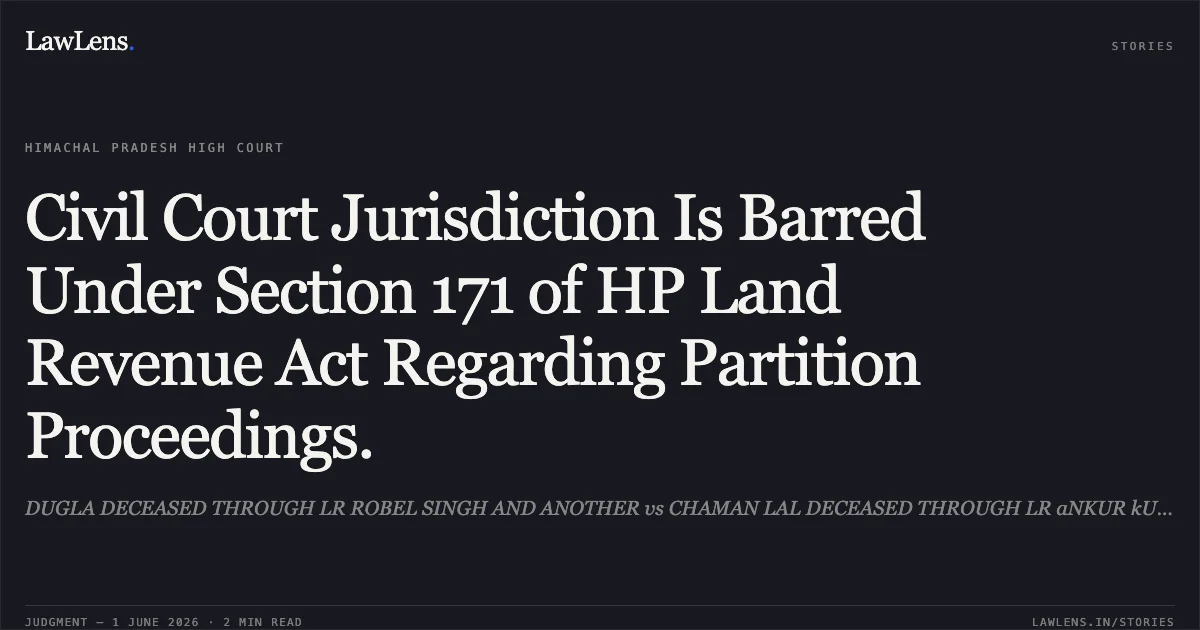
The High Court answered the first issue in the affirmative, holding that the Civil Court’s jurisdiction was barred by Section 171 of the H.P. Land Revenue Act.
The Court set aside the judgments of the lower courts and ordered the return of the plaint for presentation before the competent authority. Final decree: Appeal allowed.
Source reference: para. 33Acts & Sections Cited
2 provisions across 1 statute referred to in this judgment. Each provision opens on LawLens.
Code of Civil Procedure, 19082
Original Court PDF
DUGLA DECEASED THROUGH LR ROBEL SINGH AND ANOTHERvsCHAMAN LAL DECEASED THROUGH LR aNKUR kUMAR AND OTHERS
Click to open original judgment
Original judgment, available to read, download and summarize on LawLens.in