01Facts
The petitioner purchased Site No. 1, Arehalli Village, Bengaluru South Taluk (10,767 sq. ft.) on 17.07.2014 and, the same day, entered into a Joint Development Agreement (JDA) with respondents 2 and 3 as developers, with a 41:59 revenue split.
¶ 7Respondents 2 and 3 allegedly paid an advance of Rs. 75,00,000.
¶ 2The JDA records payment of only Rs. 25,00,000.
¶ 7When construction was obstructed by one Smt. Bhagyamma, who claimed the land, respondents 2 and 3 sought a refund, which was not paid.
¶ 2Respondents 2 and 3 lodged a complaint on 25.04.2016, leading to FIR No. 252/2016 against the petitioner and two others.
¶ 2The police charge-sheeted only the petitioner under Sections 406, 420 and 120B IPC, dropping accused nos. 2 and 3, and the Magistrate took cognizance in C.C. No. 21926/2021.
¶ 2The petitioner contended that the dispute is civil, the sale deed was executed at the developers' behest, and the JDA has not been cancelled.
¶ 4, 7The State contended that the petitioner knew of the title defect, received the advance, and failed to refund it.
¶ 502Issues
i.1. Whether the dispute between the petitioner and respondents 2 and 3, arising from a Joint Development Agreement and the refundable advance, is essentially civil in nature, such that the offences under Sections 406, 420 and 120B IPC are not made out.
¶ 4, 5, 8, 10ii.2. Whether continuation of the criminal proceedings in C.C. No. 21926/2021 amounts to an abuse of the process of court, warranting quashing under Section 482 Cr.P.C.
¶ 1003Law Applied
The Court applied Section 482 Cr.P.C. to quash proceedings that are an abuse of process.
¶ 10The Court relied on Sections 405 and 406 IPC (criminal breach of trust), Section 415 and 420 IPC (cheating), and Section 120B IPC (criminal conspiracy), which require the ingredients of each offence to be prima facie established.
¶ 9, 10The Court followed G. Saminathan v. State (SLP (Crl.) No. 10294/2025), which held that disputes over refundable security deposits under a JDA are essentially civil and do not attract Sections 406 or 420 IPC.
¶ 8The Court relied on Arshad Neyaz Khan v. State of Jharkhand (2025 SCC OnLine SC 2058), which holds that criminal breach of trust and cheating are distinct and cannot co-exist on the same facts, relying on Delhi Race Club (1940) Ltd. v. State of U.P., (2024) 10 SCC 690.
¶ 9 · ¶ 21Arshad Neyaz Khan holds that where a civil remedy exists, criminal law must not be used for vindictive proceedings, and that criminal proceedings may not be continued to cause harassment, following Inder Mohan Goswami.
¶ 9 · ¶ 22–23Provisions in the judgment · 5 · Linked ones open on LawLens
Code of Criminal Procedure, 1973 Section 482
Indian Penal Code, 1860 Section 405Section 406Section 415Section 420
04Reasoning
The Court first noted that the sale deed was executed at the developers' behest and that the JDA has not been cancelled, so the refund question "does not arise" at this stage.
¶ 7The Court held that the facts mirror G. Saminathan, where the dispute concerned a refundable deposit under a JDA.
¶ 8Applying Arshad Neyaz Khan, the Court held that the complaint could not simultaneously allege criminal breach of trust (Section 406) and cheating (Section 420).
¶ 9The Court treated the civil remedy of cancellation of the JDA or a suit for damages as the proper route for the alleged contractual default, rather than criminal prosecution.
¶ 4 · ¶ 9On this basis, the Court found that the allegations in the FIR and charge-sheet do not prima facie make out the offences under Sections 406, 420 and 120B IPC and that the matter is a purely civil dispute.
¶ 1005Holding
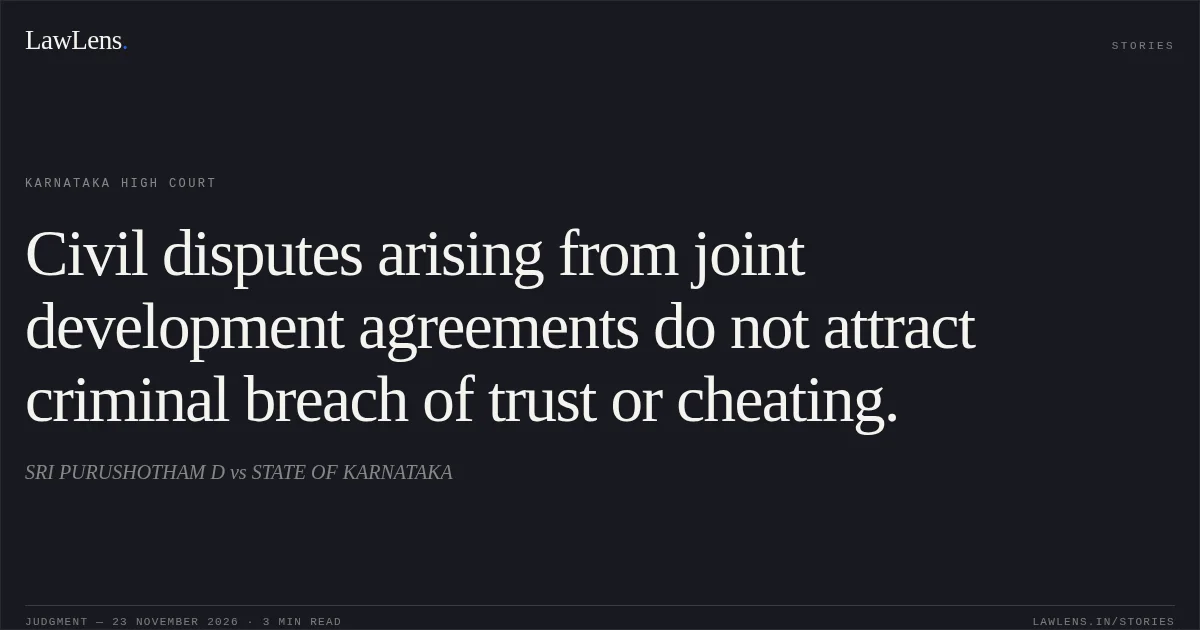
The Court held that the dispute is essentially civil and that the offences under Sections 406, 420 and 120B IPC are not prima facie made out, so continuing the criminal case would be an abuse of process.
¶ 10The petition is allowed, and the proceedings in C.C. No. 21926/2021 arising out of Crime No. 252/2016 (P.S. Subramanyapura), pending before the 4th Additional Chief Metropolitan Magistrate, Bengaluru, are quashed.
¶ 10, Order (ii)Original Court PDF
SRI PURUSHOTHAM DvsSTATE OF KARNATAKA
Click to open original judgment
Original judgment, available to read, download and summarize on LawLens.in



