Facts
The petitioner was appointed to a non-teaching post in 1982 by a private Managing Committee and was subsequently absorbed by the State Government in 1995
Source reference: p.2Following a Screening Committee review, the Health Department ordered his relief in May 2003, followed by a formal termination order dated August 29, 2003
Source reference: p.3-4After extensive litigation (CWJC No.10301 of 2003 and LPA No.1155 of 2005), a Review Committee found his appointment genuine
Source reference: p.4-5Consequently, the State issued a notification on October 17, 2007, re-absorbing him with effect from June 1, 1986, but Clause 10 of said order specified that no arrears would be paid for the period he was out of service
Source reference: p.5, 10The petitioner accepted this order, worked until his retirement on June 30, 2020, and filed the present writ in 2022 seeking arrears for the period 2003–2007
Source reference: p.6, 10Issues
1. Whether the petitioner is entitled to arrears of salary for the period between his termination and re-absorption (29.08.2003 to 31.10.2007) despite the restrictive Clause 10 in the absorption order
Source reference: p.2 / para. 112. Whether the writ petition is barred by the doctrine of delay and laches given it was filed 14 years after the cause of action
Source reference: p.7 / para. 143. Whether the petitioner can claim parity with similarly situated employees (e.g., Bishram Ojha) who received arrears
Source reference: p.5 / para. 12Law Applied
The Court applied the principle of "delay and laches," which precludes relief to litigants who sleep over their rights for an inordinate period
Source reference: p.10The Court relied on State of Uttar Pradesh & Ors. v. Arvind Kumar Srivastava & Ors. regarding the denial of parity to "deadwood" or "tardy" litigants who approach the court late
Source reference: p.7The Court applied the precedent from State of Orissa v. Pyarimohan Samantaray & Ors., establishing that making repeated representations does not provide a satisfactory explanation for delay
Source reference: p.11The Bihar State Litigation Policy, 2011, Clause 4.C(1) regarding parity was considered but found inapplicable to the petitioner's specific procedural history
Source reference: p.6Reasoning
The Court noted that the 2007 absorption notification explicitly stated in Clause 10 that the period of absence would count for pension but not for salary arrears
Source reference: p.10The petitioner accepted this condition without protest and continued service for 13 years until retirement in 2020
Source reference: p.10The Court reasoned that the petitioner "woke up" to file the writ only 14 years after the order and 17 months after retirement, making the claim stale
Source reference: p.10-11Regarding parity with Bishram Ojha, the Court distinguished the cases because Ojha had continuously and actively pursued his legal remedies through multiple specific writ petitions and appeals, whereas the petitioner remained silent
Source reference: p.11Holding
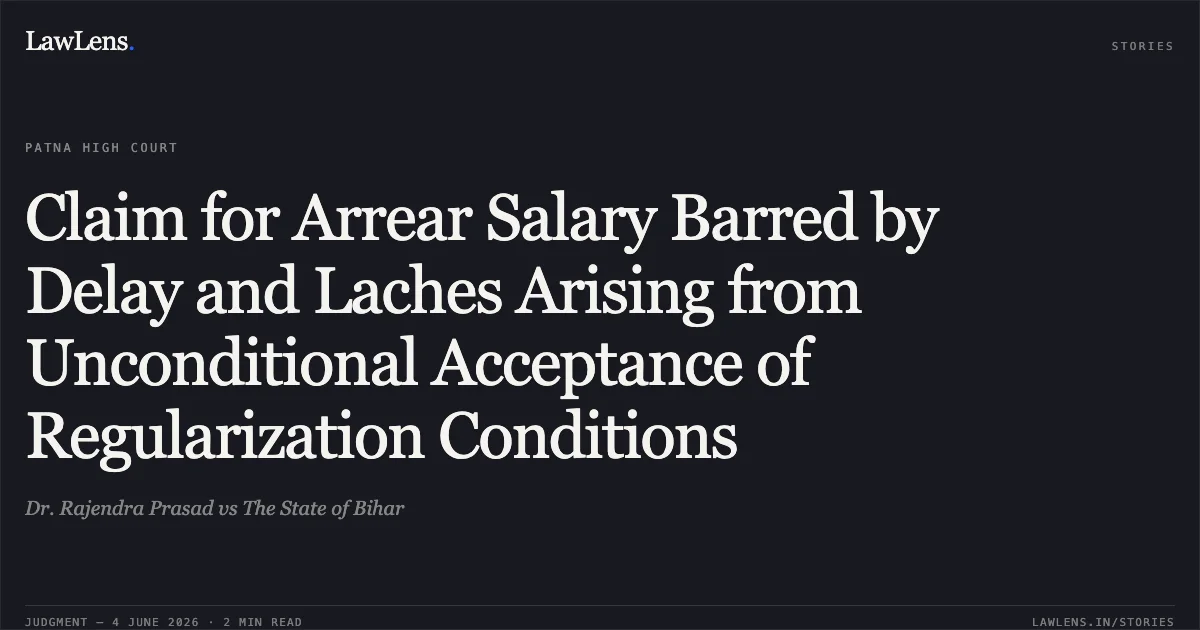
The Court held that the petition was severely hit by delay and laches, and the petitioner, having accepted the 2007 absorption terms for over a decade, could not challenge them post-retirement
The Court dismissed the writ application, holding that the petitioner failed to make out a case for payment of salary arrears
Source reference: para. 29-30Acts & Sections Cited
1 provisions across 1 statute referred to in this judgment. Linked provisions open on LawLens.
Memo No.902 dated 17.10.20071
Original Court PDF
Dr. Rajendra PrasadvsThe State of Bihar
Click to open original judgment
Original judgment, available to read, download and summarize on LawLens.in