Facts
The Petitioner was appointed as a Time Keeper in 1985 and discontinued in 1986. The Labour Court, via award dated 01.07.1996, ordered his reinstatement with back-wages.
Source reference: para. 2This award was challenged in WP No. 4927 of 1996, where the High Court, on 04.03.2013, upheld the reinstatement but specifically set aside the direction for back-wages because the workman failed to prove he was not gainfully employed.
Source reference: para. 2, 8After settling claims for "last wages drawn" (1998–2000) in Lok Adalat, the Petitioner filed an application under Section 15(2) of the Payment of Wages Act claiming back-wages from 1996 to March 2013.
Source reference: para. 2, 7The Labour Court (04.01.2019) and the Industrial Court (08.04.2021) rejected the claim, leading to the present writ petition.
Source reference: para. 2, 3Issues
1. Whether the Petitioner is entitled to claim back-wages under the Payment of Wages Act for a period during which such relief was explicitly denied by a High Court order that attained finality.
Source reference: para. 6, 92. Whether the precedent in D.N. Krishnappa v. Deputy General Manager regarding payment of wages during the pendency of litigation applies to the facts of the present case.
Source reference: para. 3, 6Law Applied
The Court applied Section 15(2) and Section 17 of the Payment of Wages Act, 1936, regarding the recovery of delayed or deducted wages.
Source reference: para. 2, 7It also considered Section 17B of the Industrial Disputes Act, 1947, which provides for payment of "last drawn wages" during the pendency of proceedings in higher courts.
Source reference: para. 7The Court distinguished the principles laid down in D.N. Krishnappa v. The Deputy General Manager (2023) AIR (SC) Civil 494, which holds that confirmation of a reinstatement order entitles an employee to wages for the interim period unless otherwise adjusted.
Source reference: para. 3, 6Reasoning
The Court observed that the Petitioner’s claim for back-wages was specifically adjudicated in the earlier round of litigation (WP No. 4927 of 1996), where the High Court explicitly set aside the Labour Court's direction for back-wages.
Source reference: para. 8, 9Because that order attained finality, the Petitioner cannot seek the same relief through the Payment of Wages Act.
Source reference: para. 9The Court distinguished the D.N. Krishnappa precedent, noting that in the present case, the High Court had already delivered a verdict on the merits declining the back-wages, whereas the precedent dealt with restoration of rights after a stay was vacated.
Source reference: para. 6Furthermore, the Petitioner's application claimed total "arrears of salary" rather than just the "last drawn wages" under Section 17B, making his claim inconsistent with the prior binding judgment of the High Court.
Source reference: para. 7Holding
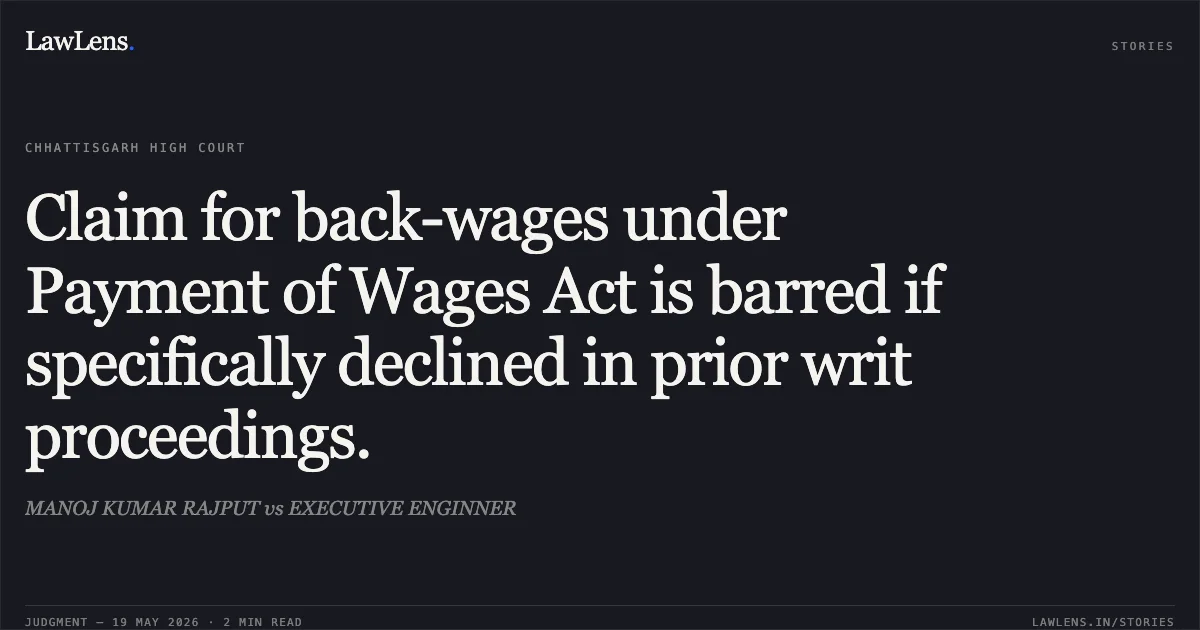
The High Court dismissed the petition, holding that the Petitioner is not entitled to back-wages as the relief was specifically denied by the High Court in WP No. 4927 of 1996, which attained finality.
The Court found no jurisdictional error or illegality in the orders of the Labour Court and Industrial Court. The petition was dismissed.
Source reference: para. 9Acts & Sections Cited
5 provisions across 2 statutes referred to in this judgment. Linked provisions open on LawLens.
Industrial Disputes Act, 19472
Payment Of Wages Act, 19363
Original Court PDF
MANOJ KUMAR RAJPUTvsEXECUTIVE ENGINNER
Click to open original judgment
Original judgment, available to read, download and summarize on LawLens.in


