Facts
On May 21, 2004, the original claimant was allegedly knocked down by a lorry (WB-41-3999) after alighting from a rickshaw, resulting in traumatic paraplegia and permanent disability.
Source reference: p. 1-2He filed a claim under Section 163A of the Motor Vehicles Act, 1988.
Source reference: p. 2The Motor Accident Claims Tribunal (MACT) dismissed the petition in 2007, finding a failure to prove that injuries were caused by the alleged accident.
Source reference: p. 2The High Court of Calcutta affirmed this dismissal in 2022, citing "glaring" discrepancies in records, such as an MRI report mentioning a "fall from lorry" and a slight variation in the vehicle registration number in oral testimony.
Source reference: p. 2, 5-6The original claimant died during pendency and is represented by his legal heirs.
Source reference: p. 3Issues
1. Whether the material on record reasonably established that the injuries sustained arose out of the motor vehicle accident despite minor discrepancies in documentation.
Source reference: p. 3 / para. 72. Whether hyper-technical evidentiary standards (proof beyond reasonable doubt) can be applied to summary proceedings under a welfare legislation like the Motor Vehicles Act.
Source reference: p. 3, 9 / para. 8, 193. Whether the Court can grant "just compensation" exceeding the structured formula of Section 163A by invoking Article 142 of the Constitution.
Source reference: p. 11-12 / para. 21, 24Law Applied
The Court applied Section 163A of the Motor Vehicles Act, 1988, noting that it provides a "no-fault" liability framework where negligence need not be proved.
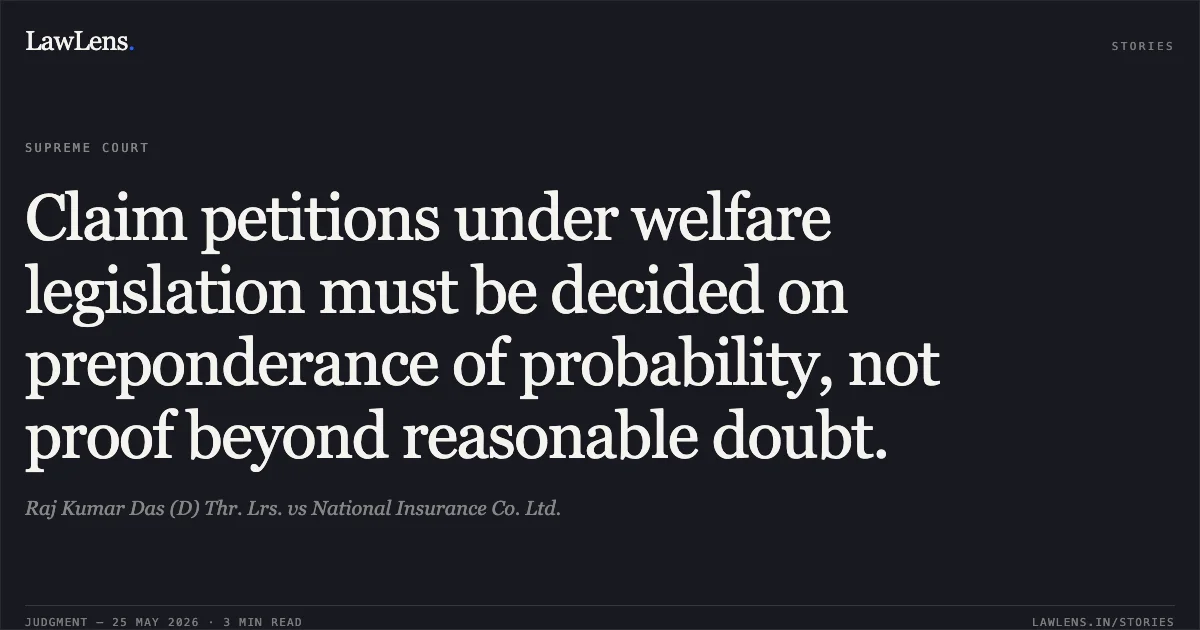
Source reference: p. 4It relied on Mathew Alexander v. Mohammed Shafi and Sunita v. Rajasthan State Road Transport Corporation, establishing that claim petitions must be decided on the "touchstone of preponderance of probability" rather than proof beyond reasonable doubt.
Source reference: p. 4, 7-8It further referred to U.P. SRTC v. Trilok Chandra regarding defects in the Second Schedule and National Insurance Co. Ltd. v. Pranay Sethi and Sarla Verma v. DTC regarding the calculation of "just compensation" and future prospects.
Source reference: p. 10, 11-12Reasoning
The Court reasoned that the High Court and Tribunal erred by adopting a "hyper-technical approach".
Source reference: p. 9It held that medical history in emergency reports (e.g., "fall from lorry") is often based on attendant hearsay and cannot displace consistent documentary evidence like the FIR and chargesheet.
Source reference: p. 5Similarly, minor delays in FIRs are natural in grievous injury cases where medical treatment is the priority.
Source reference: p. 5-6The Court clarified that a witness's inability to recall a precise registration number years later does not outweigh consistent police records.
Source reference: p. 6It emphasized that in summary proceedings, courts must differentiate between contradictions that render an accident improbable and those reflecting mere human or clerical imperfections.
Source reference: p. 4Finding that the accident was established on a balance of probabilities, the Court determined that the 100% disability justified a move beyond the restrictive "structured formula" of the old Section 163A to provide effective relief.
Source reference: p. 11-12Holding
The Supreme Court set aside the judgments of the MACT and the High Court.
It held that the claimant established the accident on the balance of probabilities and that the 20-year delay necessitated finality.
Source reference: p. 10Relying on Article 142 of the Constitution to ensure substantial justice, the Court awarded "just compensation" based on Section 166 principles.
Source reference: p. 12The Respondent-Insurer was directed to deposit Rs. 14,90,000/- with 6% interest from the date of filing before the MACT for release to the legal representatives.
Source reference: p. 14Acts & Sections Cited
3 provisions across 1 statute referred to in this judgment. Each provision opens on LawLens.
Motor Vehicles Act, 19883
Original Court PDF
Raj Kumar Das (D) Thr. Lrs.vsNational Insurance Co. Ltd.
Click to open original judgment
Original judgment, available to read, download and summarize on LawLens.in