Facts
On November 28, 2021, the appellant was a pillion rider on a motorcycle driven by his son. The motorcycle collided with an oncoming unknown vehicle while attempting to overtake another vehicle
Source reference: p. 1-2The appellant sustained serious injuries and a 20% functional disability
Source reference: p. 2, 5The Motor Accident Claims Tribunal (MACT), Morbi, awarded ₹81,800/- in compensation, attributing 50% contributory negligence to the rider of the claimant's motorcycle and 50% to the driver of the other vehicle
Source reference: p. 1; para. 12Because the other vehicle’s owners/insurers were not joined as parties, the Tribunal deducted 50% of the calculated award
Source reference: p. 7The appellant challenged this judgment on the grounds of inadequate quantum and the improper deduction for negligence
Source reference: p. 2; para. 5Issues
1. Whether the Tribunal erred in deducting 50% of the compensation amount based on the non-impleadment of one of the joint tortfeasors in a case of composite negligence
Source reference: p. 3-4; para. 82. Whether the quantum of compensation awarded was just, particularly regarding the assessment of monthly income and conventional heads of damages
Source reference: p. 3; para. 7Law Applied
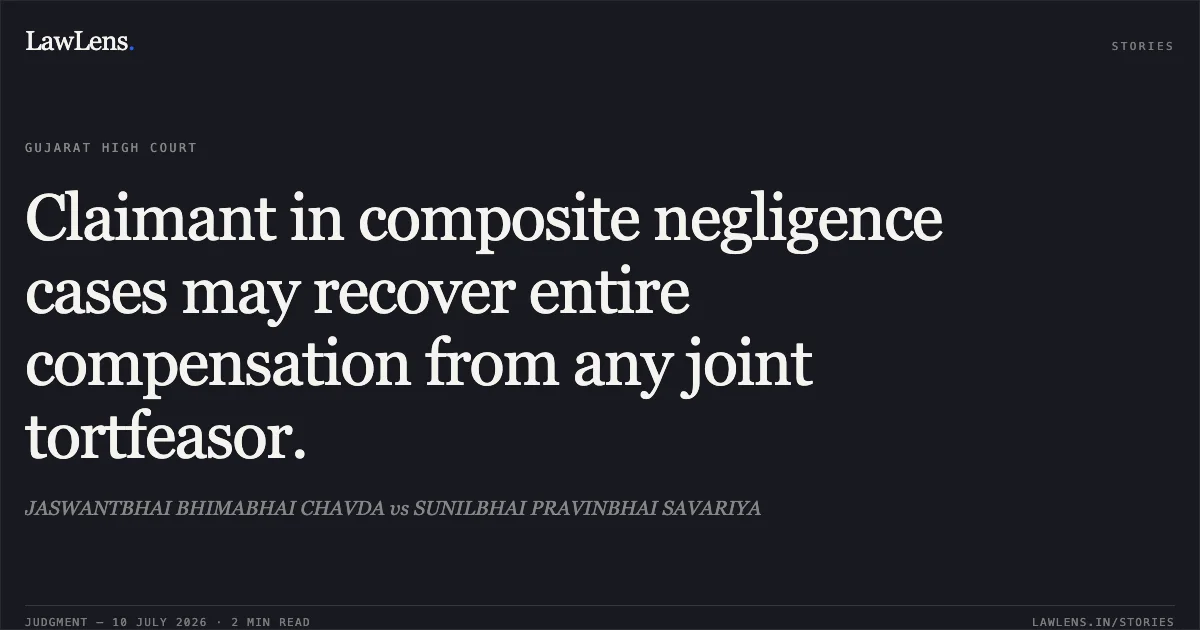
The Court applied the principle of "composite negligence," referencing Khenyei v. New India Assurance Company Limited, which establishes that a claimant can recover the entire compensation from any one of the joint tortfeasors as their liability is joint and several
Source reference: p. 4, 8The Court further relied on National Insurance Company Ltd. v. Pranay Sethi regarding future prospects and Magma General Insurance Company Limited v. Nanu Ram for awarding conventional damages
Source reference: p. 3; para. 7Assessment of income was governed by the minimum wage standards notified by the Government of Gujarat for the relevant period
Source reference: p. 3, 5; para. 13Reasoning
The Court observed that as a pillion rider, no negligence could be attributed to the appellant
Source reference: p. 5; para. 12It reasoned that the Tribunal erred in law by deducting 50% of the award; since this was a case of composite negligence, the appellant had the legal right to seek full recovery from the impleaded insurer, who could then seek inter se contribution from other tortfeasors through execution proceedings
Source reference: p. 8; para. 19-20Regarding quantum, the Court found the Tribunal’s income assessment of ₹6,000/- per month lacked a factual basis and updated it to the prevailing minimum wage of ₹9,490/-, adding 10% for future prospects
Source reference: p. 5; para. 13The Court also found the awards for pain and suffering, medical expenses, and loss of income to be "meagre" and adjusted them upward to reflect the severity of the fractures and the length of treatment
Source reference: p. 6-7; para. 14-17Holding
The High Court partly allowed the appeal, enhancing the total compensation from ₹81,800/- to ₹2,98,952/- with 7% interest
The Court set aside the 50% deduction, holding that the respondent insurance company must first pay the entire awarded amount to the claimant
Source reference: p. 8-9; para. 20-22The insurer was granted "pay and recover" rights to seek 50% of the amount from the owner/rider of the first motorcycle (due to lack of a valid license) and the remaining 50% from the owners/insurers of the second motorcycle
Source reference: p. 9; para. 22Acts & Sections Cited
1 provisions across 1 statute referred to in this judgment. Each provision opens on LawLens.
Motor Vehicles Act, 19881
Original Court PDF
JASWANTBHAI BHIMABHAI CHAVDAvsSUNILBHAI PRAVINBHAI SAVARIYA
Click to open original judgment
Original judgment, available to read, download and summarize on LawLens.in


