Facts
The claimants sought compensation under the Employees’ Compensation Act, 1923, for the death of Niranjan, alleging that he was employed as a driver by respondent no. 1 and was murdered while driving respondent no. 1’s truck.
Source reference: paras. 1–2Respondent no. 1 denied the employment relationship; the insurer also disputed liability. The Commissioner dismissed the claim, and the claimants appealed under Section 30 of the Act.
Source reference: paras. 1, 3–4Issues
Whether the Commissioner’s finding that the claimants had not established an employer–employee relationship disclosed a substantial question of law warranting interference under Section 30.
Source reference: paras. 9–11Whether the circumstances of the death, including discovery of the body inside respondent no. 1’s truck, established that the death occurred in the course of employment or otherwise entitled the claimants to compensation.
Source reference: paras. 7, 14Law Applied
Section 30 of the Employees’ Compensation Act, 1923, limits appeals to cases involving a substantial question of law; the Commissioner is ordinarily the final authority on questions of fact.
Source reference: para. 9The Court relied on Golla Rajanna v. Divisional Manager, (2017) 1 SCC 45, for that principle.
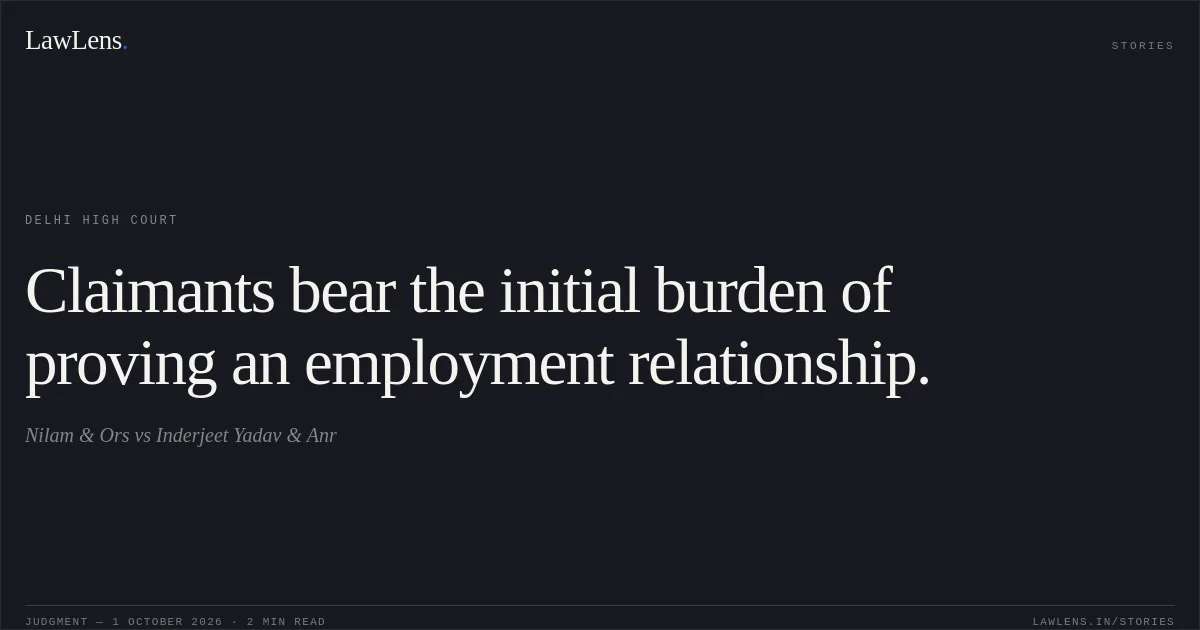
Source reference: para. 9The claimant asserting an employer–employee relationship bears the initial burden of proving it; an adverse inference from an opposing party’s failure to testify does not displace that burden.
Source reference: paras. 10–11Reasoning
The Court found that the only evidence of employment was the affidavit of the deceased’s wife, whose cross-examination showed that she did not know his workplace or the authority that issued his driving licence; the licence was not produced.
Source reference: paras. 10, 12The FIR evidence was also inconsistent with her testimony about who had reported the incident. Although respondent no. 1 had denied the relationship and led no evidence, that omission did not relieve the claimants of their initial burden.
Source reference: paras. 11, 13Nor did finding the body in respondent no. 1’s truck, by itself, establish that the deceased was acting in the course of employment. Because employment was not proved, the Court did not reach the separate question whether the death was an accidental murder or murder simpliciter.
Source reference: para. 14Holding
The Court held that the Commissioner’s findings disclosed no perversity or patent illegality and that no basis for interference under Section 30 had been established.
The appeal was dismissed.
Source reference: para. 16Acts & Sections Cited
1 provisions across 1 statute referred to in this judgment. Linked provisions open on LawLens.
Employee1
Original Court PDF
Nilam & OrsvsInderjeet Yadav & Anr
Click to open original judgment
Original judgment, available to read, download and summarize on LawLens.in