Facts
The original petitioner, Late Dr. M.A.M. Ramaswamy Chettiar, instituted proceedings in 2014 (TCP No. 1/2016) against Respondent No. 1 (R1) for the repayment of deposits under Sections 73(4) and 74(1) of the Companies Act, 2013
Source reference: p. 1-2Following the petitioner’s demise on 02.12.2015, two competing substitution applications were filed: one by Respondent No. 2 (R2) claiming status as an adopted son, and another by the Appellant Trust based on a Will
Source reference: p. 3In a prior appeal (06.09.2022), the NCLAT set aside a substitution order, holding that the legal heirship must be determined by the pending testamentary proceedings (TOS No. 27/2021) before the Madras High Court
Source reference: p. 4-5Consequently, the NCLT adjourned the main petition sine die
Source reference: p. 6In 2024, the Appellant filed IA No. 93/2024, seeking a direction for R1 to deposit the matured sum of Rs. 66.32 crores into the probate proceedings to prevent the funds from being frittered away
Source reference: p. 6-7The NCLT, via the impugned order dated 27.11.2024, declined to pass orders and directed the Appellant to seek clarification from the NCLAT
Source reference: p. 7Issues
1. Whether the NCLT could adjudicate upon the recovery and protection of the deposit amount during the pendency of testamentary proceedings regarding the substitution of the deceased petitioner
Source reference: p. 9-102. Whether a claimant to an estate can maintain proceedings to protect the assets of the deceased before the grant of probate
Source reference: p. 11Law Applied
The court applied Sections 73(4) and 74(1) of the Companies Act, 2013, which govern the repayment of deposits and the Tribunal's power to order such payments
Source reference: p. 2It further considered Section 213 of the Indian Succession Act, which generally bars establishing rights under a Will without probate
Source reference: p. 11However, the court relied on the Supreme Court precedent in Binapani Kar Chowdhury v. Sri Satyabrata Basu Anr. (2006) 10 SCC 442, which establishes that a beneficiary may institute legal proceedings to protect the estate of the deceased even before probate is granted, as such actions are not hit by the bar under Section 213
Source reference: p. 11Reasoning
The NCLAT clarified that its previous judgment dated 06.09.2022 was limited solely to the issue of who would be substituted as the legal heir
Source reference: p. 9It did not stay the substantive adjudication of whether a deposit existed or if R1 was in contravention of the Companies Act
Source reference: p. 10The Tribunal reasoned that the NCLT retains exclusive jurisdiction over Company Law matters, including the fate of matured deposits, whereas the High Court’s role is limited to determining succession
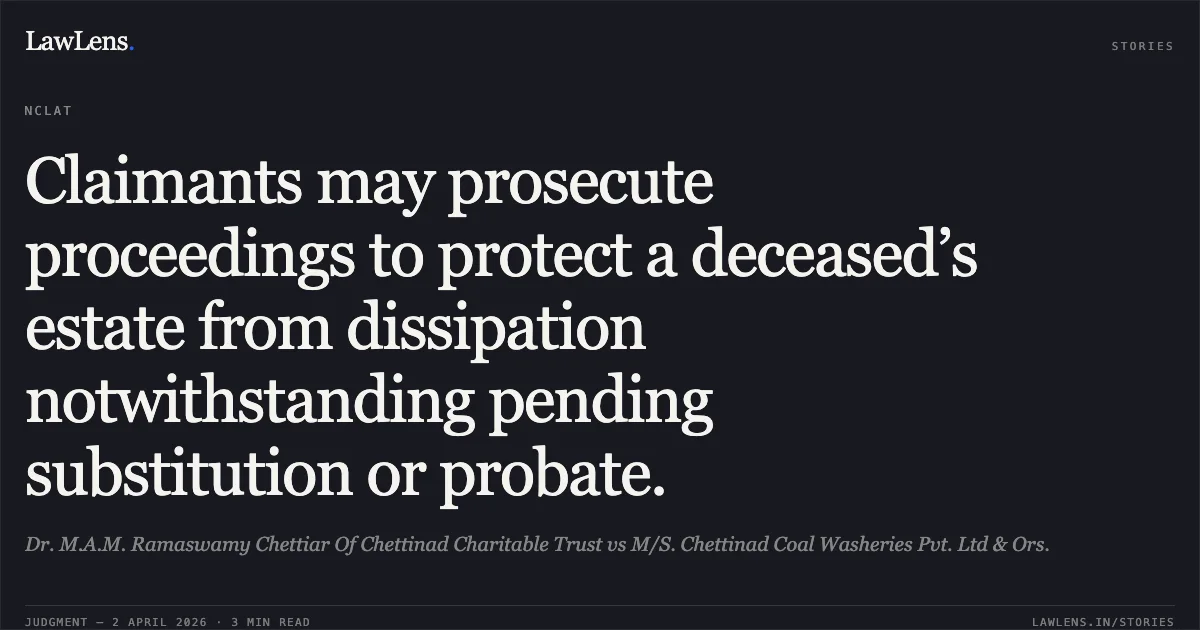
Source reference: p. 10Applying the Binapani Kar Chowdhury principle, the court held that any claimant to the estate (Appellant or R2) is entitled to prosecute the proceedings to ensure the estate’s assets are not dissipated
Source reference: p. 11Protecting the matured deposit by potentially transferring it to the credit of probate proceedings would serve the interests of the ultimate legal heir without prejudicing any party
Source reference: p. 11-12Holding
The NCLAT allowed the appeal and set aside the NCLT’s order dated 27.11.2024
The Tribunal held that the pendency of testamentary proceedings is not a bar to deciding the merits of a deposit refund claim under the Companies Act
Source reference: p. 11The matter was remanded to the NCLT with directions to adjudicate IA No. 93/2024 and the principal petition (TCP No. 1/2016) on their merits to determine the fate of the alleged deposit
Source reference: p. 12Acts & Sections Cited
3 provisions across 2 statutes referred to in this judgment. Each provision opens on LawLens.
Companies Act, 20132
Indian Succession Act, 19251
Original Court PDF
Dr. M.A.M. Ramaswamy Chettiar Of Chettinad Charitable TrustvsM/S. Chettinad Coal Washeries Pvt. Ltd & Ors.
Click to open original judgment
Original judgment, available to read, download and summarize on LawLens.in


