Facts
The claimants filed MVC No.450/2003 under Section 163-A of the Motor Vehicles Act, 1988, seeking compensation for the death of Azar, who allegedly died in a road accident on 11 May 2003 while riding a motorcycle.
Source reference: para. 4Their case was that a tempo-trax bearing registration No.KA-25/N-1786 struck the motorcycle, causing it to hit an electric pole, resulting in Azar’s death.
Source reference: para. 4The insurer denied the involvement of the tempo-trax and alleged its false implication.
Source reference: para. 7The Tribunal initially dismissed the claim petition, and its decision was affirmed by the High Court.
Source reference: para. 8The Supreme Court thereafter allowed the claimants’ appeal and remanded the matter for fresh determination.
Source reference: paras. 8–10On remand, the Tribunal held that the tempo-trax was involved in the accident and awarded ₹5,70,000 with interest at 6% per annum.
Source reference: para. 10The insurer challenged the award, while the claimants filed cross-objections seeking enhancement.
Source reference: paras. 11–12Issues
Whether the insurer was entitled to challenge afresh the finding regarding the involvement of the tempo-trax after the Supreme Court’s remand order.
Source reference: para. 18, Point No.1Whether the claimants proved, on the basis of preponderance of probabilities, that the tempo-trax was involved in causing the accident.
Source reference: para. 18, Point No.2Whether the claimants were entitled to enhancement of compensation.
Source reference: para. 18, Point No.3Law Applied
The Court applied Sections 163-A and 173(1) of the Motor Vehicles Act, 1988, and Order XLI Rule 22 of the Code of Civil Procedure.
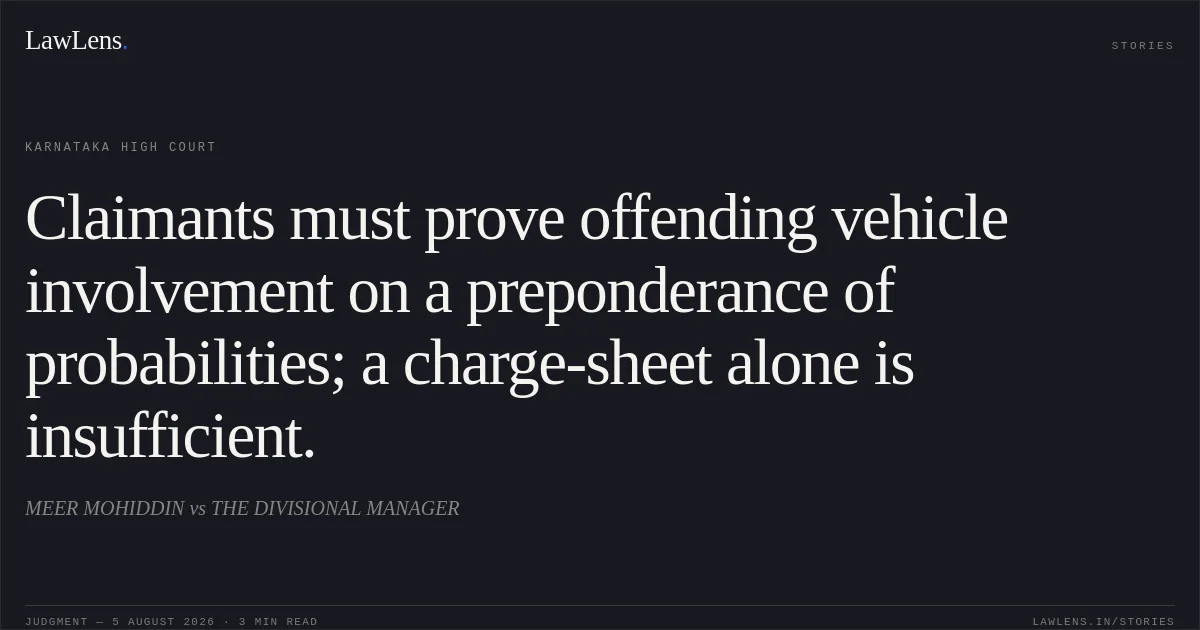
Source reference: no citationIt held that, although strict proof beyond reasonable doubt is unnecessary in motor accident claims, the claimant must establish the involvement of the offending vehicle on the touchstone of preponderance of probabilities.
Source reference: paras. 34–35, 57A police charge-sheet is only corroborative and is not conclusive proof of the vehicle’s involvement; the Tribunal must independently assess the evidence.
Source reference: paras. 38, 52Relying on Bimla Devi v. Himachal Road Transport Corporation, Dulcina Fernandes v. Joaquim Xavier Cruz and Mathew Alexander v. Mohammed Shafi, the Court reiterated that a holistic assessment is required, but negligence and vehicle involvement must nevertheless be proved.
Source reference: no citationUnder Oriental Insurance Co. Ltd. v. Premlata Shukla, a party relying on part of an admitted document cannot selectively reject the remaining contents.
Source reference: para. 39The Court also relied on United India Insurance Co. Ltd. v. Rajendra Singh to recognise the insurer’s right to pursue allegations of fraud affecting public funds.
Source reference: paras. 41–43Reasoning
The Court held that the Supreme Court’s direction for “fresh determination” required reconsideration of the entire claim and did not restrict the Tribunal to assessing compensation alone.
Source reference: paras. 44–46The contemporaneous complaint, lodged by the motorcycle’s pillion rider, attributed the accident to the motorcycle rider’s collision with an electric pole and made no reference to the tempo-trax; the spot panchanama and post-mortem history similarly referred to a self-accident.
Source reference: paras. 20–23, 36–37The tempo-trax was seized only more than a month after the accident, after which a charge-sheet was filed against its driver.
Source reference: para. 23The alleged eyewitness, P.W.2, gave materially inconsistent versions: although he supported the claim before the Tribunal, he had stated in the criminal case that he knew nothing about the accident and had not witnessed it.
Source reference: paras. 24–32His evidence regarding the vehicle being brought to the temple on the next day was also found factually impossible because the vehicle was identified and seized only later.
Source reference: paras. 24–32The Court further noted the absence of corresponding damage to the motorcycle or tempo-trax, contradictions concerning the transportation of the injured person, and the claimants’ failure to examine the pillion rider who had lodged the original complaint.
Source reference: paras. 47–48These circumstances, taken cumulatively, established that the tempo-trax had been falsely implicated and that the claimants had failed to prove its involvement, notwithstanding the filing of the charge-sheet.
Source reference: paras. 49, 55, 58–59Holding
The Court answered the first issue in the affirmative and the second in the negative; the question of enhancement did not arise.
It allowed MFA No.102865/2015, set aside the Tribunal’s judgment and award dated 10 July 2015, and held that the claimants had failed to establish the involvement of the insured tempo-trax.
Source reference: para. 62(I)The cross-objection seeking enhancement was dismissed.
Source reference: para. 62(II)Any amount deposited was directed to be refunded to the insurer, with no order as to costs; the Tribunal was directed to draw a modified award and return the records.
Source reference: para. 62(III)–(VI)Original Court PDF
MEER MOHIDDINvsTHE DIVISIONAL MANAGER
Click to open original judgment
Original judgment, available to read, download and summarize on LawLens.in