Facts
The Corporate Debtor (M/s Rana Global Limited) underwent insolvency proceedings under the IBC after failing to pay bank dues
Source reference: p. 1-2A resolution plan by Shah Publications Pvt. Ltd. was approved on 06.11.2019, vesting ownership in the new applicant
Source reference: p. 2-3Respondent No. 1 (the original writ petitioner) had previously leased the mill from the Corporate Debtor and applied for a 6000 KVA electricity connection in 2019
Source reference: p. 3The Appellant (UPCL) rejected the application on 09.06.2021, citing unpaid dues of ₹1,69,83,184.00 owed by the Corporate Debtor
Source reference: p. 3Respondent No. 1 filed a writ petition claiming entitlement to the connection based on a Memorandum of Understanding (MoU) dated 09.03.2021 with the new owner
Source reference: p. 3-4A Single Judge allowed the writ on 25.02.2026, quashing the rejection and directing the installation of the meter
Source reference: p. 4UPCL appealed, arguing that the MoU had expired on 31.03.2024, prior to the Single Judge's order
Source reference: p. 5Issues
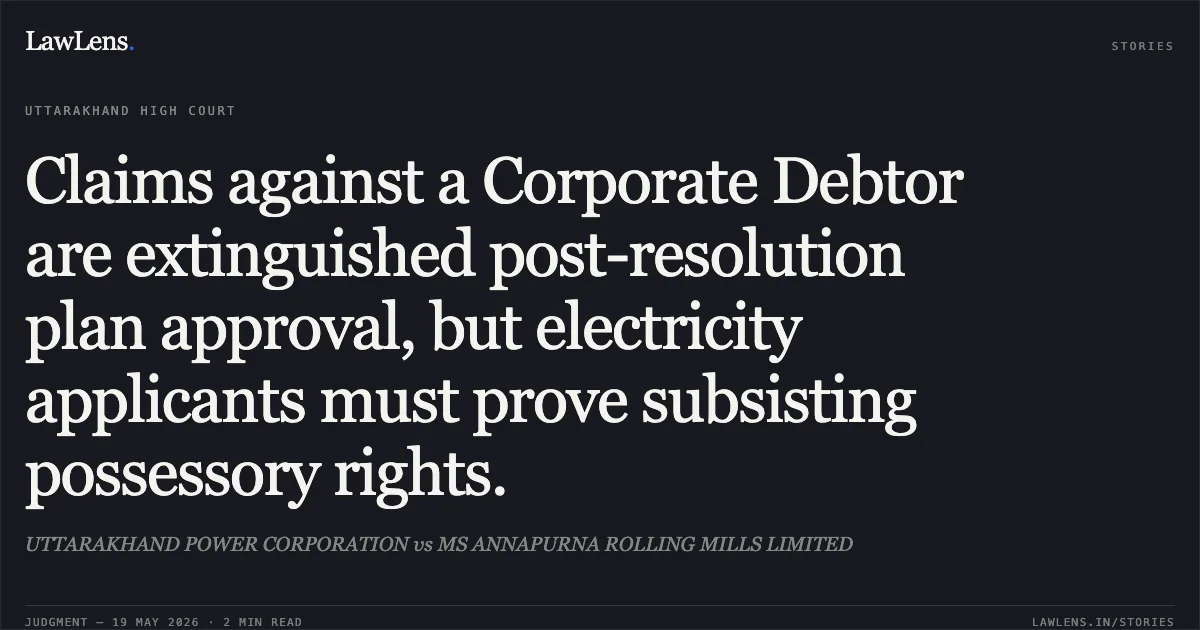
1. Whether electricity dues of a Corporate Debtor survive against a subsequent occupier/owner after the approval of a resolution plan under the IBC.
Source reference: para. 11, 152. Whether the writ petitioner possessed the locus standi and a subsisting legal right to seek an electricity connection in its own name based on an MoU that had allegedly expired.
Source reference: para. 10, 18Law Applied
The Court applied Section 9 of the Insolvency and Bankruptcy Code, 2016 (IBC), which governs the effect of approved resolution plans
Source reference: p. 2It relied on the Supreme Court precedent in Paschimanchal Vidyut Vitran Nigam Ltd. vs. Raman Ispat Pvt. Ltd. and Others (2023), establishing that claims not lodged before the Resolution Professional (RP) do not survive the approval of a resolution plan
Source reference: p. 4, 5The court applied the procedural principle that a litigant must demonstrate a subsisting legal right not only at the time of institution but also at the time of adjudication
Source reference: p. 6Reasoning
The Court affirmed the Single Judge’s finding on the first issue, noting that because UPCL failed to lodge its claim with the RP during the insolvency process, the past dues were frozen and could not be demanded from the new entity
Source reference: para. 15However, regarding the second issue, the Court found that the Single Judge erred in granting relief
Source reference: para. 18The MoU dated 09.03.2021, which established the petitioner’s status as an "occupier," had expired on 31.03.2024—nearly two years before the Single Judge’s judgment on 25.02.2026
Source reference: para. 17-18Since there was no evidence on record at that time proving the MoU had been extended, the petitioner failed to demonstrate a "subsisting legal right" to the connection in its own name
Source reference: para. 18Holding
The Division Bench upheld the principle that old dues are extinguished under the IBC but set aside the Single Judge's direction to install the electricity connection
The Court held that a petitioner must prove an enforceable right at the time of the order
Source reference: para. 18The matter was remitted to the Single Judge for the limited purpose of determining whether the Petitioner’s MoU was validly extended and whether they currently hold an enforceable right to seek the connection
Source reference: para. 19-20The petitioner was granted two weeks to file a supplementary affidavit providing proof of the extension
Source reference: para. 20Acts & Sections Cited
1 provisions across 1 statute referred to in this judgment. Each provision opens on LawLens.
Insolvency and Bankruptcy Code, 2016.1
Original Court PDF
UTTARAKHAND POWER CORPORATIONvsMS ANNAPURNA ROLLING MILLS LIMITED
Click to open original judgment
Original judgment, available to read, download and summarize on LawLens.in