Facts
The appellant, a public limited company, faced electricity disconnection and a theft FIR following a surprise inspection by the respondent Board.
Source reference: no citationAfter multiple rounds of writ litigation, the High Court referred the billing dispute to an Arbitral Tribunal.
Source reference: p. 3On 04.10.1998, the Tribunal issued an "original award" based on technical expert reports.
Source reference: no citationWhile the body of the award (pages 29–30) accepted expert B.P. Singha’s finding that the appellant used unauthorized load based on a total capacity of 6265 KVA, the concluding direction on page 32 erroneously directed billing based on lower capacities (2500 KVA and 3750 KVA).
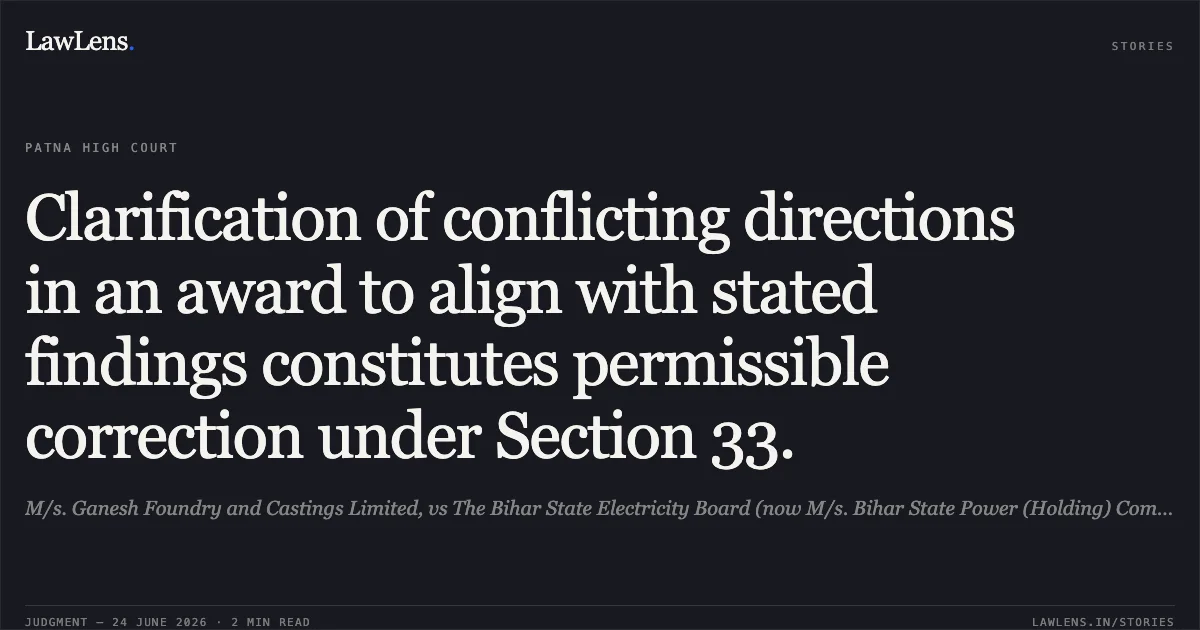
Source reference: p. 18-19, 23The respondent Board filed an application under Section 33 of the Arbitration and Conciliation Act, 1996, seeking correction of this contradiction.
Source reference: no citationThe Tribunal passed an "additional award" on 01.12.1998, modifying the billing direction to align with the 6265 KVA finding.
Source reference: p. 23The appellant challenged this under Section 34, which was dismissed by the Commercial Court (Principal District Judge, Patna) on 20.05.2025.
Source reference: p. 8-9Issues
1. Whether the application for correction filed by the respondents fell within the scope and ambit of Section 33 of the Arbitration and Conciliation Act, 1996.
Source reference: p. 152. Whether the additional award suffered from patent illegality or exceeded the jurisdiction of the Arbitral Tribunal.
Source reference: p. 10, 13Law Applied
Section 33 of the Arbitration and Conciliation Act, 1996, which permits the correction of computation, clerical, typographical, or "other errors of a similar nature" within 30 days of the award.
Source reference: p. 20-21Section 34 regarding the limited grounds for setting aside an award, specifically focusing on "patent illegality" as discussed in Gayatri Balasamy v. ISG Novasoft Technologies Limited.
Source reference: p. 10Clause 16.9 of the Electricity Tariff, which provides the formula for assessing compensation in cases of unauthorized extraction of energy.
Source reference: p. 16-17Reasoning
The Court observed that the body of the original award contained clear findings of fact, expressly agreeing with the expert report that established a total transformer capacity of 6265 KVA.
Source reference: p. 18-19The Court reasoned that the concluding direction on page 32, which mentioned different KVA figures, was a manifest clerical or "similar nature" error because it directly contradicted the reasoned findings earlier in the same document.
Source reference: p. 22-23The Court rejected the appellant's argument that this constituted a substantive review; instead, it held that Section 33 must be given a "purposive interpretation" to allow Tribunals to align contradictory directions with their own established findings.
Source reference: p. 22Since the error was "apparent on the face of it," the Tribunal was within its jurisdiction to issue the additional award to ensure the final bill reflected the accepted technical evidence.
Source reference: p. 23Holding
The Court answered the issues in the affirmative for the respondents, holding that the correction was validly made under Section 33 to rectify a contradictory direction.
The High Court upheld the Commercial Court's decision, finding no merit in the appeal and no patent illegality in the additional award. The appeal was dismissed, affirming the Board's authority to prepare fresh bills based on the corrected capacity of 6265 KVA.
Source reference: p. 23-24Acts & Sections Cited
5 provisions across 2 statutes referred to in this judgment. Each provision opens on LawLens.
Arbitration and Conciliation Act, 19964
Commercial Courts Act, 20151
Original Court PDF
M/s. Ganesh Foundry and Castings Limited,vsThe Bihar State Electricity Board (now M/s. Bihar State Power (Holding) Company Limited),
Click to open original judgment
Original judgment, available to read, download and summarize on LawLens.in