Facts
The State of Himachal Pradesh notified the Industrial Policy of 2019 and corresponding 2019 Rules to attract investment
Source reference: p.3Clause 16(a) offered a 15% discount on energy charges for "eligible enterprises," while Clause 16(b) offered a 15% rebate on "additional power consumption" for existing consumers
Source reference: p.4The respondent, an existing unit since 2006, undertook "substantial expansion" in 2020, increasing plant and machinery by 88.69%
Source reference: p.12, 22The Respondent received a Commencement of Commercial Production (COP) Certificate on 12.02.2021
Source reference: p.12The Respondent argued that as an "eligible enterprise," it was entitled to the 15% discount under Clause 16(a) in addition to the rebate under 16(b)
Source reference: p.18During the litigation, the State amended Clause 16(a) on 29.04.2022, replacing "eligible enterprises" with "new enterprises" to clarify that the 15% discount was not for expanding existing units
Source reference: p.14The High Court ruled in favor of the Respondent, setting aside restrictive clauses
Source reference: p.2Issues
1. Whether the incentive of concessional electricity charges under Clause 16(a) of the 2019 Policy was intended for existing enterprises undergoing substantial expansion, and the effect of the 29.04.2022 amendment?
Source reference: p.19 / para. 34(I)2. Whether the doctrine of promissory estoppel applies in favor of the respondent company to preclude the State from denying the benefit?
Source reference: p.19 / para. 34(II)Law Applied
The Court applied the principles governing fiscal concessions, noting that the State has the power to grant, modify, or withdraw fiscal benefits in the public interest
Source reference: p.30It relied on Shree Sidhbali Steels Ltd. v. State of U.P. and State of Rajasthan v. J.K. Udaipur Udyog Ltd., which establish that a concession recipient has no vested right beyond the currency of the grant and such rights are defeasible
Source reference: p.30, 31Regarding promissory estoppel, the Court synthesized principles from Motilal Padampat Sugar Mills and IFGL Refractories Ltd. v. Orissa State Financial Corp., holding that while the State is bound by clear, unequivocal promises that induce a party to alter its position, the doctrine cannot be invoked to compel the State to grant a benefit never intended by the policy or to provide double benefits
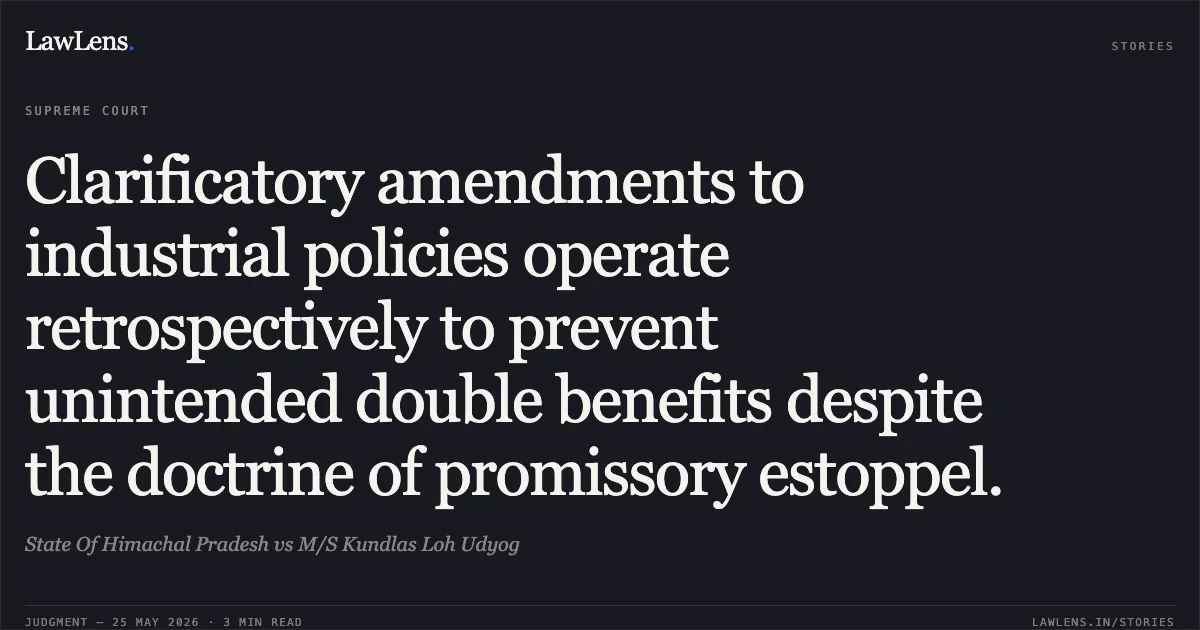
Source reference: p.33-34, 37, 40Furthermore, clarificatory amendments intended to correct drafting errors are generally retrospective
Source reference: p.25, 29Reasoning
The Court determined that the use of "eligible enterprises" in Clause 16(a) was a drafting error, as the scheme of the Policy and contemporaneous tariff orders clearly bifurcated incentives: Clause 16(a) for "new" units (base rate reduction) and Clause 16(b) for "existing" units (incremental rebate)
Source reference: p.24-25If the Respondent's view were accepted, expanding units would receive an unintended "double benefit," which would be fiscally irrational
Source reference: p.26, 37The Court held the 2022 amendment was "clarificatory" because it merely corrected the term "eligible" to "new" to reflect the original intent; thus, it operated retrospectively
Source reference: p.29, 39Regarding promissory estoppel, the Court found no "unequivocal promise" was made to the Respondent for the 16(a) benefit. The COP Certificate merely recognized the unit as "expanded," not as entitled to a specific tariff
Source reference: p.39, 36Since the Respondent already received the 16(b) rebate, no "manifest injustice" or "inequity" existed to trigger estoppel
Source reference: p.37, 40Holding
The Supreme Court allowed the appeal and set aside the High Court's judgment
(i) Clause 16(a) was always intended exclusively for new enterprises; (ii) the 2022 amendment was clarificatory and retrospective; (iii) the Respondent, as an existing unit, was only entitled to the Clause 16(b) rebate, which it had already received; and (iv) promissory estoppel does not apply as there was no promise of a double benefit and the Respondent's position was not prejudiced regarding the benefits actually intended for its category
Source reference: para. 64(i)-(iv)Acts & Sections Cited
6 provisions across 2 statutes referred to in this judgment. Linked provisions open on LawLens.
Electricity (Supply) Act, 19481
Himachal Pradesh Industrial Policy, 20195
Original Court PDF
State Of Himachal PradeshvsM/S Kundlas Loh Udyog
Click to open original judgment
Original judgment, available to read, download and summarize on LawLens.in


