Facts
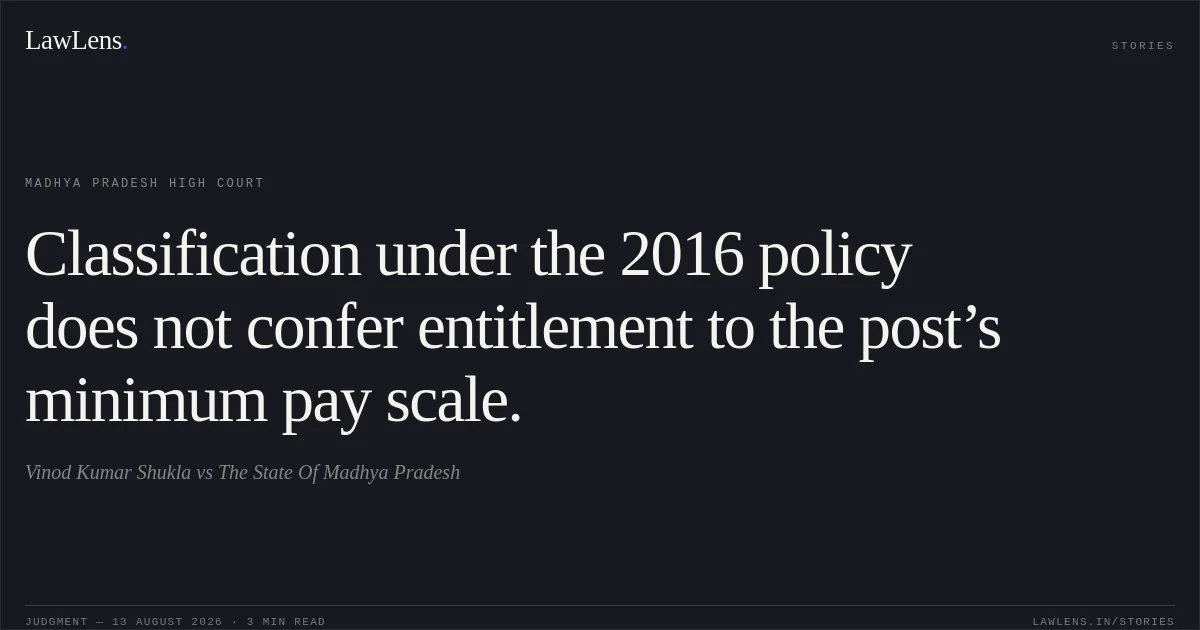
The petitioner sought payment of the minimum of the pay scale of ₹5,200–20,200 with grade pay of ₹1,900 from the date of his classification, stated to be 20 June 2011, together with arrears and consequential benefits, relying on Ram Naresh Rawat v. Ashwini Devi, (2017) 3 SCC 436.
Source reference: para. 1The State submitted that the petitioner had already received benefits under the State Government’s policy dated 7 October 2016, which classified eligible daily-wage employees into skilled, semi-skilled and unskilled categories and prescribed corresponding pay scales.
Source reference: para. 2In Chetan Lal Gupta, the Court held that employees classified under the 7 October 2016 policy could claim the pay scale applicable to their category, but not the minimum of the regular post-specific pay scale; however, their claim for arrears for the period from classification until extension of the policy benefits could be considered in light of Ram Naresh Rawat.
Source reference: paras. 2–3Issues
1. Whether the petitioner, after receiving benefits under the policy dated 7 October 2016, was entitled to the minimum of the regular pay scale of ₹5,200–20,200 with grade pay of ₹1,900 from the date of classification, i.e., 20 June 2011, under Ram Naresh Rawat.
Source reference: paras. 1–32. Whether the petitioner could claim arrears for the period commencing from classification until the date on which the benefits of the policy dated 7 October 2016 were extended to him.
Source reference: para. 23. Whether the petitioner’s entitlement depended upon verification of the relevant classification order and whether that order continued to remain operative.
Source reference: para. 4Law Applied
The Court applied the State Government policy dated 7 October 2016, under which eligible daily-wage employees were classified as skilled, semi-skilled or unskilled and granted the corresponding category-based pay scales.
Source reference: paras. 2–3It relied on Ram Naresh Rawat v. Ashwini Devi, (2017) 3 SCC 436, for the principle that a classified permanent employee may be entitled to the minimum of the applicable pay scale and consequential arrears in appropriate circumstances.
Source reference: paras. 1–2However, following Chetan Lal Gupta v. State of Madhya Pradesh, the Court held that categorisation under the 7 October 2016 policy entitled an employee only to the pay scale prescribed for the relevant category, and not automatically to the minimum of the pay scale attached to the regular post on which the employee performed duties.
Source reference: paras. 2–3The quoted decision also referred to Secretary, State of Karnataka v. Uma Devi, (2006) 4 SCC 1, concerning the State’s scheme for employees who had not been regularised.
Source reference: para. 3Reasoning
The Court treated the petitioner’s claim for the minimum of the regular post-specific pay scale as governed by Chetan Lal Gupta.
Source reference: paras. 2–3Since the petitioner had opted for and received the benefit of the 7 October 2016 policy, he could not simultaneously claim the minimum of the regular pay scale under Ram Naresh Rawat merely on the basis of his classification.
Source reference: paras. 2–3Nevertheless, the Court recognised that a distinct claim for arrears for the period between the petitioner’s classification and the actual extension of the 2016 policy benefits could remain available, subject to verification of the petitioner’s classification order and its continuing validity.
Source reference: paras. 2, 4Rather than adjudicating the quantum or entitlement finally, the Court directed the competent authority to examine the claim and pass a reasoned order.
Source reference: no citationHolding
The petition was disposed of without granting the claimed minimum regular pay scale outright.
The petitioner was directed to submit an individual, comprehensive representation to Respondent No. 3 concerning arrears payable to classified employees within 10 days.
Source reference: paras. 4–5Respondent No. 3 was directed to consider the representation, verify whether the relevant classification order related to the petitioner and remained operative, pass a self-contained speaking order in accordance with law, and communicate the decision within 60 days of receiving the representation.
Source reference: paras. 4–5If found entitled, the petitioner was to be granted the permissible benefits within that period.
Source reference: paras. 4–5No order was made as to costs.
Source reference: para. 6Original Court PDF
Vinod Kumar ShuklavsThe State Of Madhya Pradesh
Click to open original judgment
Original judgment, available to read, download and summarize on LawLens.in