Facts
The petitioner, initially appointed as a daily wager, was classified as a "permanent employee" by the respondent department effective 27.11.2004
Source reference: p. 2Despite a previous High Court order (WP No. 595/2010) directing the respondents to pay him the regular pay scale of a Pump Driver from the date of classification, the respondents issued impugned orders dated 11.3.2016 and 23.6.2017 denying full benefits and increments
Source reference: p. 2The petitioner approached the High Court seeking the quashing of these orders and the grant of arrears, increments, and a regular pay scale (Grade Pay 1900)
Source reference: p. 1Issues
1. Whether a daily wager classified as a "permanent employee" is entitled to the full regular pay scale, including annual increments and other benefits, prior to formal regularization.
Source reference: p. 4 / para. 52. Whether the denial of increments to a classified permanent employee is legally sustainable in light of the Supreme Court's precedent in Ram Naresh Rawat.
Source reference: p. 6 / para. 6Law Applied
The Court primarily applied the legal principles established by the Supreme Court of India in Ram Naresh Rawat v. Ashwini Ray (2017) 3 SCC 436
Source reference: p. 2-3This precedent clarifies the distinction between "classification" as a permanent employee under Standing Orders and "regularization" in service. It establishes that while classified employees are entitled to the minimum of the graded pay scale, they are not entitled to increments or other benefits of regular service until their services are formally regularized
Source reference: p. 4, 6The court also applied Article 14 of the Constitution, noting that the right to equality is not a negative concept; thus, even if benefits were wrongly granted to others, it does not create a right for the petitioner to claim the same illegality
Source reference: p. 6-7Reasoning
The Court examined the petitioner’s claim against the backdrop of the Ram Naresh Rawat judgment. It noted that the petitioner relied on his classification as a permanent employee to demand a revised salary and increments
Source reference: p. 2The court reasoned that "permanent" status under the Standing Orders is a distinct legal category from "regularization." Applying the Supreme Court's ratio, the High Court observed that a classified employee only gains the right to the minimum of the pay scale to prevent exploitation, but the entitlement to annual increments is a benefit reserved for those who have undergone a formal regular recruitment/regularization process
Source reference: p. 6Since the petitioner failed to demonstrate that his services were formally regularized according to the rules and seniority list, he could not legally claim benefits beyond the minimum of the pay scale
Source reference: p. 7The court further rejected the argument of parity with others who might have received such benefits, stating that an error in administration cannot be the basis for a judicial mandate under Article 226
Source reference: p. 7Holding
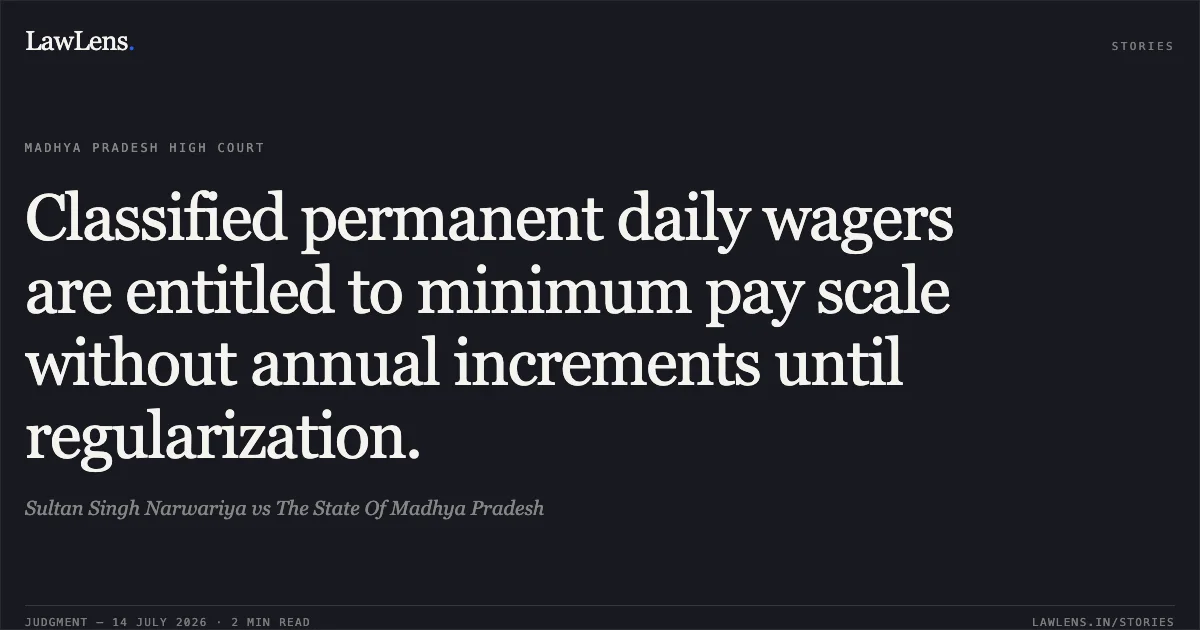
The Court answered the issues in the negative, holding that the petitioner is only entitled to the minimum of the pay scale without increments until regularization
The court found no illegality in the impugned orders dated 11.3.2016 and 23.6.2017. Consequently, the Writ Petition was dismissed, and all pending interlocutory applications were disposed of. No costs were awarded
Source reference: p. 7Original Court PDF
Sultan Singh NarwariyavsThe State Of Madhya Pradesh
Click to open original judgment
Original judgment, available to read, download and summarize on LawLens.in