Facts
The petitioner challenged the notice dated 19.06.2026 issued under Section 148 of the Income Tax Act, 1961 and the corresponding order under Section 148A(3), seeking to reopen its assessment for A.Y. 2022–23.
Source reference: paras. 2–3, pp. 1–3The reopening originated from a search conducted in the case of CFM Asset Reconstruction Private Limited (“CFM ARC”), which had acquired the petitioner’s non-performing assets at a discounted value. The Assessing Officer alleged that the petitioner might have claimed deduction of unpaid interest of ₹13.52 crore and that the subsequent cessation or waiver of the liability could attract Section 41(1) and Explanation 1(b) to Section 115JB(2).
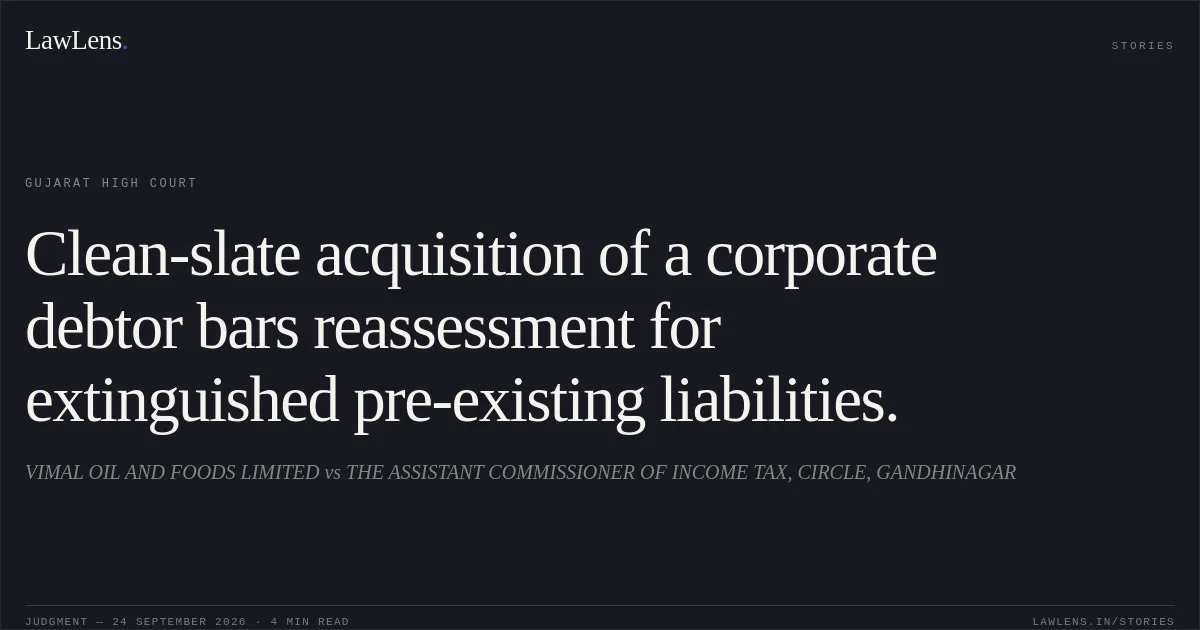
Source reference: para. 3, p. 2The petitioner had undergone CIRP, followed by liquidation, and was sold as a going concern to Arrhum Tradelink Private Limited under an agreement dated 03.03.2021. It contended that the acquisition was on a “clean slate” basis and that all past liabilities and investigations stood extinguished.
Source reference: para. 3.1, pp. 2–3It also asserted that it had never claimed deduction of the disputed interest, had not recognised such interest in its profit and loss account since F.Y. 2015–16, and had obtained a No Due Certificate.
Source reference: paras. 4.1, 10, pp. 4, 8–9Despite the petitioner’s reply, the Assessing Officer concluded that income of approximately ₹13.52 crore had escaped assessment and issued the Section 148 notice. The order additionally stated that the petitioner had made “bogus purchase[s]”, although that ground had not appeared in the Section 148A(1) show-cause notice.
Source reference: paras. 3.2, 4.3, 11–12, pp. 3, 5, 9–10Issues
Whether the reassessment proceedings under Sections 148 and 148A of the Income Tax Act could be sustained when they were based on the assumption that the petitioner might have claimed deduction of interest, despite the petitioner’s assertion that no such deduction had been claimed and that the alleged liability had not ceased.
Source reference: paras. 8–11, pp. 7–9Whether the acquisition of the petitioner as a going concern during liquidation proceedings on a “clean slate” basis precluded the Revenue from pursuing past liabilities or reopening the petitioner’s assessment on that basis.
Source reference: paras. 7–10, pp. 7–9Whether the Section 148A(3) order was invalid for introducing the unrelated ground of “bogus purchase[s]” without including it in the show-cause notice or affording the petitioner an opportunity of hearing.
Source reference: paras. 4.3, 11–12, pp. 5, 9–10Whether the reassessment could be initiated when the impugned order itself recorded that the petitioner’s liability had not ceased.
Source reference: para. 11, p. 9Law Applied
The Court exercised jurisdiction under Article 226 of the Constitution to review the legality of the reassessment notice and Section 148A order.
Source reference: para. 2, p. 1Section 41(1) of the Income Tax Act applies where a deduction or allowance has previously been granted in respect of a trading liability and that liability is subsequently remitted or ceases; therefore, a mere assumption of deduction and cessation is insufficient. Explanation 1(b) to Section 115JB(2) was relevant only if the alleged waiver or remission was legally and factually established.
Source reference: paras. 3, 11, pp. 2, 9The Court applied Regulation 32(e) of the Insolvency and Bankruptcy Board of India (Liquidation Process) Regulations, 2016 and the “clean slate” principle applicable to a purchaser acquiring a corporate debtor as a going concern.
Source reference: para. 7, p. 7Relying on Ghanshyam Mishra & Sons (P.) Ltd. v. Edelweiss Asset Reconstruction Co. Ltd. , (2021) 126 taxmann.com 132 (SC), KRBL Ltd. v. State of Gujarat , (2023) 154 taxmann.com 489 (Gujarat), and its earlier judgment in the petitioner’s own case dated 30.06.2026, the Court held that past liabilities could not be foisted upon the going-concern purchaser.
Source reference: para. 9, p. 8Further, an order under Section 148A(3) must remain confined to the grounds stated in the Section 148A(1) notice, and a new ground cannot be introduced without a meaningful opportunity of hearing.
Source reference: para. 12, pp. 9–10Reasoning
The Court found that the alleged escapement of income rested on conjecture because the Assessing Officer merely stated that the petitioner “might have claimed” deduction of interest, while the petitioner maintained that no deduction had been claimed and that the interest had not been recorded in its accounts since F.Y. 2015–16.
Source reference: para. 10, p. 8The petitioner’s acquisition as a going concern during liquidation, coupled with the applicable clean-slate principle and the earlier decision concerning the same alleged interest liability, further undermined the Revenue’s case.
Source reference: paras. 7–10, pp. 7–9The impugned order was also internally contradictory: it relied on cessation of liability while expressly recording that the liability had not ceased, thereby destroying the basis for invoking Section 41(1) and Explanation 1(b) to Section 115JB(2).
Source reference: para. 11, p. 9Finally, the introduction of the “bogus purchase” allegation, absent from the show-cause notice, violated natural justice and demonstrated non-application of mind.
Source reference: para. 12, pp. 9–10Holding
The Court answered the issues in favour of the petitioner. It held that the reassessment was founded on surmises and conjectures, contradicted the Assessing Officer’s own finding regarding cessation of liability, disregarded the clean-slate principle, and travelled beyond the show-cause notice.
The notice dated 19.06.2026 issued under Section 148 and the order dated 19.06.2026 passed under Section 148A(3) for A.Y. 2022–23 were quashed and set aside. The writ petition was allowed, the Rule was made absolute, and there was no order as to costs.
Source reference: para. 14, p. 11Acts & Sections Cited
1 provisions across 1 statute referred to in this judgment. Each provision opens on LawLens.
Insolvency and Bankruptcy Code, 2016.1
Original Court PDF
VIMAL OIL AND FOODS LIMITEDvsTHE ASSISTANT COMMISSIONER OF INCOME TAX, CIRCLE, GANDHINAGAR
Click to open original judgment
Original judgment, available to read, download and summarize on LawLens.in