Facts
The plaintiff and defendants jointly obtained 23 villas/row houses under a Joint Development Agreement dated 23 August 2010.
Source reference: pp. 4–7The plaintiff’s share was three villas, while defendants 1–5 received eight and defendants 6–9 received twelve.
Source reference: pp. 4–7The defendants admitted the respective allotments in their written statements.
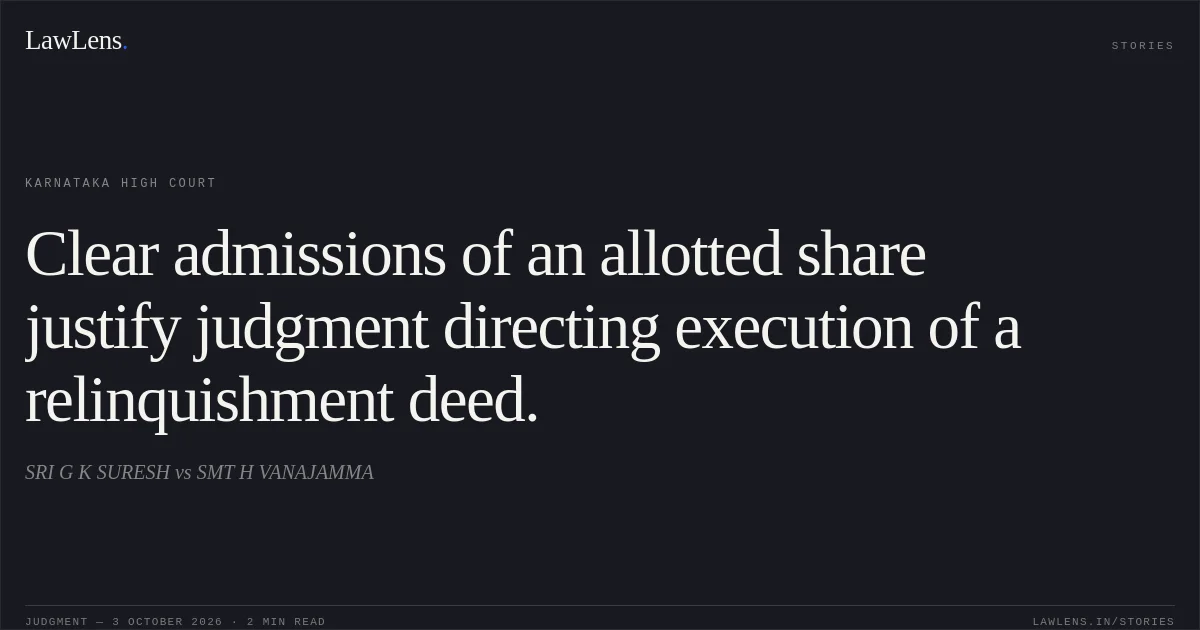
Source reference: pp. 4–7The plaintiff sued for a mandatory injunction directing the defendants to execute a relinquishment deed concerning the three villas in the suit “B” schedule.
Source reference: pp. 4–7The trial court dismissed the suit, and the plaintiff appealed.
Source reference: pp. 4–7The High Court noted that the defendants had also stated they were willing to execute documents in the plaintiff’s favour.
Source reference: pp. 9–10Issues
Whether the defendants’ admissions concerning the plaintiff’s share in the three villas entitled the plaintiff to judgment under Order XII Rule 6 CPC.
Source reference: pp. 8–10Whether the trial court’s dismissal of the suit, despite those admissions, should be set aside.
Source reference: pp. 6–7, 10Law Applied
Order XII Rule 6 of the Code of Civil Procedure, 1908 permits a court, at any stage of a suit, to pronounce judgment on admissions made in pleadings or otherwise.
Source reference: pp. 8–9Section 58 of the Indian Evidence Act, 1872 provides that facts admitted by the parties or deemed admitted under applicable pleading rules need not be proved, although the court may require proof notwithstanding the admission.
Source reference: pp. 8–9Reasoning
The High Court treated the defendants’ written statements as admissions that the plaintiff had received three villas and that the defendants were willing to execute the necessary documents.
Source reference: pp. 6–10It held that the trial court’s conclusion that no relevant partition or arrangement had been established was contrary to the pleadings and record, which reflected the parties’ respective allocations of the 23 villas.
Source reference: pp. 6–10Applying Order XII Rule 6 CPC read with Section 58 of the Evidence Act, the Court concluded that the admissions supported granting the relief sought.
Source reference: pp. 6–10Holding
The High Court allowed the appeal, set aside the trial court’s judgment and decree, and decreed the suit by granting a mandatory injunction directing the defendants to execute a relinquishment deed in favour of the plaintiff in respect of the suit “B” schedule property.
No order as to costs was made.
Source reference: pp. 10–11Acts & Sections Cited
1 provisions across 1 statute referred to in this judgment. Each provision opens on LawLens.
Code of Civil Procedure, 19081
Original Court PDF
SRI G K SURESHvsSMT H VANAJAMMA
Click to open original judgment
Original judgment, available to read, download and summarize on LawLens.in