Facts
The respondent-wife, along with her son, instituted proceedings under Section 125 Cr.P.C. seeking maintenance. The Family Court allowed the application ex parte on 6 September 2022 and directed the petitioner-husband to pay ₹5,000 per month to the wife and ₹3,000 per month to the son.
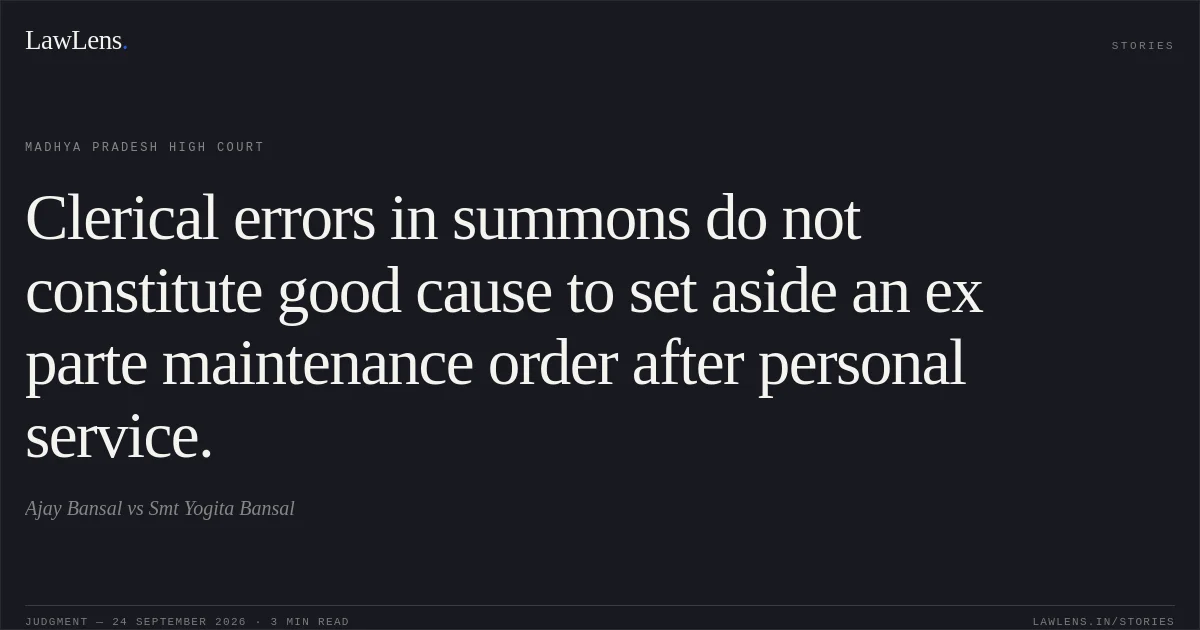
Source reference: para. 1–2; pp. 1–2The petitioner thereafter applied under Section 126(2) Cr.P.C. for setting aside the ex parte maintenance order, contending that he had not been served with the summons and that the summons incorrectly mentioned his father’s name. The Family Court rejected that application, leading to the present revision under Sections 397 and 401 Cr.P.C., read with Section 19(4) of the Family Courts Act.
Source reference: para. 1–2; pp. 1–2The respondent maintained that the summons had been personally served and that the petitioner had wilfully failed to appear.
Source reference: para. 4; p. 2Issues
Whether an ex parte maintenance order under Section 125 Cr.P.C. is invalid merely because the evidence was recorded in the absence of the person against whom maintenance was claimed?
Source reference: para. 7–8; pp. 3–4Whether the petitioner established “good cause” under the proviso to Section 126(2) Cr.P.C. for setting aside the ex parte maintenance order?
Source reference: para. 9–15; pp. 4–7Whether the Family Court’s refusal to set aside the ex parte order warranted interference in revisional jurisdiction?
Source reference: para. 15–17; pp. 7–8Law Applied
Section 126(2) Cr.P.C. requires evidence in maintenance proceedings to be recorded in the presence of the person against whom maintenance is sought, but its proviso creates an exception permitting an ex parte determination where that person wilfully avoids service or wilfully neglects to attend the Court; such an order may be set aside upon “good cause” being shown.
Source reference: para. 6–8; pp. 3–4The Court exercised revisional jurisdiction under Sections 397 and 401 Cr.P.C., read with Section 19(4) of the Family Courts Act. Relying on Basawaraj v. Special Land Acquisition Officer, (2013) 14 SCC 81, and the principles discussed therein, the Court held that “good cause” requires an honest, bona fide and sufficiently diligent explanation, without negligence, inaction or deliberate delay; the expression is to be applied liberally only where lack of bona fides cannot be attributed to the applicant.
Source reference: para. 1, 6–8, 13; pp. 1–7Reasoning
The Court rejected the petitioner’s argument that the evidence recorded in his absence automatically invalidated the maintenance order, holding that the proviso to Section 126(2) expressly permits an ex parte decision where the respondent wilfully avoids service or attendance.
Source reference: para. 7–8; pp. 3–4Although the petitioner’s father’s name was incorrectly recorded in the summons, the service report showed personal service by the police constable, and the summons bore the petitioner’s signature, which the Family Court found corresponded with his signature on the Section 126(2) application.
Source reference: para. 11–12; pp. 4–5The petitioner neither denied the signature nor specifically challenged the service report, did not explain how he subsequently learned of the ex parte order, and did not assert that the address in the summons was incorrect.
Source reference: para. 14; p. 6The error in the father’s name was therefore treated as a clerical mistake that did not invalidate personal service. Since the petitioner failed to demonstrate an honest, bona fide and non-negligent reason for his absence, no “good cause” was established.
Source reference: para. 13–15; pp. 5–7Holding
The Court held that the petitioner was duly served, wilfully failed to appear, and did not establish good cause for setting aside the ex parte maintenance order.
The proviso to Section 126(2) Cr.P.C. validly authorised the Family Court to proceed ex parte, and the petitioner’s challenge based solely on the incorrect mention of his father’s name was insufficient. Finding no jurisdictional or legal error warranting revisional interference, the High Court dismissed Criminal Revision No. 1327 of 2025 as devoid of merit and affirmed the Family Court’s order rejecting the Section 126(2) application.
Source reference: para. 15–17; pp. 7–8Acts & Sections Cited
5 provisions across 2 statutes referred to in this judgment. Each provision opens on LawLens.
Code of Criminal Procedure, 19734
Family Courts Act, 19841
Original Court PDF
Ajay BansalvsSmt Yogita Bansal
Click to open original judgment
Original judgment, available to read, download and summarize on LawLens.in