Facts
The appellants (legal heirs of Indravadan Shah) challenged an order dated 09.05.2012 passed by the 2nd Additional Senior Civil Judge, Valsad, which rejected their plaint under Order VII Rule 11(d) of the CPC
Source reference: p.1The dispute concerned "Property-A" (Survey Nos. 1048 & 1049), which was jointly allotted via a family partition deed dated 23.07.1986, with Mutation Entry No. 9326 recorded in 1989-90
Source reference: p.2-3In 2010, the defendants sold the property via a registered sale deed. The plaintiffs filed a suit in 2010 seeking declaration that the sale deed was void and claiming joint ownership/possession
Source reference: p.3The defendants filed an application (Exh-31) for rejection of the plaint, arguing it was barred by limitation and res judicata due to a previous 2001 rent recovery suit that was compromised and withdrawn in 2005
Source reference: p.3-4Issues
1. Whether the plaint was liable to be rejected under Order VII Rule 11(d) of the CPC on the grounds of being barred by the law of limitation.
Source reference: p.12-132. Whether the suit was barred by the principle of res judicata or Section 135-J of the Bombay Land Revenue Code.
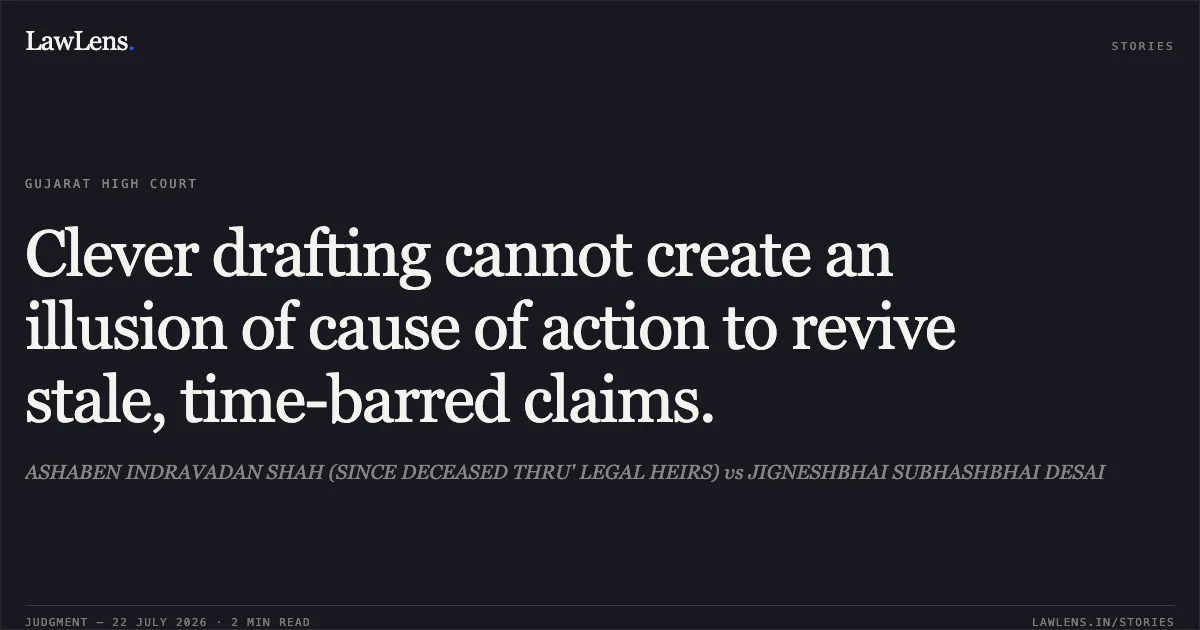
Source reference: p.13-143. Whether "clever drafting" was used to create an illusion of a fresh cause of action to revive a stale claim.
Source reference: p.14Law Applied
The court primarily applied Order VII Rule 11 of the CPC regarding the rejection of a plaint that fails to disclose a cause of action or is barred by law
Source reference: p.14-15It relied heavily on the precedent of Dahiben v. Arvindbhai Kalyanji Bhanusali, which established that the court must scrutinize the substance of the plaint and documents to terminate "sham litigation" at the threshold
Source reference: p.15-18The court also considered Article 58/59 of the Limitation Act, 1963 (implied), and the principle that mutation entries have presumptive fiscal value under the Bombay Land Revenue Code but do not create title
Source reference: p.5Reasoning
The Court observed that while the plaintiffs ostensibly challenged the 2010 sale deed, their underlying claim of joint ownership was rooted in the 1986 partition and 1989 mutation entries
Source reference: p.12-13The Court found that the plaintiffs had knowledge of these arrangements for over two decades, especially since they had filed a prior suit in 2001 regarding the same property's rent, which they later withdrew without liberty to challenge title
Source reference: p.13, 20The Court reasoned that "clever drafting" to manufacturing a fresh cause of action (alleged obstruction of way in 2010) cannot circumvent the law of limitation for a claim that became stale decades ago
Source reference: p.14, 20It held that at the Order VII Rule 11 stage, the court should look at the substance of the plaint; if the suit is "manifestly vexatious" and "bound to prove abortive," it must be dismissed to save judicial time
Source reference: p.18, 21Holding
The Court held that the suit was barred by the law of limitation as the real grievance stemmed from a 1986 partition which remained unchallenged for 24 years
The High Court dismissed the First Appeal and upheld the rejection of the plaint
Source reference: p.21Acts & Sections Cited
2 provisions across 1 statute referred to in this judgment. Each provision opens on LawLens.
Code of Civil Procedure, 19082
Original Court PDF
ASHABEN INDRAVADAN SHAH (SINCE DECEASED THRU' LEGAL HEIRS)vsJIGNESHBHAI SUBHASHBHAI DESAI
Click to open original judgment
Original judgment, available to read, download and summarize on LawLens.in


