Facts
The husband had filed CP No. 61 of 2022 under Section 13(1) of the Hindu Marriage Act, 1955 (HMA), seeking divorce.
Source reference: pp. 1–4, paras. 1–9Evidence had been led by both parties, but the proceeding remained pending.
Source reference: pp. 1–4, paras. 1–9The wife later filed CP No. 128 of 2025 under Section 9 HMA for restitution of conjugal rights.
Source reference: pp. 1–4, paras. 1–9Her application, filed in CP No. 61 of 2022 on 13 October 2025, seeking analogous hearing of both proceedings remained undecided.
Source reference: pp. 1–4, paras. 1–9The husband sought a direction for expeditious disposal of CP No. 61 of 2022.
Source reference: pp. 1–4, paras. 1–9The High Court considered the writ petition at admission without notice to the wife.
Source reference: pp. 1–4, paras. 1–9Issues
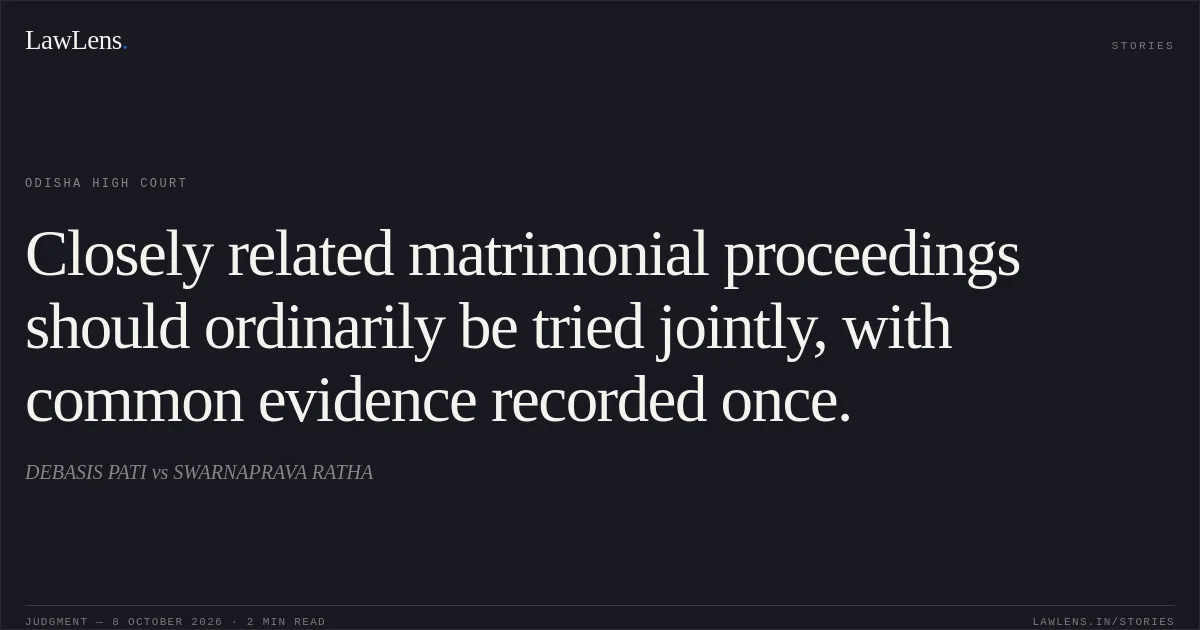
Whether the Family Court should hear CP No. 61 of 2022 and CP No. 128 of 2025 together, given their connection and the risk of duplicated proceedings or conflicting decisions
Source reference: pp. 4–7, paras. 8, 10–13Whether evidence already recorded in CP No. 61 of 2022 could be used in the later proceeding, subject to procedural safeguards
Source reference: pp. 6–8, paras. 12–14Whether directions should be issued to expedite the proceedings
Source reference: pp. 1–2, para. 2; p. 8, para. 15Law Applied
Sections 9 and 13(1) HMA provide for petitions for restitution of conjugal rights and divorce, respectively.
Source reference: pp. 5–6, paras. 11–13Section 21A HMA does not exclude the broader procedural power to transfer or consolidate closely connected matrimonial proceedings where justice so requires.
Source reference: pp. 5–6, paras. 11–13In Guda Vijayalakshmi v. Guda Ramchandra Sekhara Sastry, (1981) 2 SCC 646, the Supreme Court recognised that closely connected matrimonial proceedings may appropriately be heard together to avoid conflicting decisions.
Source reference: pp. 5–6, paras. 11–13The Court also referred to N.C.V. Aishwarya v. A.S. Saravana Karthik Sha, 2022 SCC OnLine SC 1199, in connection with avoiding multiplicity of trials on the same issues.
Source reference: p. 4, para. 8In a common or controlled trial, evidence already recorded may be adopted or read in the other proceeding to the extent legally permissible and relevant; parties retain the right to cross-examine on genuinely new matters.
Source reference: pp. 7–8, paras. 13–14Reasoning
The proceedings involved closely connected matrimonial disputes, and a separate trial risked duplicating evidence, prolonging adjudication, and producing conflicting findings.
Source reference: pp. 6–8, paras. 12–14Although CP No. 61 of 2022 was substantially advanced, the Court held that this did not require CP No. 128 of 2025 to be tried entirely separately.
Source reference: pp. 6–8, paras. 12–14It therefore directed a common or controlled trial, preserving evidence already recorded and permitting its use in the later proceeding where legally permissible, while allowing additional evidence and cross-examination on genuinely new matters.
Source reference: pp. 6–8, paras. 12–14To advance both proceedings, the Court also directed that CP No. 61 of 2022 be listed on 9 October 2026 if it was otherwise posted for a later date.
Source reference: p. 5, para. 10Holding
The writ petition was disposed of.
The Family Court was directed to consider the wife’s pending application for analogous hearing, settle issues in CP No. 128 of 2025, and proceed with both petitions through a common or controlled trial, using existing evidence subject to the stated safeguards.
Source reference: pp. 5–8, paras. 10, 13–14The Court expressed the expectation that both proceedings be concluded at the earliest, preferably by the end of January 2027, and directed the parties to avoid unnecessary adjournments and cooperate.
Source reference: p. 8, paras. 15–17Acts & Sections Cited
3 provisions across 1 statute referred to in this judgment. Each provision opens on LawLens.
Hindu Marriage Act, 19553
Original Court PDF
DEBASIS PATIvsSWARNAPRAVA RATHA
Click to open original judgment
Original judgment, available to read, download and summarize on LawLens.in