01Facts
The Enforcement Directorate (ED) registered an ECIR against M/s NKG Infrastructure Ltd. (the "Applicant") and others for money laundering related to a Delhi Jal Board tender obtained via a false performance certificate.
¶ 2–3Tajinder Pal Singh (the "Petitioner") moved an application under Sections 306 and 307 of the CrPC to become an approver.
¶ 4The Applicant sought impleadment in those pardon proceedings, but the Special Judge rejected the impleadment on 30.07.2024 and subsequently denied Singh’s pardon on 22.08.2024.
¶ 4Singh challenged the denial via a Revision Petition. On 03.12.2024, the High Court set aside the Special Judge’s order and granted Singh approver status.
¶ 5The Applicant then filed the present application (CRL.M.A. 17144/2025) seeking to recall the 03.12.2024 order, arguing they were a necessary party and were not heard.
¶ 6–702Issues
i.1. Whether the High Court has the power under Section 482 of the CrPC to revisit and recall a final order in light of the bar contained in Section 362 of the CrPC.
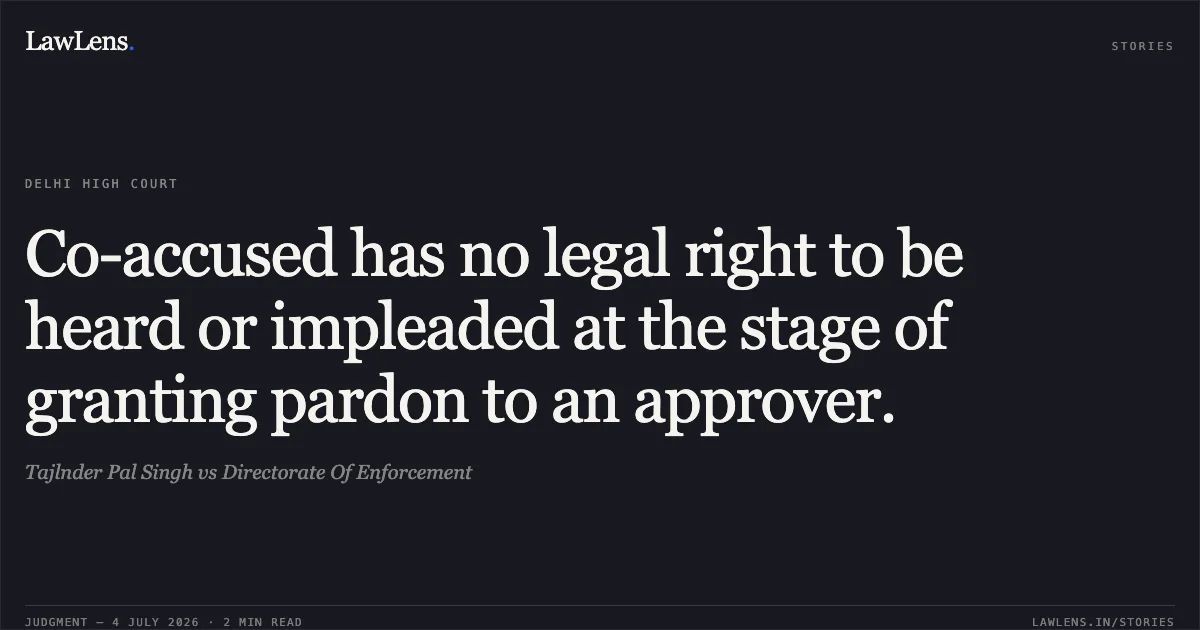
¶ 18(a) / 19ii.2. Whether a co-accused has a legal right to be heard or to oppose the grant of pardon to another accused under Sections 306 and 307 of the CrPC.
¶ 18(b) / 2703Law Applied
The court applied Section 362 of the CrPC, which bars a criminal court from altering or reviewing its final judgment except for clerical errors.
¶ 19The bar under Section 362 CrPC does not apply to "procedural reviews" involving violations of natural justice, citing State of Punjab v. Davinder Pal Singh Bhullar.
¶ 21The grant of pardon is a matter between the Court, the prosecution, and the applicant-accused, as established in CBI v. Ashok Kumar Aggarwal and Gurvinder Singh Bhatia v. CBI.
¶ 30–31The principle of res judicata in criminal proceedings, referencing S.C. Garg v. State of U.P., holds that issues finally decided between parties cannot be reopened.
¶ 24Provisions in the judgment · 3 · Linked ones open on LawLens
Bharatiya Nagarik Suraksha Sanhita, 2023 Section 528
Code of Criminal Procedure, 1973 Section 401
Prevention of Corruption Act, 1988 Section 13
04Reasoning
The Court first clarified that while Section 362 CrPC generally prohibits review, a court may exercise inherent powers under Section 482 to recall an order if it is a nullity due to a procedural lapse or violation of the audi alteram partem rule.
¶ 22The Court found that the Applicant was barred by res judicata because they had previously sought impleadment before the Trial Court, which was rejected on merits on 30.07.2024—an order the Applicant never challenged.
¶ 25–26The Court reasoned that the scheme of Section 306 CrPC does not require hearing a co-accused because the grant of pardon does not adjudicate their guilt.
¶ 29The Court held that a co-accused suffers no prejudice at this stage, as their right to challenge the approver’s testimony arises during the trial through cross-examination.
¶ 32–3305Holding
The Court answered the first issue in the affirmative (power to recall exists for procedural defects) but answered the second issue in the negative (co-accused has no right to be heard during pardon proceedings).
¶ 36The Court held that since the Applicant had no statutory or legal right to be heard at the stage of granting pardon, there was no violation of natural justice; consequently, the application for recall was dismissed.
¶ 36–37Original Court PDF
Tajlnder Pal SinghvsDirectorate Of Enforcement
Click to open original judgment
Original judgment, available to read, download and summarize on LawLens.in