01Facts
The appellant, Managing Director of M/s. Ogun Steel Rolling Mills Pvt. Ltd. (the Company), challenged Order-in-Appeal No. 228/2018 dated 12.09.2018, which upheld a penalty of Rs. 11,00,000 imposed on him under Rule 26 of the Central Excise Rules, 2002.
¶ 1Show Cause Notice No. 82/2016 alleged that the Company received MS ingots without paying duty between July 2011 and October 2012 and cleared TMT bars clandestinely. It proposed duty of Rs. 43,09,187 against the Company and a Rule 26(1) penalty on the appellant, whose statement stated that every purchase was duty paid.
¶ 2The Adjudicating Authority confirmed all proposals. The Commissioner (Appeals) upheld the order.
¶ 3The Company's appeal (E.A. No. 42659 of 2018) was dismissed on 12.02.2021 after the Company settled the dispute under the Sabka Vishwas (Legacy Dispute Resolution) Scheme, 2019 (the Scheme).
¶ 3The Department's letter dated 03.12.2020 recorded that the case against the Company was closed.
¶ 7The appellant filed no declaration before the Scheme closed on 15.01.2020 under Notification No. 7/2019-C.E. (N.T.) dated 31.12.2019.
¶ 702Issues
i.1. Whether the penalty under Rule 26 imposed on a co-noticee can survive once the duty demand against the principal noticee, in the same proceedings, has been settled under the Scheme, although the co-noticee filed no declaration of his own.
¶ 603Law Applied
The penalty was imposed under Rule 26(1) of the Central Excise Rules, 2002.
¶ 2The governing relief is Section 124(1)(b) of the Finance (No.2) Act, 2019, which grants relief of the entire penalty where the tax dues relate to a show cause notice for penalty only, or where the duty in the notice has been paid or is nil. The clause turns on payment of the duty and does not depend on acceptance of the principal noticee's declaration.
¶ 8CBIC Circular No. 1071/4/2019-CX.8 dated 27.08.2019 (paras 5(iii), 10(d), 10(i)) confirms that the clause covers penal action against co-noticees, that co-noticees cannot avail the Scheme until the principal's duty demand is settled, and that a declaration is required even where duty is nil.
¶ 9-10The Court invoked its independent duty to apply the correct law, as stated in New India Assurance Co. Ltd. v. Dolly Satish Gandhi, 2026 INSC 498.
¶ 9Under Sant Lal Gupta v. Modern Cooperative Group Housing Society Ltd., 2010 (262) E.L.T. 6 (S.C.), a coordinate Bench's decision must be followed or referred to a Larger Bench, not disregarded.
¶ 12The Tribunal relied on Anil K. Modani (CESTAT Mumbai).
¶ 8The Tribunal also followed JPFL Films, Venkateswara Steels, Protochem, Dinesh Kanoria, Ekam International, Mahendra Kumar Tulsian, and B.L. Chetan. The contrary single-member view in Four R Associates (2023 (11) TMI 9) was noted but not followed.
¶ 11Provisions in the judgment · 1 · Linked ones open on LawLens
Central Excise Act, 1944 Section 11
04Reasoning
The Tribunal held that the Scheme is built around tax dues, and a person faced only with penalty is eligible to declare if no duty demand remains pending in the same proceedings.
¶ 8The duty demand against the Company was the basis of the penalty on the appellant. Because that demand was unpaid while it remained pending, the appellant could not have sought relief under clause (b).
¶ 10The Tribunal accepted that the appellant's omission to declare was a procedural lapse, not a substantive bar, because the entitlement under clause (b) does not depend on the principal's declaration.
¶ 8, 11It acknowledged that Circular para 5(iii) requires a declaration even for nil duty, but found that the record did not show when the Company declared or paid, and the Revenue did not contend that a window was open to the appellant that he allowed to pass. That question was therefore left undecided.
¶ 10The Tribunal observed that the Company had obtained the Scheme's benefit on the very demand underlying the penalty, and that the penalty in the same proceedings, on the same allegations, could not survive consistently with the Scheme.
¶ 10The Authorised Representative identified no ground to distinguish the consistent line of coordinate Bench decisions.
¶ 1105Holding
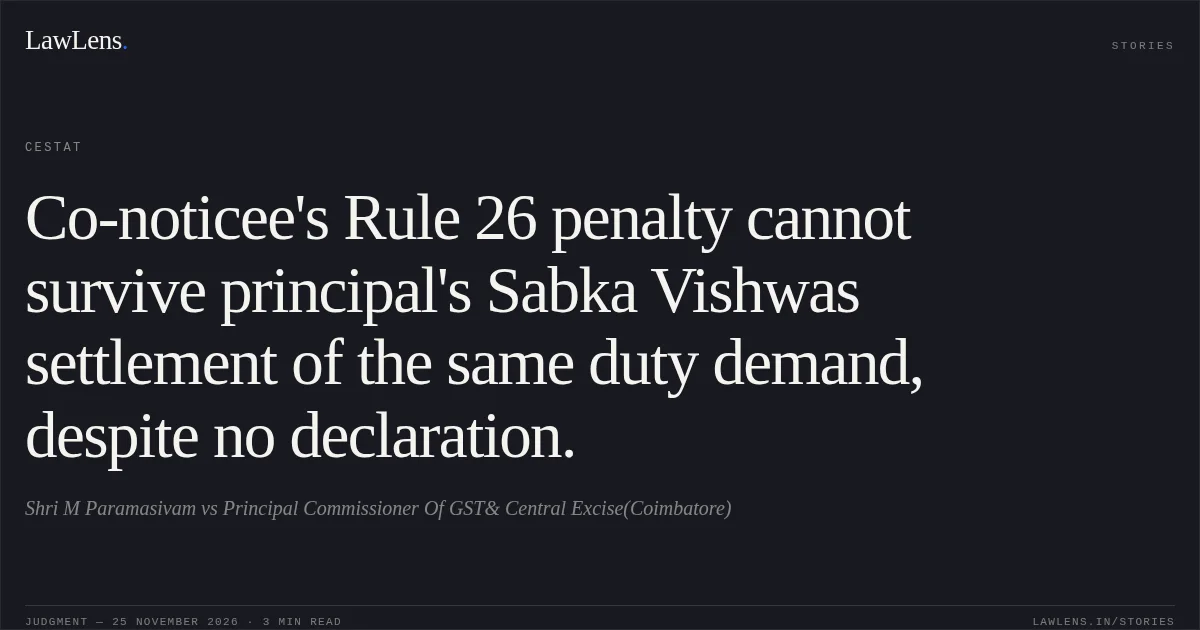
The penalty of Rs. 11,00,000 under Rule 26 cannot be sustained once the co-noticee's principal demand has been settled under the Scheme, even where the appellant filed no declaration.
¶ 10, 13The Tribunal followed the coordinate Bench decisions under Sant Lal Gupta.
¶ 12The appeal is allowed. The impugned order is set aside insofar as it upholds the Rs. 11,00,000 penalty under Rule 26, with consequential relief, if any, in accordance with law.
¶ 13Original Court PDF
Shri M ParamasivamvsPrincipal Commissioner Of GST& Central Excise(Coimbatore)
Click to open original judgment
Original judgment, available to read, download and summarize on LawLens.in