Facts
The appellants, Chairpersons of five District Milk Producers’ Co-operative Unions in Rajasthan, challenged a Rajasthan High Court judgment that struck down certain bye-laws.
Source reference: para 2, 6The District Milk Unions had framed Bye-law Nos. 20.1(2), 20.1(4), 20.2(7), and 20.2(9) under the Rajasthan Co-operative Societies Act, 2001 ("Act"), prescribing eligibility conditions for primary societies' representatives seeking to contest elections for the Unions' Board of Directors.
Source reference: para 3, 6.1These conditions included audit classifications (Category A or B), operational continuity (not closed for >90 days), and minimum milk supply requirements (270 days and minimum quantity).
Source reference: para 4Certain primary societies (respondents) successfully challenged these bye-laws in writ proceedings, where the High Court declared them ultra vires the Act for imposing unauthorized disqualifications.
Source reference: para 3, 6.3The appellants, who were not impleaded in the original writ petitions, filed this appeal claiming the judgment prejudiced their governance structures without a hearing.
Source reference: para 6.5, 13Issues
Whether a writ petition under Article 226 of the Constitution was maintainable against the District Milk Unions and their internal bye-laws?
Source reference: para 7, 14Whether the High Court erred in entertaining the writ petitions despite the availability of an efficacious alternative statutory remedy under the Act?
Source reference: para 7.4, 15Whether the impugned bye-laws constituted "disqualifications" under Section 28 or valid "eligibility criteria" under Section 8 read with Schedule B of the Act?
Source reference: para 16, 19Whether the High Court judgment was vitiated by the non-joinder of necessary parties and for granting in rem relief?
Source reference: para 7.5, 21Law Applied
The Court primarily applied the Rajasthan Co-operative Societies Act, 2001, specifically Section 8 and Schedule B (power to frame bye-laws for internal management), Section 28 (statutory disqualifications), Section 32 (conduct of elections according to bye-laws), and Section 58 (mandatory arbitration for election disputes).
Source reference: para 6, 8.1, 15.1, 20.1It relied on Thalappalam Service Co-operative Bank Ltd. v. State of Kerala, establishing that co-operative societies are not "State" under Article 12.
Source reference: para 14.6It further applied the principles from Federal Bank Ltd. v. Sagar Thomas, holding that regulatory control does not render a private entity amenable to writ jurisdiction.
Source reference: para 14.7Regarding election rights, it relied on Jyoti Basu v. Debi Ghosal and K. Krishna Murthy v. Union of India, which clarify that the rights to vote and contest are purely statutory and subject to regulation.
Source reference: para 18.1Finally, the doctrine of actus curiae neminem gravabit and principles of natural justice from Dattatreya v. Mahaveer were applied regarding the non-joinder of affected parties.
Source reference: para 7.11, 21.3Reasoning
The Court held the writ petitions were not maintainable because District Milk Unions are autonomous co-operative bodies, not "State" instrumentalities under Article 12, as they lack deep and pervasive State control.
Source reference: para 14.5, 14.8Furthermore, Section 58(2)(c) of the Act provides a specialized, multi-tiered remedial framework for election disputes, which the respondents improperly bypassed.
Source reference: para 15.4, 15.8On the merits, the Court found the High Court failed to distinguish between the "right to vote" (not restricted) and the "right to contest" (a statutory right that can be conditioned).
Source reference: para 18.5, 18.7It determined that the bye-laws were not unauthorized "disqualifications" under Section 28, but "eligibility criteria" under Section 8 and Schedule B, designed to ensure that only active, functioning societies participate in the federal union's management.
Source reference: para 19.3, 20.4, 20.7The Court also noted a gross procedural error: the High Court struck down bye-laws in rem across all unions in the State without hearing the unions or their chairpersons, violating the principle of audi alteram partem.
Source reference: para 21.5, 21.6Holding
The Supreme Court allowed the appeal and set aside the High Court's judgments.
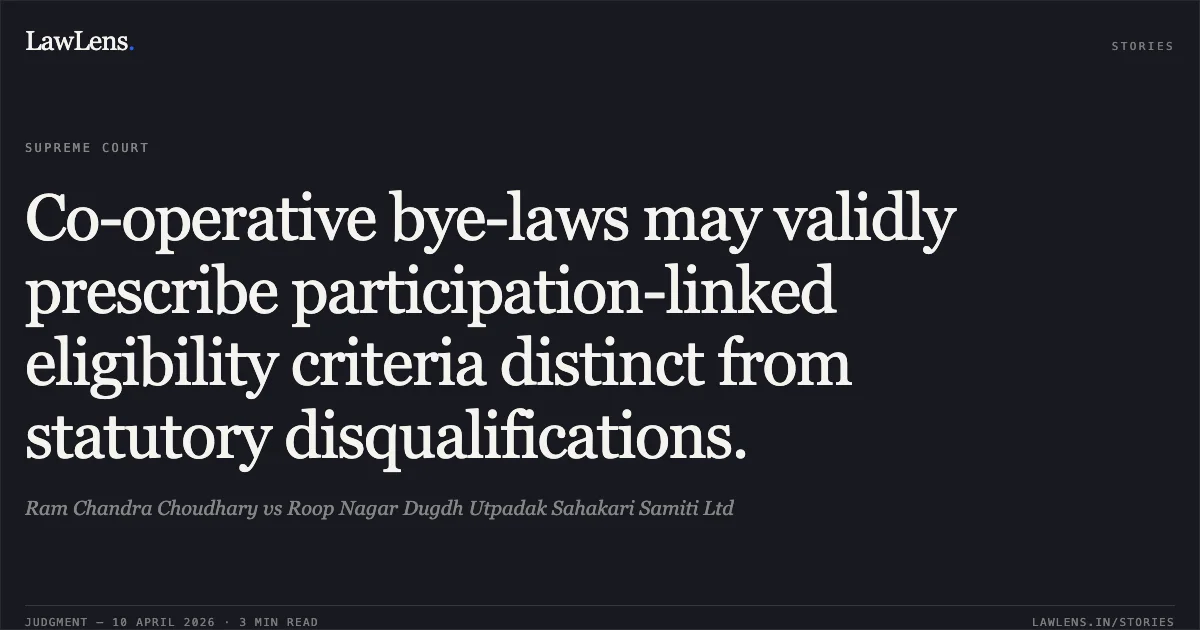
It held that the impugned bye-laws are intra vires the Act, as they are traceable to the enabling powers under Section 8 read with Schedule B and do not trench upon the statutory disqualifications under Section 28.
Source reference: para 20.10, 22The Court concluded that the High Court lacked jurisdiction under Article 226 and erred by conflating eligibility conditions with disqualifications while ignoring the mandatory statutory dispute-resolution mechanism.
Source reference: para 22The validity of Bye-law Nos. 20.1(2), 20.1(4), 20.2(7), and 20.2(9) was upheld.
Source reference: para 3, 22Acts & Sections Cited
28 provisions across 3 statutes referred to in this judgment. Each provision opens on LawLens.
rajasthan co-operative societies act, 2001
KARNATAKA CO-OPERATIVE SOCIETIES ACT, 1959.1
Banking Regulation Act, 19491
Original Court PDF
Ram Chandra ChoudharyvsRoop Nagar Dugdh Utpadak Sahakari Samiti Ltd
Click to open original judgment
Original judgment, available to read, download and summarize on LawLens.in