Facts
Two former employees (Respondent No. 3 in both petitions) filed complaints before the Ombudsman alleging that due to the petitioner’s delay in remitting pension contributions, they received a reduced pension for a certain period.
Source reference: p. 5The Ombudsman found the petitioner liable and directed it to "adequately compensate" the retired employees within three months.
Source reference: p. 8-9The petitioner contended that the Ombudsman lacked jurisdiction over service-related disputes of employees and that the orders were legally unworkable.
Source reference: p. 5-6Issues
1. Whether the Co-operative Ombudsman has the jurisdiction under Section 69A of the Kerala Co-operative Societies Act, 1969, to entertain complaints regarding pensionary benefits raised by past employees.
Source reference: p. 82. Whether an order directing "adequate compensation" without specifying a quantified amount is legally sustainable.
Source reference: p. 9Law Applied
Section 69 of the Kerala Co-operative Societies Act, 1969, which mandates that disputes between a society and its employees/past employees must be adjudicated by the Co-operative Arbitration Court or the Registrar, to the exclusion of other authorities.
Source reference: p. 7-8Section 69A(1) of the same Act, which restricts the Ombudsman’s jurisdiction to "redressal of complaints relating to deficiency in banking or other services rendered by co-operative societies".
Source reference: p. 8The principle from Kiranbala Dandapat v. Secretary, Grid Corporation of Orissa Ltd. (AIR 1998 Ori 159), establishing that "compensation" signifies an equivalent in value and must be specifically determined or quantified by the adjudicating authority.
Source reference: p. 9-12Reasoning
The court reasoned that Section 69 contains a non-obstante clause and clear language—"no other court or other authority shall have jurisdiction"—which effectively bars the Ombudsman from hearing employment-related disputes.
Source reference: p. 7-8The court clarified that the Ombudsman's statutory mandate under Section 69A is limited to grievances concerning "banking or other services" provided to customers, not service-related grievances of employees.
Source reference: p. 8-9The court found the impugned orders "unworkable" because the Ombudsman failed to specify the quantum of compensation. Citing legal definitions of 'compensation' and 'damages', the court held that any judicial or quasi-judicial order for compensation must balance the loss against a specific monetary value; a vague direction to provide "adequate compensation" leaves the relief indeterminate.
Source reference: p. 9-12Holding
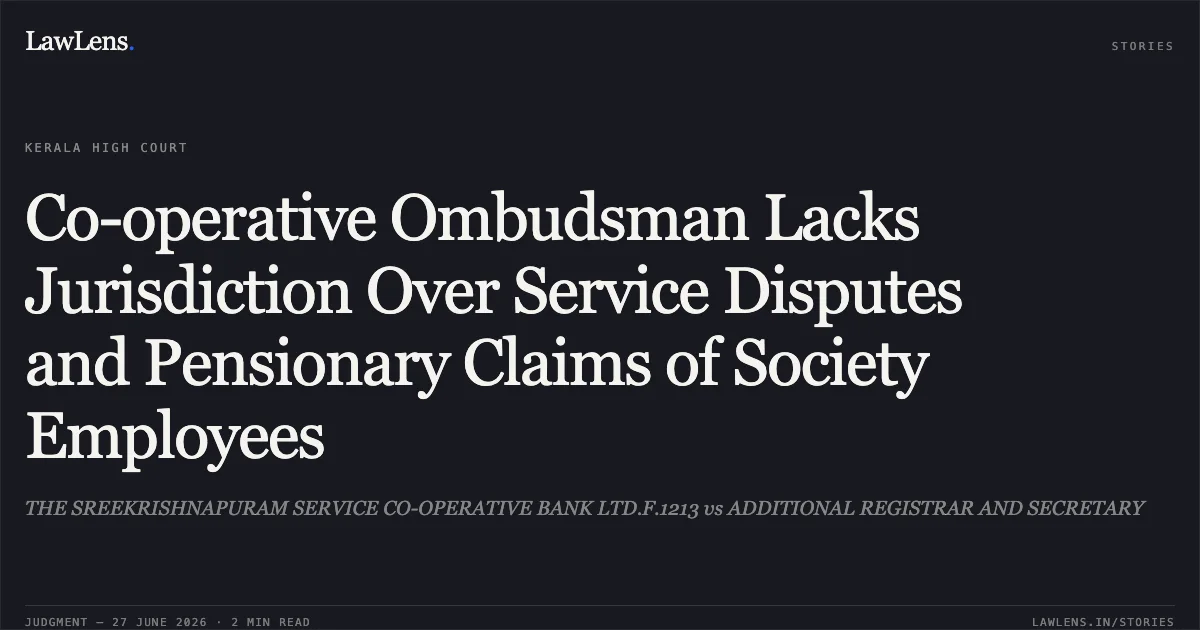
The Court answered the first issue in the negative, holding that the Ombudsman lacks jurisdiction over employee pension disputes, and the second issue in the negative, holding that unquantified compensation orders are unsustainable.
The writ petitions were allowed, and the orders of the Ombudsman (Ext.P4) were quashed. The court reserved the right of the retired employees to seek appropriate remedies before the competent forum in accordance with the law.
Source reference: p. 12Acts & Sections Cited
4 provisions across 1 statute referred to in this judgment. Linked provisions open on LawLens.
Kerala Cooperative Societies Act, 19694
Original Court PDF
THE SREEKRISHNAPURAM SERVICE CO-OPERATIVE BANK LTD.F.1213vsADDITIONAL REGISTRAR AND SECRETARY
Click to open original judgment
Original judgment, available to read, download and summarize on LawLens.in


