Facts
The predecessor-in-interest of the respondents (plaintiff) filed a suit for possession and recovery of occupation charges against the appellant (defendant) regarding a portion of a double-storeyed building
Source reference: para. 2The plaintiff claimed exclusive title via her husband’s Will; however, the defendant contended that the property was jointly owned by other co-sharers (Raj Kumar and Rakesh Kumar) and challenged the suit’s maintainability due to non-joinder of necessary parties
Source reference: para. 3The Trial Court dismissed the suit solely on the ground of non-joinder of these co-sharers
Source reference: para. 6On appeal, the First Appellate Court allowed the plaintiff’s applications under Order 1 Rule 10 CPC (to implead co-sharers as proforma defendants) and Order 6 Rule 17 CPC (to amend the plaint), subsequently remanding the case for trial afresh
Source reference: para. 6, 9The defendant appealed this remand order under Order 43 Rule 1(u) CPC
Source reference: para. 1Issues
1. Whether a suit for possession and recovery of damages filed by one co-owner is maintainable without impleading other co-owners?
Source reference: para. 17-202. Whether the First Appellate Court erred in allowing the impleadment of parties and amendment of the plaint at the appellate stage and remanding the matter?
Source reference: para. 29-32Law Applied
Order 1 Rule 9 CPC, which provides that no suit shall be defeated by reason of mis-joinder or non-joinder of parties, except in the case of a "necessary party"
Source reference: para. 13-14Order 1 Rule 10(2) CPC, authorizing the Court to add parties at any stage to ensure complete adjudication
Source reference: para. 13, 15Shri Ram Pasricha v. Jaganath (1976) and Om Prakash v. Mishri Lal (2017), which stipulates that a co-owner is as much an owner of the entire property as any other co-owner and can maintain a suit for eviction/possession against a tenant or trespasser without joining other co-owners
Source reference: para. 21-22, 24Vasantha v. Rajalakshmi (2024), confirming that a plaint can be amended at any stage, including the appellate stage
Source reference: para. 31Reasoning
The High Court observed that the Trial Court committed a legal error by dismissing the suit for non-joinder.
Source reference: para. 18, 28Applying the two-fold test from Aliji Momonji & Co. v. Lalji Mavji, the court determined that while other co-owners might be "proper parties," they are not "necessary parties" in a possession suit against a trespasser because an effective decree can be passed in their absence
Source reference: para. 18, 28Since a co-owner has a legal right to defend the joint property, the suit was maintainable from its inception
Source reference: para. 24-25The Court reasoned that the First Appellate Court’s decision to allow impleadment and amendment was a valid exercise of jurisdiction intended to settle the controversy completely and avoid technical dismissals
Source reference: para. 27, 30Furthermore, a dismissal based on non-joinder does not constitute res judicata as it is not a decision on the merits
Source reference: para. 23Holding
The High Court dismissed the appeal and upheld the First Appellate Court's order of remand
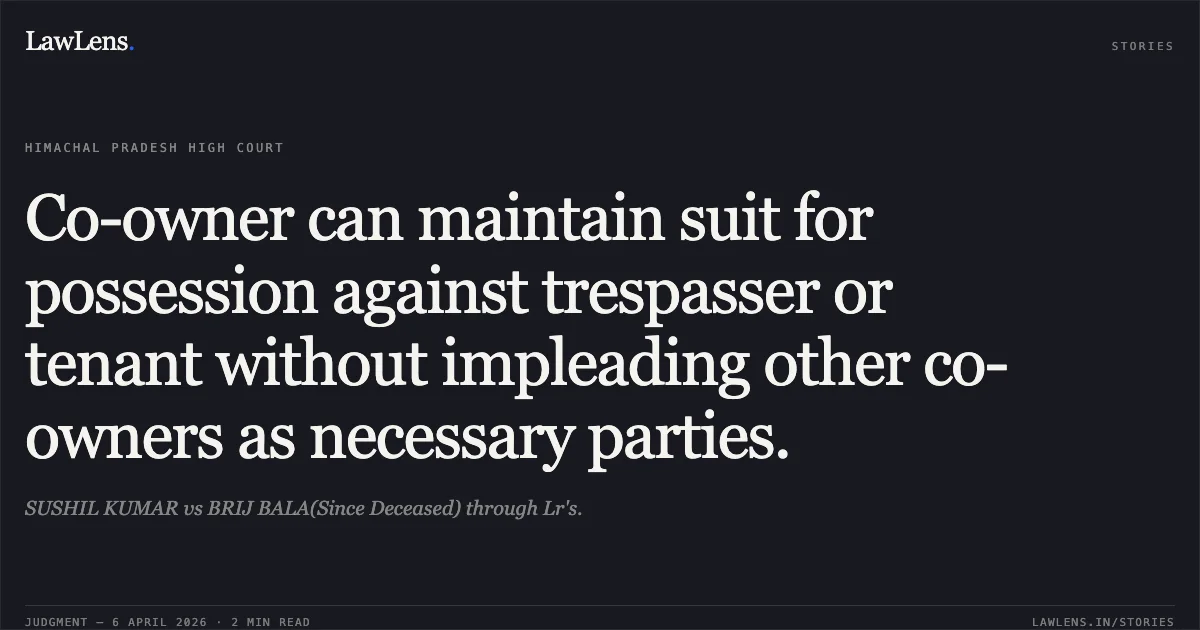
It held that a co-owner can independently maintain a suit for possession against an unauthorized occupant without joining other co-owners
Source reference: para. 24The impleadment of co-sharers as proforma defendants and the corresponding amendment to the plaint were deemed necessary for a final adjudication
Source reference: para. 30, 32The Trial Court was directed to decide the matter expeditiously, no later than October 31, 2026
Source reference: para. 33Acts & Sections Cited
5 provisions across 1 statute referred to in this judgment. Each provision opens on LawLens.
Code of Civil Procedure, 19085
Original Court PDF
SUSHIL KUMARvsBRIJ BALA(Since Deceased) through Lr's.
Click to open original judgment
Original judgment, available to read, download and summarize on LawLens.in