Facts
The petitioner, a co-owner of land in Village Ghayaj, Vadodara, challenged the land acquisition proceedings (and subsequent award) undertaken for the Vadodara–Mumbai Expressway
Source reference: p. 1The petitioner had initially filed an application under Section 64 of the 2013 Act, which was rejected on 31.08.2024 because the acquisition was governed by the National Highways Act, 1956
Source reference: p. 2Subsequently, the petitioner filed an application under Section 3G(5) of the 1956 Act on 03.10.2024
Source reference: p. 3Crucially, the petitioner’s father (also a co-owner) had previously filed a writ petition for the same relief, which was dismissed on 05.02.2026
Source reference: p. 2The father also had an active arbitration proceeding regarding the same land where the mandate of the Arbitrator had been extended by the District Court until September 2026
Source reference: p. 3Issues
1. Whether a co-owner can maintain a separate writ petition and seek a separate arbitration direction when the same relief was previously denied to another co-owner and the matter is already seized by an Arbitrator
Source reference: p. 2, para 42. Whether the mandate of the Arbitrator had expired, necessitating fresh directions
Source reference: p. 3, para 9–10Law Applied
Section 3G(5) of the National Highways Act, 1956, which provides for the determination of compensation by an arbitrator if the amount determined by the competent authority is not acceptable
Source reference: p. 2Section 29A of the Arbitration and Conciliation Act, 1996, regarding the extension of the mandate of an arbitrator
Source reference: p. 3The Right to Fair Compensation and Transparency in Land Acquisition, Rehabilitation and Resettlement Act, 2013, (specifically Section 64) is not the applicable forum for challenges where the acquisition is specifically initiated under the 1956 Act
Source reference: p. 2Reasoning
The court found the petition to be "wholly misconceived" because the petitioner’s interests were already represented in ongoing legal processes
Source reference: p. 1The court noted that the petitioner’s father, as a co-owner of the exact same survey blocks, had already litigated the matter and failed in a prior Special Civil Application
Source reference: p. 2The court rejected the petitioner's verbal claim that there were "two separate awards" for the co-owners, noting a lack of supporting material
Source reference: p. 2Furthermore, the court observed that since the Collector (acting as Arbitrator) was already seized of the matter via the father’s application—and the District Court had legally extended the arbitrator's mandate under Section 29A of the Arbitration Act—there was no legal ground for a second, separate application for the same land
Source reference: p. 3-4Holding
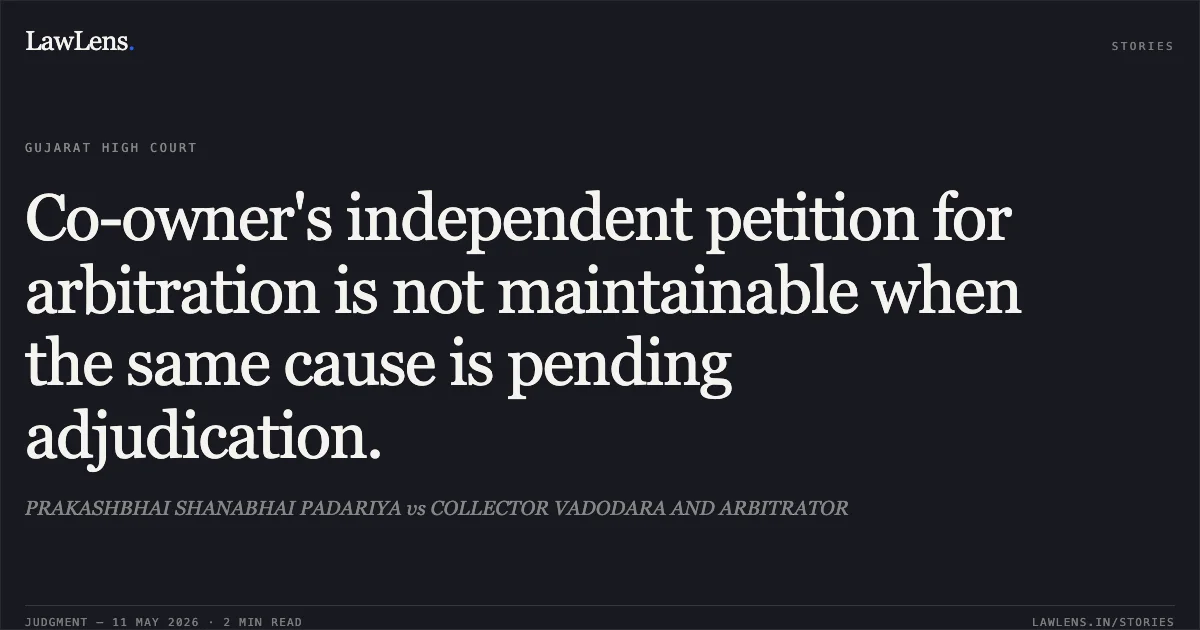
The High Court dismissed the petition, holding that a separate application under Section 3G(5) cannot be entertained when the statutory Arbitrator is already adjudicating the matter at the instance of a co-owner
The court affirmed that the Arbitrator’s mandate is currently valid due to the extension granted by the Civil Court. No costs were ordered
Source reference: p. 3-4Acts & Sections Cited
1 provisions across 1 statute referred to in this judgment. Each provision opens on LawLens.
Right to Fair Compensation and Transparency in Land Acquisition, Rehabilitation and Resettlement Act, 20131
Original Court PDF
PRAKASHBHAI SHANABHAI PADARIYAvsCOLLECTOR VADODARA AND ARBITRATOR
Click to open original judgment
Original judgment, available to read, download and summarize on LawLens.in


