Facts
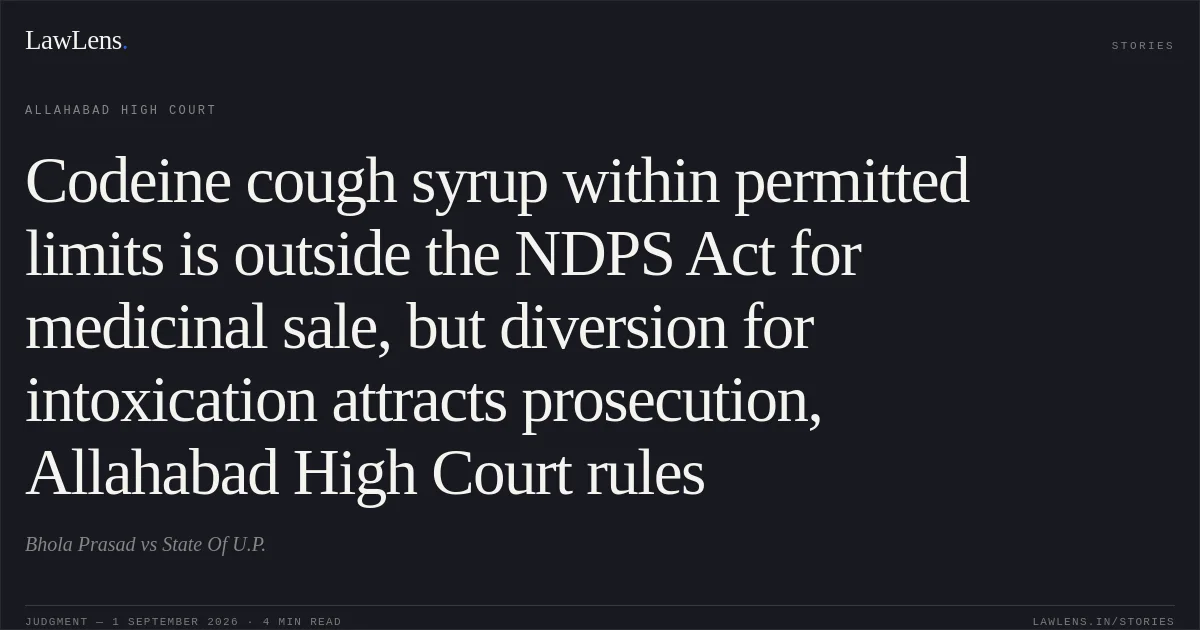
The High Court heard 76 connected bail applications involving the alleged stock, sale, transport and diversion of codeine-based cough syrups, including New Phensedyl, Eskuf, Codectus, Lykarex-T, Phencypink-T and Rexley-T.
Source reference: para. 1–2, pp. 10–11The applicants included licensed pharmaceutical wholesalers and retailers, proprietors of medical firms, transporters, drivers, helpers, godown caretakers and alleged intermediaries.
Source reference: no citationIn the lead matter, Bhola Prasad was alleged to have sold 7,53,000 bottles of New Phensedyl through his firm, Saili Traders, to two licensed firms which allegedly existed only on paper; the consignments were said to have been diverted through layered firms and transported for non-medical use.
Source reference: para. 59(2)–(16), pp. 42–50The Court separately assessed each applicant’s alleged role, the available documentary and testimonial material, the existence of conscious possession or knowledge, the filing of charge-sheets, criminal history and the applicability of the statutory bar under Section 37 of the NDPS Act.
Source reference: paras. 57–58, pp. 41–42Issues
Whether codeine-based cough syrup containing the permitted quantity of codeine under Entry 35 of the Notification dated 14 November 1985 attracts the NDPS Act when sold or transported by a drug-licence holder to another licensed dealer or person for medicinal purposes.
Source reference: para. 19, pp. 16–17Whether such codeine-based cough syrup, although manufactured as a cough suppressant and containing the permitted quantity of codeine, attracts the NDPS Act when stocked, sold or transported for non-medicinal purposes, such as intoxication.
Source reference: para. 19, pp. 16–17Whether the entire weight of the cough-syrup preparation, rather than merely the quantity of codeine contained in it, is relevant for determining whether the recovered quantity is commercial under the NDPS Act.
Source reference: paras. 53–54, pp. 39–40Whether the individual applicants were entitled to bail on the basis of their specific roles, the nature of the evidence, absence of conscious possession or knowledge, filing of the charge-sheet and other bail considerations.
Source reference: paras. 57–58, pp. 41–42Law Applied
The Court applied Sections 2(xi), 2(xiv), 2(xvi), 2(xx), 8(c), 9(1)(a)(va), 21, 27A, 29, 37 and 80 of the NDPS Act.
Source reference: no citationCodeine is an opium derivative and a manufactured drug under Sections 2(xi) and 2(xvi)(c), while a preparation includes a mixture or solution containing a narcotic drug.
Source reference: paras. 21–25, pp. 17–20However, Entry 35 of the Notification dated 14 November 1985 excludes from the definition of manufactured drug a preparation compounded with another ingredient, containing not more than 100 mg of codeine per dosage unit and not more than 2.5% concentration, provided it has been established in therapeutic practice.
Source reference: paras. 26–28, pp. 20–21Relying on Mohd. Sahabuddin v. State of Assam, (2012) 13 SCC 491, the Court held that the therapeutic-use requirement must be satisfied where the preparation is transported or dealt with without valid authority or in circumstances indicating non-medical use.
Source reference: paras. 39–40, pp. 27–29Under Union of India v. Sanjeev V. Deshpande, (2014) 13 SCC 1, the NDPS Act operates in addition to, and not in derogation of, the Drugs and Cosmetics Act.
Source reference: para. 15, p. 14The Court also relied on Hira Singh v. Union of India, (2020) 20 SCC 272, for treating the entire mixture as relevant to quantity determination.
Source reference: paras. 53–54, pp. 39–40Reasoning
The Court held that the codeine concentration and dosage limits under Entry 35 are necessary but not sufficient by themselves. A compliant cough-syrup preparation remains outside the NDPS Act when dealt with in the ordinary course of licensed pharmaceutical business for medicinal use.
Source reference: paras. 27–31, pp. 20–23; para. 55, p. 40Conversely, where the material prima facie showed fictitious firms, non-existent premises, absence of stock or delivery, forged invoices, implausible vehicle details, rapid movement of very large quantities, unexplained cash deposits, or recovery of the same batches in other States during illegal transport, the Court inferred possible diversion for intoxication.
Source reference: paras. 44–52, pp. 34–39The Court nevertheless differentiated between principal or intermediary actors allegedly involved in diversion and persons such as drivers, cleaners, caretakers and licensed dealers against whom there was no material showing knowledge, conscious possession or involvement in non-medical trafficking.
Source reference: paras. 60(8)–(10), pp. 56–57; paras. 65–67, pp. 72–78; paras. 96–101, pp. 154–161In contrast, applicants connected with layered transactions and allegedly fictitious firms, unexplained financial transfers, non-delivery of consignments and recovery of corresponding batches at trafficking destinations were found prima facie involved and were denied bail.
Source reference: paras. 59(18)–(22), pp. 50–53; paras. 72(3)–(9), pp. 87–91; paras. 73(4)–(7), pp. 92–97; paras. 114(3)–(8), pp. 193–196Holding
The Court answered Question No. 1 in the negative: codeine-based cough syrup satisfying the dosage, concentration and therapeutic-practice requirements of Entry 35 is not treated as a narcotic substance when sold or transported for medicinal use in the ordinary course of licensed pharmaceutical business.
It answered Question No. 2 in the affirmative: the same preparation, if stocked, sold or transported for intoxication or another non-medical purpose, is treated as a codeine preparation falling within the category of manufactured drug and attracts the NDPS Act; the entire mixture is relevant for quantity determination.
Source reference: para. 55, p. 40; paras. 53–54, pp. 39–40Bhola Prasad’s bail application was rejected because the material prima facie indicated diversion of a very large quantity through fictitious or paper firms, layered transactions, unexplained financial transfers and transportation for non-medical use; his unexplained criminal history also weighed against bail.
Source reference: para. 59(18)–(22), pp. 50–53Bail was granted to several applicants whose involvement was limited, whose knowledge or conscious possession was not established, or against whom only co-accused statements were relied upon, subject to personal bonds, two sureties, non-tampering, cooperation with trial, abstention from criminal activity, attendance before the court and a prohibition on leaving India without permission.
Source reference: paras. 60–126, pp. 53–221; para. 127, pp. 221–222The Court further directed the Commissioner of Food Safety and Drug Administration, Uttar Pradesh, to guide Drug Inspectors to proceed under the Drugs and Cosmetics Act for licensing violations and to obtain legal advice before registering NDPS FIRs in appropriate cases.
Source reference: paras. 95(9)–(12), pp. 153–154; paras. 128–130, pp. 222–223Acts & Sections Cited
42 provisions across 6 statutes referred to in this judgment. Each provision opens on LawLens.
Narcotic Drugs and Psychotropic Substances Act, 1985
Drugs and Cosmetics Act, 19403
Bharatiya Nyaya Sanhita, 2023
Bharatiya Nagarik Suraksha Sanhita, 20234
Indian Penal Code, 18602
Essential Commodities Act, 19551
Original Court PDF
Bhola PrasadvsState Of U.P.
Click to open original judgment
Original judgment, available to read, download and summarize on LawLens.in