Facts
The appellants owned portions of the ground floor to the third floor and a portion of the fourth floor of “Indira Arcade” pursuant to a Memorandum of Understanding with M/s Indira Foundations Private Limited. The first respondent, a co-owner and daughter of the original plot owner, occupied a portion of the second floor and complained of unauthorised construction, excess construction, and deviations in the building attributable to the appellants
Source reference: p.1, para.1In earlier proceedings, the High Court directed rectification of the building violations. The appellants removed the fifth floor and basement partitions and, in respect of the fourth floor, applied for regularisation under Section 113-C of the Tamil Nadu Town and Country Planning Act, 1971, read with Government Orders Nos. 110 and 111 dated 22 June 2017.
Source reference: pp.2–3, paras.2–3The High Court subsequently recorded the appellants’ undertaking and noted that the regularisation application was pending.
Source reference: p.3, para.3After the first respondent made further representations, the Chennai Metropolitan Development Authority (CMDA) issued a report identifying continuing deviations. The appellants challenged that report. On 27 September 2023, the High Court allowed the challenge and directed that no coercive action be taken until the Supreme Court decided the pending litigation concerning regularisation under Section 113-C and the relevant Government Orders.
Source reference: pp.4–6, para.4Despite this order, the High Court, in proceedings initiated by the first respondent, directed the CMDA to remove the unauthorised constructions within eight weeks, holding that pendency of the regularisation application did not prevent demolition.
Source reference: p.8, para.8Issues
1. Whether the High Court was justified in directing demolition of the alleged unauthorised constructions despite its earlier order dated 27 September 2023 restraining coercive action pending adjudication of the regularisation issue before the Supreme Court?
Source reference: p.9, para.102. Whether the pendency of the appellants’ regularisation application and the unresolved validity of the applicable Government Orders required maintenance of status quo rather than immediate removal of the disputed constructions?
Source reference: pp.8–10, paras.8, 10–11Law Applied
The Court applied Section 113-C of the Tamil Nadu Town and Country Planning Act, 1971, which permits regularisation of unauthorised constructions subject to statutory requirements.
Source reference: p.5, para.5Government Orders Nos. 110 and 111 dated 22 June 2017 had been held invalid by the Madras High Court in C. Prabhakaran v. Dharmendra Pratap Yadav; the challenge to that decision, including in M/s Billroth Hospital Ltd. v. State of Tamil Nadu, remained pending before the Supreme Court.
Source reference: pp.5–6, para.5The Court further applied the principle that parties and authorities must abide by an earlier subsisting judicial order concerning the same subject matter, particularly where that order expressly restrained coercive action pending resolution of the underlying legal issue.
Source reference: pp.6, 9–10, paras.6, 10–11Reasoning
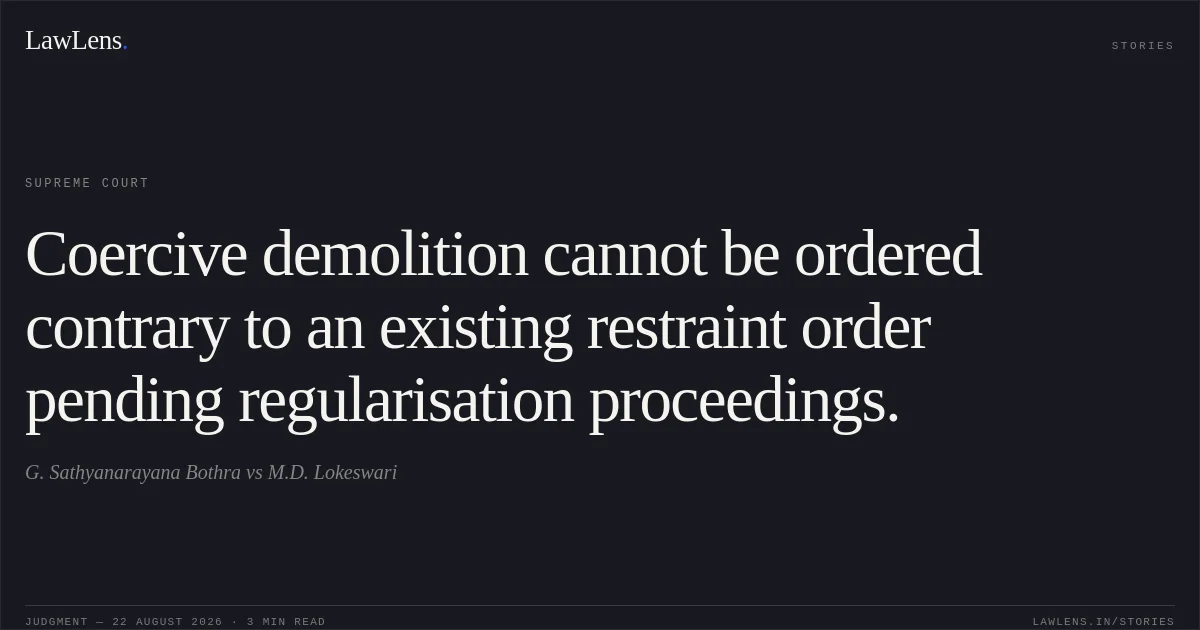
The Supreme Court held that the CMDA was bound by the High Court’s earlier order dated 27 September 2023, to which the appellants and the CMDA were parties, directing that no coercive steps be taken until the Supreme Court resolved the regularisation issue.
Source reference: p.9, para.10That issue—including the validity of the relevant Government Orders and the appellants’ regularisation application—was still pending. The later Division Bench order directing demolition failed to consider the earlier order and thereby created inconsistent directions concerning the same constructions and parties.
Source reference: p.9, para.10Since the legal basis for regularisation had not been finally determined, the High Court was not justified in treating the application as incapable of consideration and ordering immediate demolition. The appropriate course was to preserve the existing position until the pending civil appeals were decided.
Source reference: pp.9–10, paras.10–11Holding
The Supreme Court allowed the appeal and set aside the High Court’s order dated 28 April 2025 directing removal of the unauthorised constructions.
The appellants, the CMDA, and the concerned respondent were directed to remain governed by the earlier High Court order dated 27 September 2023. All parties were permitted to take further steps after the regularisation issue was decided in the pending civil appeals before the Supreme Court, and status quo regarding the existing constructions was directed to be maintained until then. The parties were left to bear their own costs.
Source reference: p.10, para.11Acts & Sections Cited
1 provisions across 1 statute referred to in this judgment. Linked provisions open on LawLens.
Tamil Nadu Town and Country Planning Act, 19711
Original Court PDF
G. Sathyanarayana BothravsM.D. Lokeswari
Click to open original judgment
Original judgment, available to read, download and summarize on LawLens.in