Facts
The Municipal Corporation of Delhi (MCD) challenged two orders passed by the Labour Court in proceedings under Section 33C(2) of the Industrial Disputes Act, 1947.
Source reference: para. 3In the first case (Jagvir), despite filing a calculation chart, the MCD failed to pay a cost of ₹7,000, leading the Labour Court to issue warrants for the attachment of the salary of the Deputy Commissioner, Keshav Puram Zone.
Source reference: para. 6-7In the second case (Raju), although the cost was paid, the MCD failed to file the calculation chart and service records despite repeated warnings, prompting the Labour Court to issue Non-Bailable Warrants (NBWs) against the Deputy Commissioner and seek a formal explanation from the Commissioner, MCD.
Source reference: para. 8-9The petitioners moved the High Court seeking to set aside these coercive directions.
Source reference: para. 10Issues
1. Whether the coercive steps, including the issuance of Non-Bailable Warrants and salary attachment orders against high-ranking municipal officials, were sustainable under the facts and circumstances of the case.
Source reference: para. 10-112. Whether the procedural lapses by the MCD in labor proceedings justified the interference of the High Court under Article 226.
Source reference: para. 11-14Law Applied
The court's jurisdiction was invoked under Article 226 of the Constitution of India.
Source reference: no citationThe underlying proceedings were governed by Section 11(3)(b) of the Industrial Disputes Act, 1947, which grants Labour Courts the powers of a Civil Court for compelling the production of documents.
Source reference: para. 9The court also referenced Order 16 Rules 10 and 12 of the Code of Civil Procedure (CPC), which provide for coercive measures, including warrants and fine-based recoveries, to ensure the attendance of witnesses or production of records.
Source reference: para. 9Reasoning
The High Court noted the MCD's admission of lapses and miscommunication that led to the Labour Court's frustration.
Source reference: para. 10While acknowledging that the MCD had significantly delayed filing necessary service records and calculation sheets due to departmental formalities, the Court observed that the MCD had since expressed regret and taken steps to rectify the situation, including issuing a Standard Operating Procedure (SOP) to ensure future compliance.
Source reference: para. 10, 13The Court reasoned that while the Labour Court was justified in its frustration due to repeated non-compliance, the extreme coercive measures—specifically the NBWs and salary attachments—could be set aside if the MCD strictly undertook to comply with all pending and future directions with promptitude.
Source reference: para. 11-12Holding
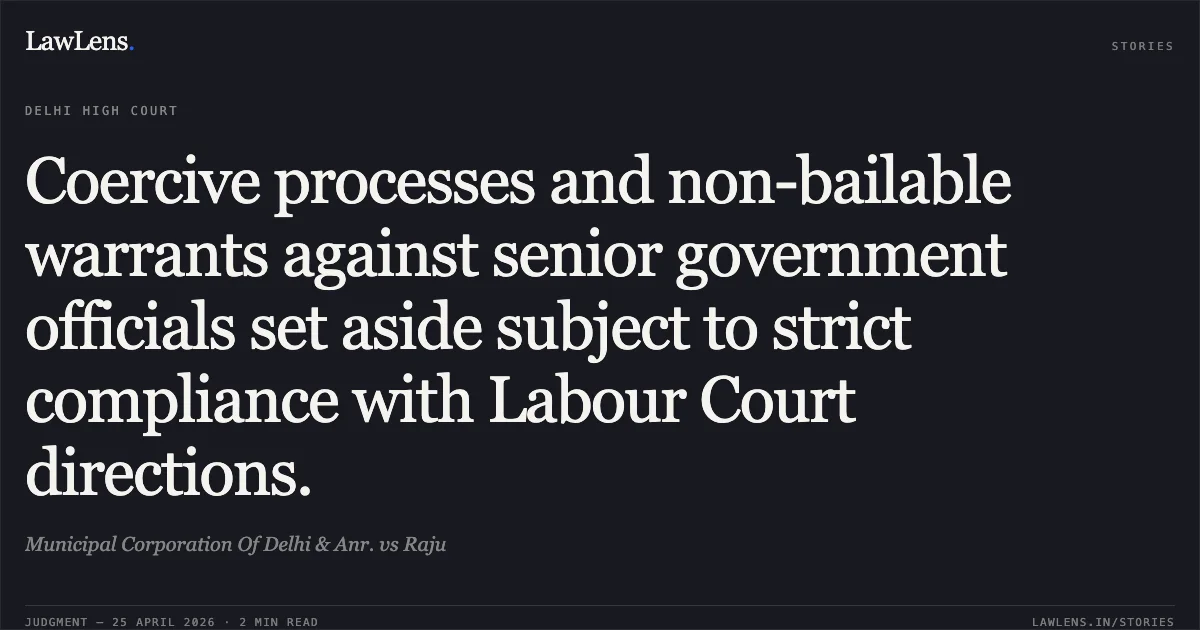
The High Court set aside the issuance of Non-Bailable Warrants (NBWs), the attachment of salary, and the requirement for formal explanations from the Commissioner, MCD.
This relief was granted subject to the MCD’s undertaking to scrupulously adhere to all past and future directions of the Labour Court regarding the supply of information and the payment of all costs imposed.
Source reference: para. 11-12The Court directed the MCD to proceed with diligence in all ongoing Section 33C(2) proceedings and utilize its internal SOP to prevent further inconvenience to the Labour Court.
Source reference: para. 13-14The petitions were disposed of accordingly.
Source reference: para. 14Acts & Sections Cited
1 provisions across 1 statute referred to in this judgment. Each provision opens on LawLens.
Code of Civil Procedure, 19081
Original Court PDF
Municipal Corporation Of Delhi & Anr.vsRaju
Click to open original judgment
Original judgment, available to read, download and summarize on LawLens.in