Facts
M/s Career Solutions Pvt. Ltd., through its Director, alleged that it had entered into an agreement with the petitioners for advertising the petitioners’ colleges and facilitating student admissions.
Source reference: pp. 2–3, paras. 2–3It claimed to have incurred expenses of ₹67,41,000 and stated that four cheques dated 18 January 2016 were issued towards discharge of that liability.
Source reference: pp. 2–3, paras. 2–3The cheques were twice dishonoured with the remark “account blocked.”
Source reference: pp. 2–3, paras. 2–3After a demand notice dated 24 February 2016 went unanswered, the complainant instituted proceedings alleging offences under Sections 406 and 420 of the IPC and Section 138 of the Negotiable Instruments Act, 1881 (“N.I. Act”).
Source reference: pp. 2–3, paras. 2–3The petitioners disputed the underlying liability, asserted that substantial advance payments had already been made, and contended that the bank account had been blocked pursuant to action by an enforcement agency.
Source reference: pp. 4–7, paras. 4–9The Magistrate allegedly permitted the delay merely by recording “Allowed” in the margin of the condonation petition, without a reasoned order or consideration of sufficient cause, and thereafter took cognizance under Section 138 of the N.I. Act on 24 August 2016.
Source reference: pp. 13–15, paras. 16–18Issues
Whether the Magistrate could validly condone the 118-day delay under the proviso to Section 142(b) of the N.I. Act without recording reasons or determining whether sufficient cause had been shown?
Source reference: pp. 11–13, paras. 13–14; pp. 15–16, paras. 19–20Whether the order taking cognizance under Section 138 of the N.I. Act and issuing summons could be sustained when the delay had not been validly condoned before cognizance was taken?
Source reference: pp. 15–16, paras. 19–21Law Applied
Section 138 of the N.I. Act criminalises dishonour of a cheque issued for discharge of a legally enforceable debt or liability, subject to the statutory requirements of presentation, demand notice, and failure to pay.
Source reference: pp. 8–10, para. 12Section 139 creates a presumption in favour of the holder that the cheque was received towards discharge of a debt or liability.
Source reference: p. 10, para. 12Under Section 142(b) and its proviso, a complaint under Section 138 must ordinarily be filed within one month from accrual of the cause of action; a belated complaint may be entertained only where the complainant satisfies the court that sufficient cause prevented timely filing.
Source reference: pp. 10–11, para. 12Relying on H.S. Oberoi Builtech Pvt. Ltd. v. MSN Woodtech, 2025 SCC OnLine SC 2906, and S. Nagesh v. Shobha S. Aradhya, 2026 SCC OnLine SC 18, the Court held that condonation of delay requires an application disclosing reasons, judicial consideration of those reasons, and a reasoned satisfaction that sufficient cause exists; such satisfaction must precede taking cognizance.
Source reference: pp. 11–13, paras. 13–14Reasoning
The High Court confined its consideration to the limitation issue and expressly declined to adjudicate disputed questions concerning the alleged advance payments, genuineness of bills, or the circumstances in which the bank account was blocked.
Source reference: p. 14, para. 15The record showed that although a petition seeking condonation of the 118-day delay was filed, the Magistrate merely marked it “Allowed” in the margin, dated 20 August 2016, without drawing an order-sheet or recording any reasons regarding the alleged sufficient cause.
Source reference: pp. 13–16, paras. 16–19The subsequent cognizance order incorrectly treated the delay petition as having been allowed, but did not demonstrate any independent judicial satisfaction.
Source reference: pp. 13–16, paras. 16–19Applying the principles in H.S. Oberoi and S. Nagesh, the Court held that a mechanical endorsement could not constitute valid condonation, particularly because condonation had to precede cognizance and could not be presumed or treated as a purely procedural formality.
Source reference: pp. 11–13, paras. 13–14; p. 16, paras. 19–20Holding
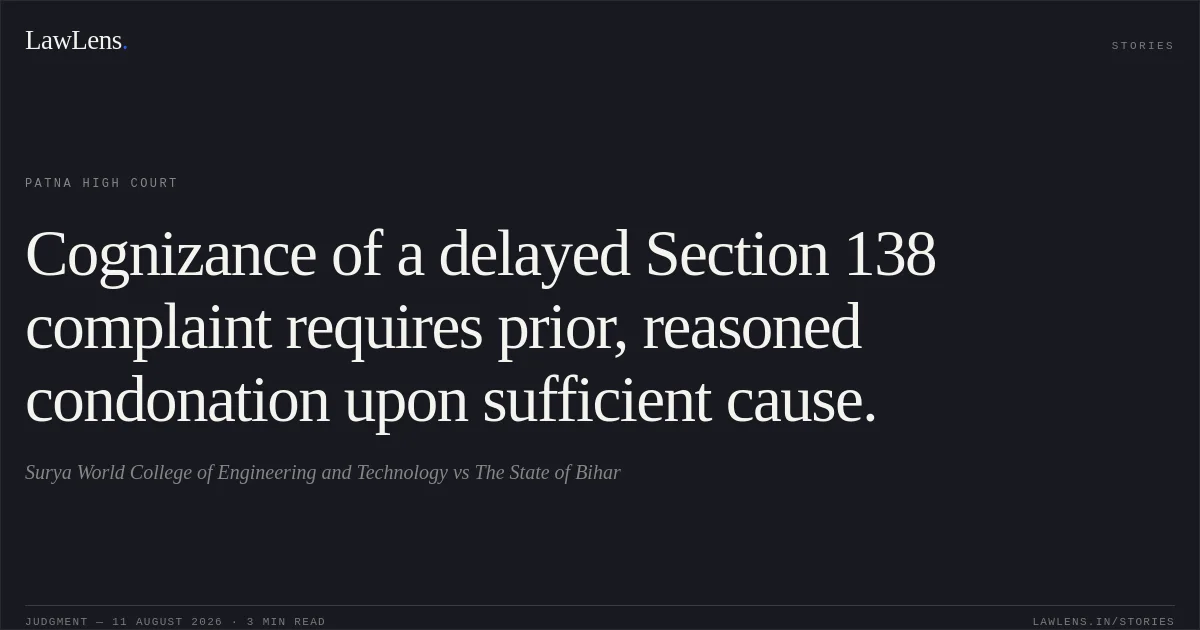
The Court held that the 118-day delay had been illegally and mechanically condoned without consideration of sufficient cause.
Consequently, the Magistrate’s order dated 24 August 2016 taking cognizance under Section 138 of the N.I. Act and issuing summons was quashed and set aside, along with all consequential proceedings against both petitioners.
Source reference: pp. 15–16, paras. 20–23The criminal miscellaneous petition was allowed, and the trial court was directed to receive a copy of the judgment along with the trial court record, if any.
Source reference: pp. 15–16, paras. 20–23Acts & Sections Cited
5 provisions across 2 statutes referred to in this judgment. Each provision opens on LawLens.
Negotiable Instruments Act, 18813
Indian Penal Code, 18602
Original Court PDF
Surya World College of Engineering and TechnologyvsThe State of Bihar
Click to open original judgment
Original judgment, available to read, download and summarize on LawLens.in