Facts
Opposite Party No. 2 alleged that, on 23 November 2016, the petitioner, an Assistant Sub-Inspector of Police, and others forcibly took her son, Banti Singh, in a Scorpio vehicle.
Source reference: paras. 3–4She subsequently learned that he was in police custody and alleged that the petitioner assaulted him with a lathi and used abusive language when she attempted to meet him at the police station.
Source reference: paras. 3–4The Magistrate took cognizance against the petitioner under Sections 323, 504 and 354 IPC by order dated 16 February 2017. In revision, the Sessions Court deleted Section 354 IPC but maintained cognizance under Sections 323 and 504 IPC.
Source reference: para. 2The petitioner contended that Banti Singh had in fact been arrested on 28 November 2016 in Sadar Gopalganj P.S. Case No. 492 of 2016 and remanded to judicial custody, and that the complaint was retaliatory.
Source reference: paras. 5–7He further relied on materials indicating that he was posted at Sadar Gopalganj Police Station and had not been present at Thawe Police Station on the alleged dates.
Source reference: paras. 6, 19Issues
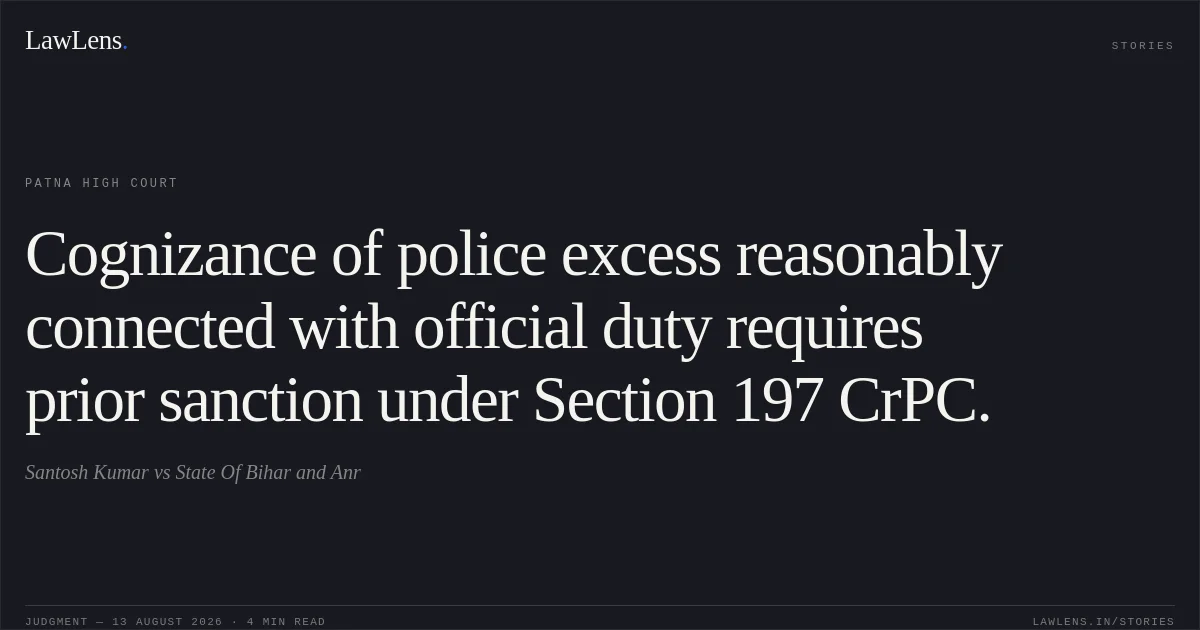
Whether the alleged assault and abusive conduct by the police officer, arising from the detention and custody of the complainant’s son, had a reasonable and integral nexus with the petitioner’s official duty so as to attract the protection of Section 197 Cr.P.C.
Source reference: paras. 12–17, 25Whether the Magistrate could validly take cognizance without prior sanction under Section 197 Cr.P.C.
Source reference: paras. 13, 16, 20–22Whether the High Court ought to exercise its inherent jurisdiction under Section 482 Cr.P.C. to quash the cognizance orders and the consequential criminal proceedings against the petitioner.
Source reference: paras. 9–11, 22, 26–31Law Applied
The Court applied Section 482 Cr.P.C., which empowers the High Court to prevent abuse of process and secure the ends of justice, subject to sparing and circumspect exercise in exceptional cases, as explained in State of Haryana v. Bhajan Lal and Neeharika Infrastructure Pvt. Ltd. v. State of Maharashtra.
Source reference: paras. 9–11Section 197 Cr.P.C. requires previous governmental sanction before cognizance is taken of an offence allegedly committed by a public servant while acting or purporting to act in the discharge of official duty.
Source reference: paras. 13–17The protection depends not on whether the act was lawful, but on whether it had a reasonable connection with, or was directly and integrally connected to, the official duty; even an excess of official duty may remain protected if such nexus exists.
Source reference: paras. 13–17The Court relied on D.T. Virupakshappa v. C. Subash, State of Orissa v. Ganesh Chandra Jew, Om Prakash v. State of Jharkhand, and K. Satwant Singh v. State of Punjab for these principles.
Source reference: paras. 13–16The issue of sanction may be considered at the inception of proceedings where unimpeachable material establishes the official-duty nexus, since prior sanction is a condition precedent to cognizance.
Source reference: para. 16Reasoning
The Court held that the complaint itself placed the alleged acts within the context of police detention, custody and investigation of the complainant’s son.
Source reference: paras. 17, 19The materials produced by the petitioner showed that the son had been arrested in a criminal case and remanded to judicial custody, while the petitioner’s official posting raised a substantial question regarding his presence at the place of occurrence.
Source reference: para. 19The Court did not treat these materials as conclusively determining the truth of the allegations or conduct a mini-trial; rather, they were considered for the limited jurisdictional question whether Section 197 Cr.P.C. could be ignored at the stage of cognizance.
Source reference: paras. 19, 22Since the alleged police excess was reasonably connected with police action, arrest and custody, the Magistrate was required to address the statutory requirement of prior sanction.
Source reference: paras. 17, 25The cognizance order merely recorded the existence of a prima facie case and did not meaningfully consider Section 197 Cr.P.C.
Source reference: para. 21In these circumstances, continuation of the prosecution without first satisfying the sanction requirement constituted a legally defective exercise of jurisdiction and justified intervention under Section 482 Cr.P.C.
Source reference: paras. 25–30Holding
The High Court held that the cognizance order dated 16 February 2017, as modified by the revisional order dated 28 May 2017, was unsustainable because the requirement of prior sanction under Section 197 Cr.P.C. had not been considered before cognizance was taken.
Both orders were set aside/quashed insofar as they concerned the petitioner, and the criminal proceeding arising from Complaint Case No. 11722 of 2016 was quashed against him.
Source reference: para. 31The order was confined to the petitioner and was not to prejudice proceedings against any other accused.
Source reference: para. 31The application under Section 482 Cr.P.C. was accordingly allowed.
Source reference: para. 32Acts & Sections Cited
9 provisions across 3 statutes referred to in this judgment. Each provision opens on LawLens.
Code of Criminal Procedure, 19732
Indian Penal Code, 18606
Arms Act, 19591
Original Court PDF
Santosh KumarvsState Of Bihar and Anr
Click to open original judgment
Original judgment, available to read, download and summarize on LawLens.in