Facts
The applicants were accused of running an illegal "dabba trading" operation from a private residence using "Market Plus" applications, dummy SIM cards, and mobile phones to provide trading tips without a SEBI license
Source reference: p. 2Following a police raid, an FIR was registered under Sections 406, 420, 465, 467, 468, 471, 474, 114, and 120B of the IPC; Sections 13, 14, 19, and 23 of the Securities Contracts (Regulation) Act, 1956 (SCRA); and Section 66D of the IT Act
Source reference: p. 1-2The applicants moved the High Court to quash the FIR, arguing that the court cannot take cognizance of SCRA offenses via a police report and that IPC sections for cheating and breach of trust were not attracted
Source reference: p. 3Issues
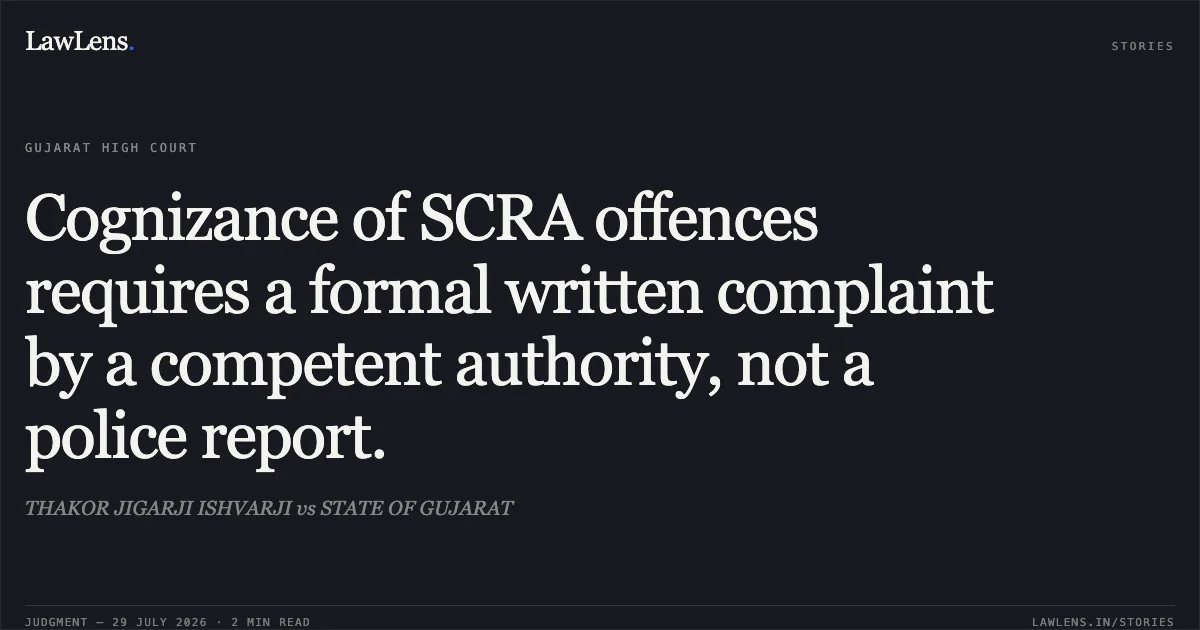
1. Whether a Court can take cognizance of offenses under the Securities Contracts (Regulation) Act, 1956, based on a police report/FIR rather than a formal complaint
Source reference: p. 4 / para. 7.12. Whether the allegations in the FIR prima facie constitute offenses of criminal breach of trust (Section 406 IPC) and cheating (Section 420 IPC)
Source reference: p. 6 / para. 8Law Applied
Section 26 of the Securities Contracts (Regulation) Act, 1956, which mandates that cognizance of any offense under the Act can only be taken upon a written complaint by the Central/State Government, SEBI, or a recognized Stock Exchange
Source reference: p. 4Definition of "complaint" under Section 2(d) of the CrPC, distinguishing it from a police report
Source reference: p. 5Section 405 (Criminal Breach of Trust), requiring "entrustment" of property
Source reference: p. 7Section 420 (Cheating), requiring "dishonest inducement"
Source reference: p. 8State of Haryana v. Bhajan Lal regarding the quashing of proceedings where there is an express legal bar
Source reference: p. 10Delhi Race Club (1940) Ltd. v. State of UP regarding the mutual exclusivity of Sections 406 and 420 IPC
Source reference: p. 8Reasoning
The Court reasoned that Section 26 of the SCRA creates a specific jurisdictional bar; while police may investigate cognizable offenses under Section 23 of the SCRA, the trial court lacks the power to take cognizance based on a police charge-sheet, as the statute requires a formal "complaint" by a specialized authority
Source reference: para. 7.3-7.6Regarding IPC Sections 406 and 420, the Court found that the prosecution failed to show any "entrustment" of property or that the applicants had pocketed money causing actual financial loss to any specific person
Source reference: para. 8.1The Court noted that even if the allegations were true, they constituted a breach of regulatory law (SCRA) rather than criminal misappropriation or cheating
Source reference: para. 8.1Additionally, it held that Sections 406 and 420 cannot coexist in the same transaction as they are distinct offenses
Source reference: para. 8.2Holding
The Court held that the legal bar under Section 26 SCRA prevented the court from taking cognizance of those specific statutory offenses via FIR
The Court partially allowed the application, quashing the FIR and consequential proceedings only in respect of Sections 406 and 420 of the IPC and all sections of the Securities Contracts (Regulation) Act, 1956
Source reference: para. 10The investigating agency was permitted to proceed with the remaining IPC offenses (forgery, etc.) and the IT Act charge
Source reference: para. 11the relevant authorities were granted liberty to file a fresh complaint under the SCRA in accordance with legal procedures
Source reference: para. 12Acts & Sections Cited
14 provisions across 3 statutes referred to in this judgment. Each provision opens on LawLens.
Code of Criminal Procedure, 19734
Indian Penal Code, 1860
Securities and Exchange Board of India Act, 19921
Original Court PDF
THAKOR JIGARJI ISHVARJIvsSTATE OF GUJARAT
Click to open original judgment
Original judgment, available to read, download and summarize on LawLens.in