Facts
The Block Education Officer, Benipatti, directed registration of a criminal case alleging that government funds sanctioned during various financial years for construction of additional classrooms and Headmaster rooms had not been properly utilised and that the construction works had not been initiated or completed, amounting prima facie to defalcation of government money.
Source reference: para. 3; p. 2Pursuant to the direction, Benipatti P.S. Case No. 161 of 2016 was registered against the petitioners and other accused persons for offences under Sections 406, 409, 420 and 34 of the Indian Penal Code.
Source reference: para. 4; p. 2After submission of the police report/charge-sheet, the Additional Chief Judicial Magistrate, Benipatti, took cognizance of the alleged offences and issued process against the petitioners by order dated 12 June 2018.
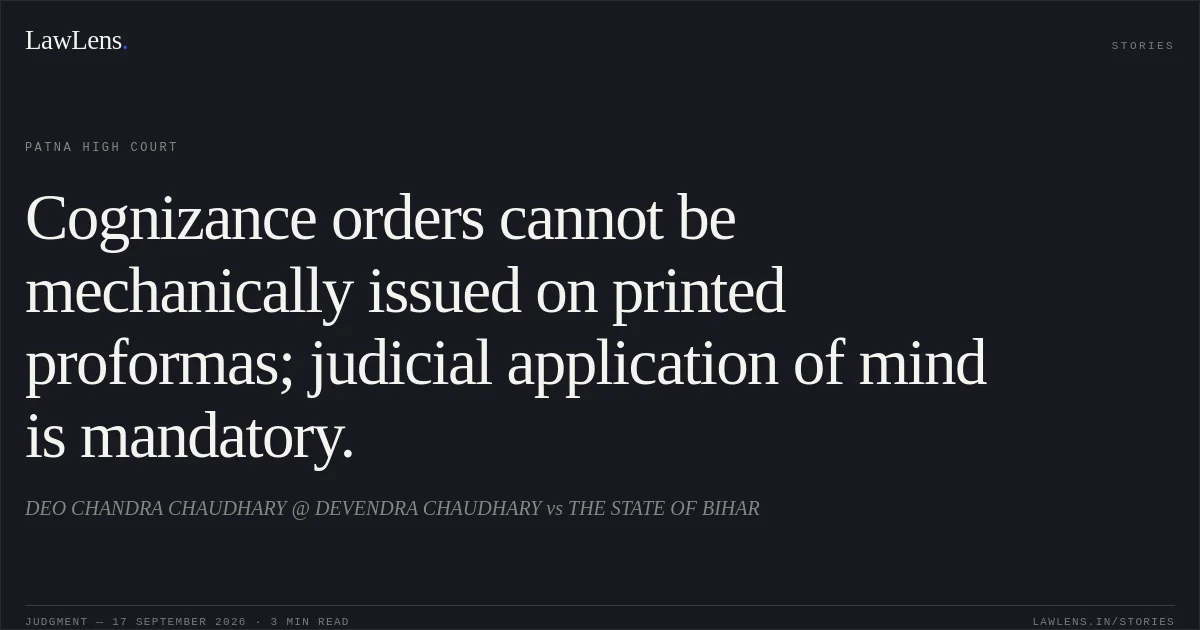
Source reference: para. 2; p. 1Before the High Court, the petitioners principally challenged the cognizance order as having been passed mechanically on a printed proforma, without application of judicial mind.
Source reference: para. 5; p. 2Issues
Whether a Magistrate’s order taking cognizance and issuing process can be sustained when it is passed mechanically on a printed proforma without reflecting application of judicial mind to the allegations and the offences disclosed?
Source reference: paras. 5, 8–11; pp. 2, 4–6Whether the cognizance order dated 12 June 2018 was liable to be quashed and the matter remitted for consideration afresh in accordance with law?
Source reference: paras. 9–12; pp. 5–6Law Applied
The Court considered Sections 406, 409, 420 and 34 of the IPC, under which the petitioners were alleged to have committed criminal breach of trust, criminal breach of trust by a public servant or agent, cheating, and acts done in furtherance of common intention.
Source reference: paras. 2, 4; pp. 1–2It applied Section 190 of the Code of Criminal Procedure, which permits a Magistrate to take cognizance of an offence upon receiving a complaint, a police report, or other information, including information based on the Magistrate’s own knowledge or suspicion.
Source reference: para. 7; p. 3Relying on Darshan Singh Ram Kishan v. State of Maharashtra, (1971) 2 SCC 654, the Court held that cognizance is taken when the Magistrate applies judicial mind to the alleged commission of an offence and takes judicial notice of it.
Source reference: para. 7; p. 3Although a detailed or elaborate reasoned order is not mandatory at the cognizance stage, the order must nevertheless demonstrate application of judicial mind and cannot be passed mechanically by filling blanks in a printed proforma or by affixing a ready-made seal.
Source reference: paras. 8–10; pp. 4–5Reasoning
The High Court noted that the cognizance and summoning of an accused is a serious judicial act requiring the Magistrate to consider the facts alleged and determine which offences were prima facie disclosed.
Source reference: para. 10; p. 5In the present case, the impugned order was found to have been prepared in a typed or printed proforma by filling in blanks, without reasons or any indication that the Magistrate had examined the allegations, the police report, or the applicability of Sections 406, 409, 420 and 34 IPC to the petitioners.
Source reference: para. 11; p. 6The absence of a detailed discussion was not, by itself, fatal; however, the complete lack of a discernible application of judicial mind rendered the order contrary to the governing principles under Section 190 CrPC and the decision in Darshan Singh Ram Kishan.
Source reference: paras. 7–10; pp. 3–5Holding
The Court held that the cognizance order dated 12 June 2018 had been passed mechanically and without application of judicial mind.
It therefore quashed and set aside the impugned order and directed the learned trial court to pass a fresh order, supplying appropriate reasons and acting in accordance with law, if the matter was still pending before it.
Source reference: para. 11; p. 6The criminal miscellaneous petition was accordingly allowed, and a copy of the judgment was directed to be sent to the trial court.
Source reference: paras. 12–13; p. 6Acts & Sections Cited
5 provisions across 2 statutes referred to in this judgment. Each provision opens on LawLens.
Indian Penal Code, 18604
Code of Criminal Procedure, 19731
Original Court PDF
DEO CHANDRA CHAUDHARY @ DEVENDRA CHAUDHARYvsTHE STATE OF BIHAR
Click to open original judgment
Original judgment, available to read, download and summarize on LawLens.in