Facts
On 21 December 2016 at approximately 10:45 p.m., the petitioners allegedly set fire to the residential house of Opposite Party No. 2, causing clothes, bedding, utensils and crops to be destroyed, and allegedly dismantled the informant’s pucca house. The informant claimed that he narrowly escaped and that villagers witnessed the occurrence.
Source reference: p. 2, para. 3In Gopalpur P.S. Case No. 132 of 2016, the learned Chief Judicial Magistrate, Bettiah, passed an order dated 13 June 2018 taking cognizance against the petitioners for offences under Sections 147, 149, 436, 307 and 427/34 of the Indian Penal Code.
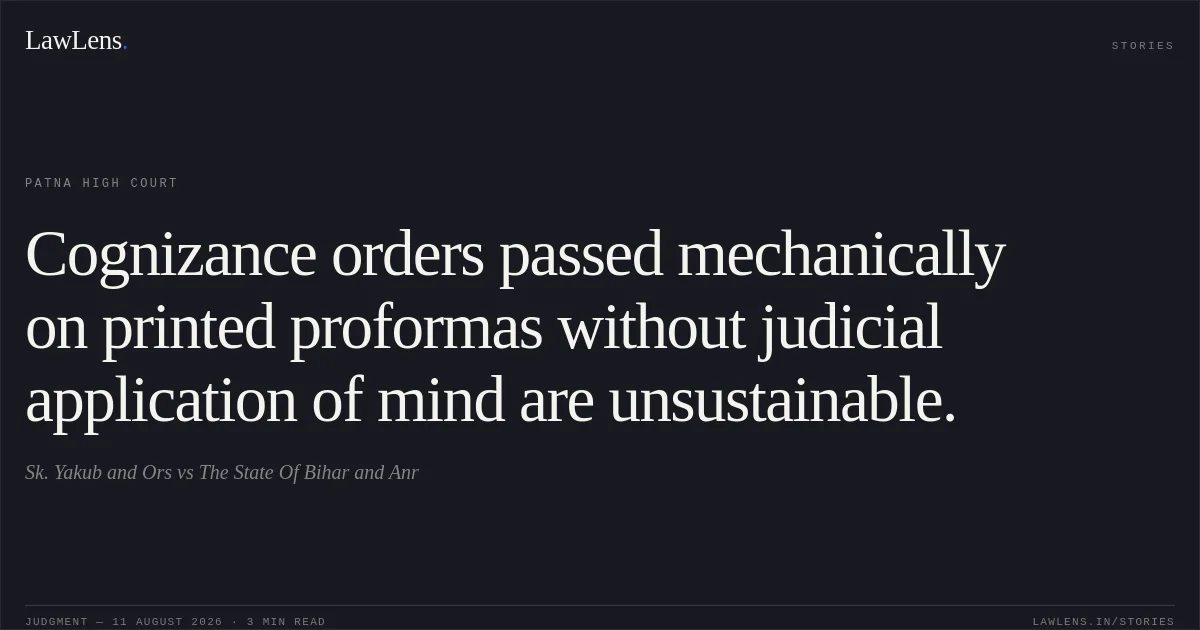
Source reference: p. 2, para. 2The petitioners challenged the cognizance order principally on the ground that it was issued mechanically on a printed proforma, without application of judicial mind.
Source reference: p. 2, para. 4Issues
Whether a Magistrate’s order taking cognizance on a police report must demonstrate application of judicial mind, even though a detailed, reasoned order is not ordinarily required at that stage.
Source reference: p. 4, para. 7; p. 5, para. 8Whether an order of cognizance passed mechanically by filling blanks in a printed proforma, without indicating the offences prima facie disclosed, is legally sustainable.
Source reference: p. 5, paras. 8–10Whether the impugned cognizance order dated 13 June 2018 was liable to be quashed and remitted for fresh consideration.
Source reference: p. 6, para. 11Law Applied
Section 190 of the Code of Criminal Procedure, 1973 authorises a Magistrate to take cognizance of an offence upon receiving a complaint, a police report, information from a person other than a police officer, or upon the Magistrate’s own information or suspicion.
Source reference: p. 4, para. 7Taking cognizance occurs when the Magistrate applies judicial mind to the alleged commission of an offence and takes judicial notice of it; it does not require any prescribed formal act.
Source reference: p. 4, para. 7Relying on Darshan Singh Ram Kishan v. State of Maharashtra , (1971) 2 SCC 654, the Court held that although a detailed or elaborate order is not necessary at the cognizance stage, the order must nevertheless reflect judicial application of mind.
Source reference: p. 4, para. 7; p. 5, para. 8A cognizance order cannot validly be passed mechanically by using a printed proforma, filling blanks, or affixing a ready-made seal; it must indicate that the Magistrate considered the facts and the offences prima facie disclosed.
Source reference: p. 5, paras. 8–10Reasoning
The High Court confined its consideration to the manner in which cognizance had been taken, without examining the petitioners’ other merits-based objections.
Source reference: p. 2, para. 4Although the allegations concerned serious offences under Sections 147, 149, 436, 307 and 427/34 IPC, the impugned order did not demonstrate that the Magistrate had independently considered the allegations or satisfied himself as to which offences were prima facie made out.
Source reference: p. 6, para. 10The Court distinguished between the absence of a requirement to provide detailed reasons and the impermissibility of passing a wholly mechanical order.
Source reference: p. 6, paras. 9–11Since the order appeared to have been prepared on a typed proforma by filling in blanks, it failed to meet the minimum requirement of judicial application of mind and was contrary to settled judicial norms.
Source reference: p. 6, paras. 9–11Holding
The High Court allowed the petition to the stated extent and quashed and set aside the cognizance order dated 13 June 2018.
The learned trial court was directed to pass a fresh order, in accordance with law and by supplying reasons, if the criminal proceeding was still pending.
Source reference: p. 6, para. 11A copy of the judgment was directed to be transmitted to the trial court, which was further instructed to proceed expeditiously since the occurrence dated back to 2016.
Source reference: p. 7, paras. 13–14Acts & Sections Cited
7 provisions across 2 statutes referred to in this judgment. Each provision opens on LawLens.
Indian Penal Code, 18606
Code of Criminal Procedure, 19731
Original Court PDF
Sk. Yakub and OrsvsThe State Of Bihar and Anr
Click to open original judgment
Original judgment, available to read, download and summarize on LawLens.in