Facts
The complainant, who had contested a Panchayat election, alleged that on 8 June 2016 the petitioners—then serving as Deputy Superintendent of Police, Sub-Divisional Officer and Executive Magistrate—assaulted protesters demonstrating for a recount of votes and used abusive language against female protesters.
Source reference: para. 4A separate FIR had been registered concerning the same incident, alleging that the protesters obstructed a road and assaulted the Executive Magistrate and police personnel.
Source reference: para. 6The Magistrate took cognizance against the petitioners and others under Sections 341, 323, 354-B and 504 IPC without prior sanction under Section 197 CrPC.
Source reference: para. 3The petitioners sought to quash that order, contending that the alleged acts arose from their official law-and-order duties and that the complaint was a counterblast to the FIR.
Source reference: paras. 5–7Issues
Whether the alleged acts had a reasonable connection with the petitioners’ official duties, attracting the protection of Section 197 CrPC.
Source reference: paras. 11, 13–17Whether, in the absence of prior sanction under Section 197 CrPC, the Magistrate’s cognizance order could stand.
Source reference: paras. 18, 21–23Law Applied
Section 197 CrPC bars a court from taking cognizance of an offence allegedly committed by a qualifying public servant while acting or purporting to act in the discharge of official duty unless the required previous sanction has been obtained.
Source reference: paras. 9–12The test is whether the alleged act bears a reasonable connection with official duty; the act need not have been strictly within the officer’s authority, and an alleged excess does not by itself remove the protection.
Source reference: paras. 9–12The Court relied on S.K. Zutshi v. Bimal Debnath, (2004) 8 SCC 31, and State of Orissa v. Ganesh Chandra Jew, (2004) 8 SCC 40, as well as the reasonable-connection principle stated in Matajog Dobey v. H.C. Bhari, AIR 1956 SC 44.
Source reference: paras. 9–12Reasoning
The Court found that the petitioners’ presence at the protest, deployment and control of police personnel, and steps to manage the crowd were connected to their law-and-order responsibilities.
Source reference: paras. 14–15It held that the alleged use of excessive force did not, at this stage, sever that connection; whether the force was excessive or the response proper was not necessary to decide the sanction requirement.
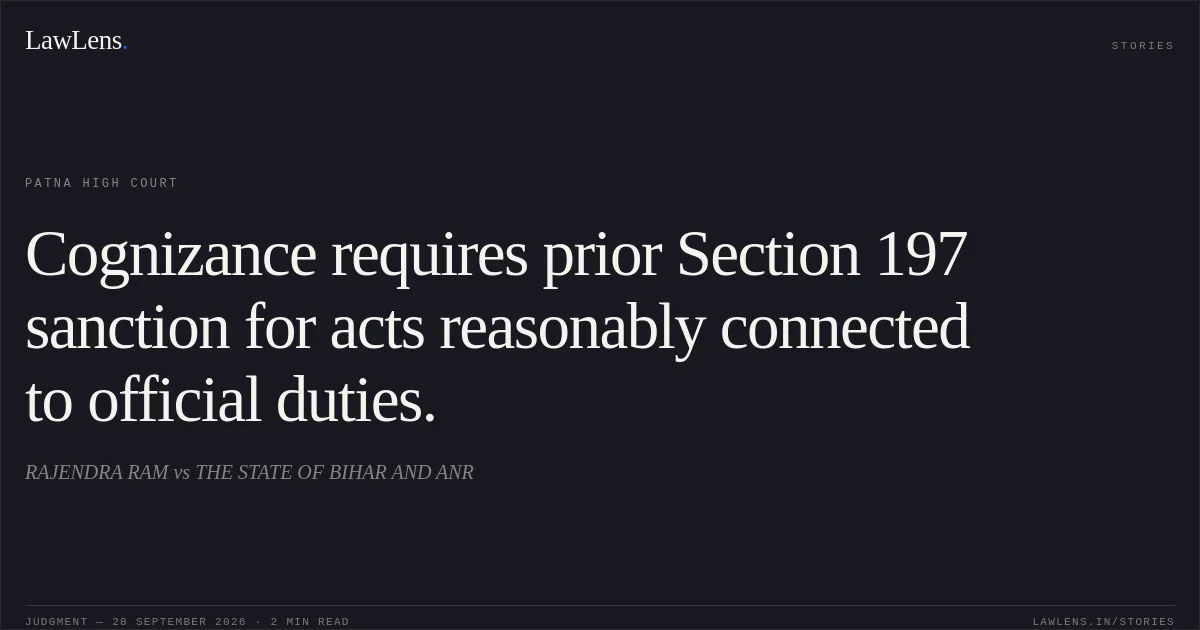
Source reference: paras. 16–17Since the alleged acts were reasonably connected with official duties, prior sanction was required before cognizance could be taken.
Source reference: paras. 18, 21Holding
The Court held that the cognizance order dated 27 August 2018 could not be sustained against the petitioners because no prior sanction under Section 197 CrPC had been obtained.
It quashed and set aside the order insofar as it concerned the petitioners and allowed both applications.
Source reference: paras. 23–24Acts & Sections Cited
6 provisions across 2 statutes referred to in this judgment. Each provision opens on LawLens.
Indian Penal Code, 18603
Code of Criminal Procedure, 19733
Original Court PDF
RAJENDRA RAMvsTHE STATE OF BIHAR AND ANR
Click to open original judgment
Original judgment, available to read, download and summarize on LawLens.in