Facts
On 8 December 2023, police officials conducting a naka for checking drunken driving stopped the petitioner and asked him to undergo a breathalyser test. He allegedly refused, obstructed the officials, abused them, accused them of demanding bribes, threatened them, and attempted to intimidate them by referring to his influence.
Source reference: para. 2The incident was allegedly witnessed by police officials and recorded on video. After obtaining permission under Section 155(2) CrPC, the police investigated the non-cognizable allegations and submitted a Kalandra/police report for offences under Sections 186 and 189 IPC before the Additional Chief Judicial Magistrate, Dehra.
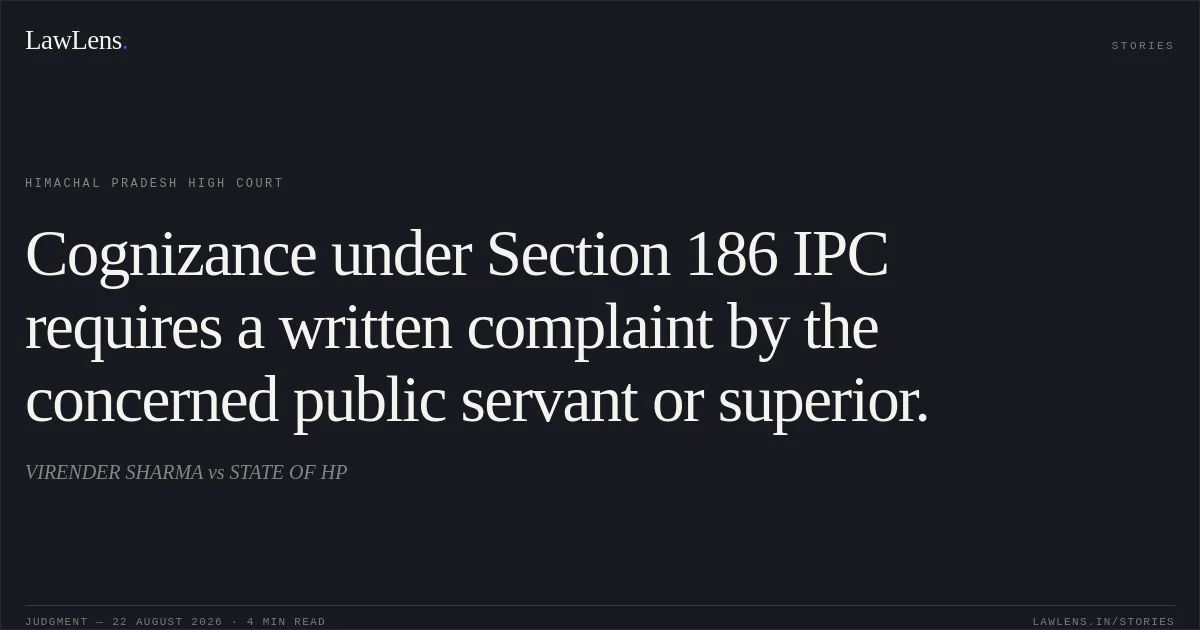
Source reference: paras. 2–3The petitioner invoked Section 528 BNSS, corresponding to Section 482 CrPC, seeking quashing of the Kalandra and consequential proceedings on the ground that cognizance of Section 186 IPC could not be taken without a written complaint by the concerned public servant or his superior.
Source reference: para. 3Issues
1. Whether cognizance of an offence under Section 186 IPC can be taken on a police report/Kalandra without a written complaint by the concerned public servant or a public servant to whom he is administratively subordinate, contrary to Section 195(1)(a) CrPC.
Source reference: para. 162. Whether the police report for Section 186 IPC could be treated as a complaint under the Explanation to Section 2(d) CrPC, thereby overcoming the statutory bar under Section 195 CrPC.
Source reference: para. 183. Whether the allegations constituted the offence under Section 189 IPC and whether that offence could be independently proceeded with despite its connection with the Section 186 IPC allegation.
Source reference: paras. 19–204. Whether the Kalandra and consequential proceedings ought to be quashed in exercise of the High Court’s inherent jurisdiction under Section 528 BNSS/Section 482 CrPC.
Source reference: paras. 7–14Law Applied
Section 195(1)(a) CrPC bars every court from taking cognizance of offences under Sections 172–188 IPC, including Section 186, except upon a written complaint by the concerned public servant or his administrative superior.
Source reference: para. 17Although the Explanation to Section 2(d) CrPC deems a police report disclosing a non-cognizable offence to be a complaint and the police officer to be the complainant, that legal fiction does not satisfy Section 195 because it does not make the aggrieved public servant or his superior the complainant.
Source reference: para. 18; Umashankar Yadav v. State of Uttar Pradesh, Criminal Appeal No. 439 of 2018, decided 8 May 2025Investigation into a non-cognizable offence requires prior Magistrate’s permission under Section 155(2) CrPC.
Source reference: para. 18The High Court may quash proceedings under Section 528 BNSS/Section 482 CrPC to prevent abuse of process or secure the ends of justice, including where the allegations do not disclose an offence or where continuation is legally barred, as recognised in State of Karnataka v. L. Muniswamy, State of Haryana v. Bhajan Lal, Vineet Kumar v. State of U.P., Prashant Bharti v. State (NCT of Delhi), Anand Kumar Mohatta v. State (NCT of Delhi) and B.N. John v. State of U.P.
Source reference: paras. 8–13Section 189 IPC requires a threat of injury intended to induce a public servant to act, or refrain from or delay an act, connected with the exercise of public functions; mere abuse, allegations, or words uttered during an altercation do not necessarily constitute such a threat.
Source reference: paras. 19–20Reasoning
The Court held that cognizance of Section 186 IPC had admittedly been taken on a police Kalandra rather than on a written complaint by the concerned public servant or his superior, directly violating Section 195(1)(a) CrPC.
Source reference: para. 18The prior permission under Section 155(2) CrPC authorised investigation of the non-cognizable offence but did not cure the separate statutory defect concerning the mode of cognizance. Nor could the police report be treated as a valid complaint under Section 2(d), since the deemed complainant was the police officer and not the aggrieved public servant or superior.
Source reference: para. 18The Court further found that Section 189 IPC was not made out: the allegations of abuses and false accusations of bribery did not demonstrate an intention to inflict legally caused harm or to induce the police officials to perform or refrain from performing a public function.
Source reference: paras. 19–20Since the Section 189 allegation arose from the same transaction and could not be used to circumvent the Section 195 bar applicable to Section 186, continuation of the proceedings would serve no legitimate purpose and would amount to abuse of process.
Source reference: paras. 19–21Holding
The High Court answered the principal issues in the petitioner’s favour. Cognizance of Section 186 IPC on the police Kalandra was impermissible for want of a written complaint under Section 195(1)(a) CrPC, and the ingredients of Section 189 IPC were also absent.
Exercising jurisdiction under Section 528 BNSS/Section 482 CrPC, the Court allowed the petition and quashed the Kalandra/police report under Sections 186 and 189 IPC, along with all consequential proceedings pending before the Additional Chief Judicial Magistrate, Dehra, qua the petitioner.
Source reference: para. 22Acts & Sections Cited
44 provisions across 3 statutes referred to in this judgment. Each provision opens on LawLens.
Bharatiya Nagarik Suraksha Sanhita, 20231
Indian Penal Code, 1860
Code of Criminal Procedure, 19735
Original Court PDF
VIRENDER SHARMAvsSTATE OF HP
Click to open original judgment
Original judgment, available to read, download and summarize on LawLens.in