Facts
The petitioner sought quashing of the FIR dated 8 January 2016, the consequential charge-sheet, and the order dated 11 January 2016 by which the JMFC, Jabalpur, took cognizance in RCT No. 425/2016 for offences under Sections 294, 506 and 295-A of the IPC.
Source reference: para. 1The prosecution alleged that, while the complainant was offering prayers at a temple, the petitioner abused him, objected to the ringing of the temple bell and entry of outsiders, threatened to remove the idol of Lord Shankar, and issued threats of serious consequences.
Source reference: para. 2The petitioner contended that cognizance of the Section 295-A offence was barred in the absence of previous governmental sanction under Section 196(1)(a) of the CrPC.
Source reference: para. 3He also relied on the petitioner’s age, the pendency of the prosecution since 2016, and the examination of only two witnesses to assert violation of the constitutional right to speedy trial under Article 21.
Source reference: para. 4The State opposed complete quashing, arguing that the allegations disclosed cognizable offences and that the factual merits should be determined by the trial Court.
Source reference: para. 5Issues
1. Whether cognizance of the offence under Section 295-A IPC was invalid for want of previous sanction under Section 196(1)(a) CrPC?
Source reference: paras. 7–92. Whether the FIR, charge-sheet, and criminal proceedings for Sections 294 and 506 IPC were liable to be quashed on the basis of disputed facts, alleged mala fides, or absence of the ingredients of Section 295-A IPC?
Source reference: para. 103. Whether the delay in concluding the trial violated the petitioner’s right to speedy trial under Article 21 so as to warrant quashing of the entire prosecution?
Source reference: para. 11Law Applied
Section 196(1)(a) CrPC prohibits any Court from taking cognizance of an offence punishable under Section 295-A IPC without the previous sanction of the Central or State Government; the requirement is mandatory and jurisdictional.
Source reference: paras. 7–9Sections 294 and 506 IPC do not fall within the scope of Section 196 CrPC and do not require such sanction.
Source reference: para. 10The High Court may intervene where continuation of proceedings is legally impermissible, but disputed factual questions and allegations of mala fides ordinarily require adjudication by the trial Court.
Source reference: para. 10The constitutional right to speedy trial under Article 21, as explained in Abdul Rehman Antulay v. R.S. Nayak , (1992) 1 SCC 225, requires expeditious criminal proceedings; however, delay does not automatically mandate termination of a prosecution in every case.
Source reference: para. 11The petition was filed under Section 528 of the Bharatiya Nagarik Suraksha Sanhita, 2023.
Source reference: para. 1Reasoning
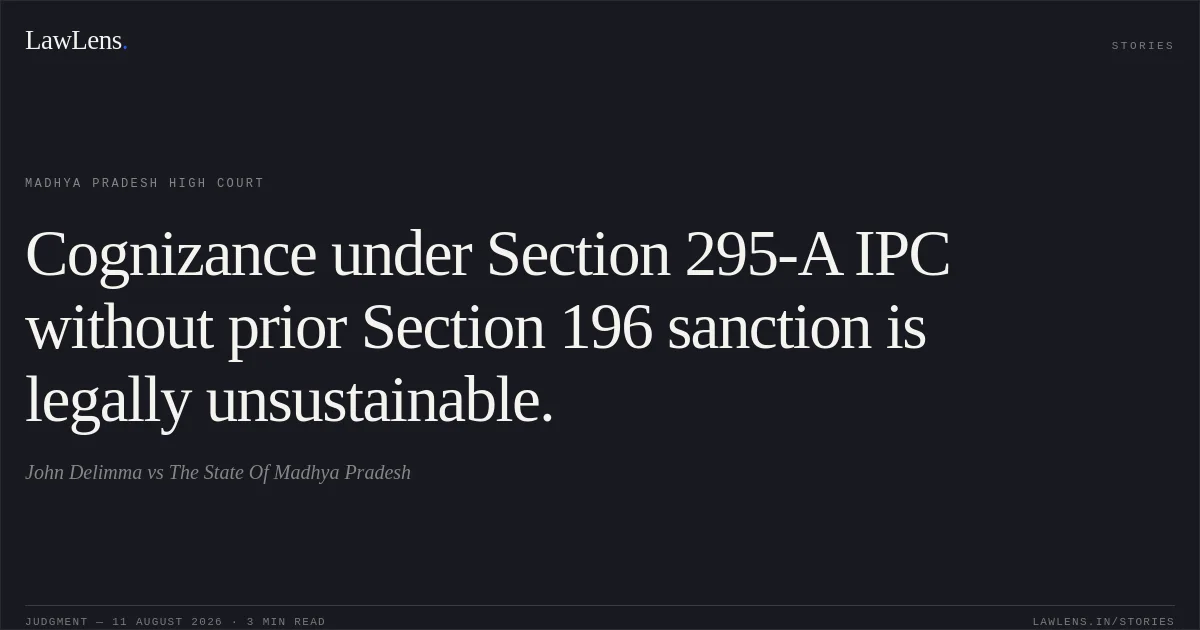
The Court found that Section 196(1)(a) CrPC expressly covers Section 295-A IPC and creates an absolute restriction on cognizance without prior sanction.
Source reference: para. 8Since the State did not dispute that no sanction had been obtained before filing the charge-sheet or before cognizance was taken on 11 January 2016, the Magistrate’s cognizance of the Section 295-A offence was without jurisdiction and could not stand.
Source reference: para. 9However, the same defect did not affect the offences under Sections 294 and 506 IPC, which are outside Section 196 CrPC.
Source reference: para. 10Whether the allegations ultimately establish those offences, or whether the prosecution was motivated by mala fides, involved disputed factual matters unsuitable for determination in the quashing jurisdiction.
Source reference: para. 10Although the Court acknowledged that the trial had remained pending for nearly ten years and that only two witnesses had been examined despite repeated opportunities, it considered that the appropriate remedy was an expedited trial rather than termination of the remaining prosecution, particularly because evidence had already commenced and the surviving offences were comparatively limited in nature.
Source reference: para. 11Holding
The petition was partly allowed.
The order dated 11 January 2016 taking cognizance, and all consequential proceedings insofar as they related to Section 295-A IPC, were quashed for want of previous sanction under Section 196(1)(a) CrPC.
Source reference: para. 12(a)The proceedings under Sections 294 and 506 IPC were permitted to continue.
Source reference: para. 12(b)The trial Court was directed to make every endeavour to conclude the trial preferably within six months of receiving the certified copy of the order and to avoid unnecessary adjournments.
Source reference: para. 12(c)The petitioner was left at liberty to raise all other permissible defences before the trial Court.
Source reference: para. 12(d)Acts & Sections Cited
7 provisions across 3 statutes referred to in this judgment. Each provision opens on LawLens.
Bharatiya Nagarik Suraksha Sanhita, 20231
Code of Criminal Procedure, 19733
Indian Penal Code, 18603
Original Court PDF
John DelimmavsThe State Of Madhya Pradesh
Click to open original judgment
Original judgment, available to read, download and summarize on LawLens.in