Facts
Manju Devi filed Complaint Case No. 221 of 2016 before the Chief Judicial Magistrate, Arwal, alleging that Sima Kumari had filed a mutation application concerning land and that Upendra Prasad, a peon posted in the Office of the Circle Officer, Arwal, colluded with her in forging the signatures of the complainant and another person on notices and consent documents.
Source reference: pp. 2–3The alleged purpose was to secure a favourable mutation order and deprive the complainant of her share in the land.
Source reference: pp. 2–3The complaint was registered for offences under Sections 419, 420, 465, 467, 468 and 472 of the Indian Penal Code.
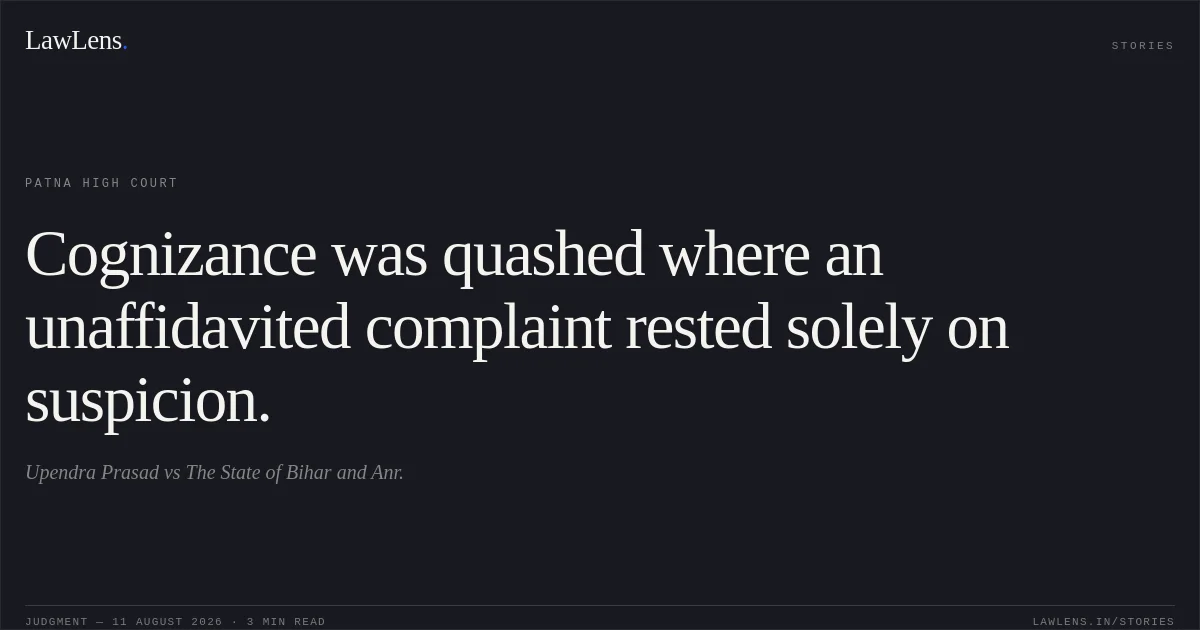
Source reference: pp. 3–4Following examination of the complainant and an enquiry, the learned Magistrate took cognizance under Sections 465 and 420 IPC against Upendra Prasad and two co-accused persons by order dated 11 September 2017.
Source reference: pp. 3–4Issues
Whether the cognizance order under Sections 465 and 420 IPC against the petitioner was liable to be quashed because the complaint was not supported by an affidavit, in light of Priyanka Srivastava v. State of Uttar Pradesh?
Source reference: p. 4; para. 6Whether the allegations in the complaint disclosed the essential ingredients of offences under Sections 465 and 420 IPC against the petitioner, or merely raised suspicion based on his employment in the Circle Officer’s office?
Source reference: pp. 4–5; paras. 5–8Whether the proceedings against the petitioner fell within the categories warranting exercise of the High Court’s inherent jurisdiction under the principles stated in State of Haryana v. Bhajan Lal?
Source reference: pp. 4–5; paras. 6–8Law Applied
The Court considered Sections 465 and 420 of the Indian Penal Code, concerning forgery and cheating, respectively.
Source reference: pp. 4–5It relied on Priyanka Srivastava v. State of Uttar Pradesh, 2015 (6) SCC 287, for the principle that a complaint invoking Magistrate-directed investigation under Section 156(3) of the Code of Criminal Procedure should be supported by an affidavit.
Source reference: pp. 4–5It also applied the principles in State of Haryana v. Bhajan Lal, 1992 Supp. (1) SCC 335, under which the High Court may quash criminal proceedings where the allegations, even if accepted at face value, do not disclose the commission of an offence or where continuation of the proceedings would amount to abuse of process.
Source reference: pp. 4–5Reasoning
The Court found that the complaint was not supported by an affidavit, contrary to the principle relied upon from Priyanka Srivastava.
Source reference: p. 4; para. 7On the merits, the Court noted that the petitioner was merely a peon in the Circle Officer’s office and that the allegations against him were founded principally on suspicion that he had assisted the co-accused in the mutation proceedings.
Source reference: pp. 4–5; paras. 5, 7The complaint did not adequately establish that the petitioner had forged the complainant’s signatures, participated in the alleged fabrication, or possessed the dishonest intention necessary to sustain the charge of cheating under Section 420 IPC.
Source reference: pp. 4–5; paras. 5, 7Applying the Bhajan Lal principles, the Court concluded that the allegations did not make out a sufficient criminal case against the petitioner and that continuation of the proceedings would not be justified.
Source reference: p. 5; para. 8Holding
The High Court allowed the petition and quashed the cognizance order dated 11 September 2017, insofar as it concerned Upendra Prasad, along with all consequential proceedings in Complaint Case No. 221 of 2016/Trial No. 1376 of 2017.
The order was quashed only in relation to the petitioner; the judgment does not record any relief in favour of the co-accused.
Source reference: p. 5; paras. 8–9A copy of the judgment was directed to be communicated to the trial court along with the trial court record, if any.
Source reference: p. 5; para. 10Acts & Sections Cited
6 provisions across 1 statute referred to in this judgment. Each provision opens on LawLens.
Indian Penal Code, 18606
Original Court PDF
Upendra PrasadvsThe State of Bihar and Anr.
Click to open original judgment
Original judgment, available to read, download and summarize on LawLens.in